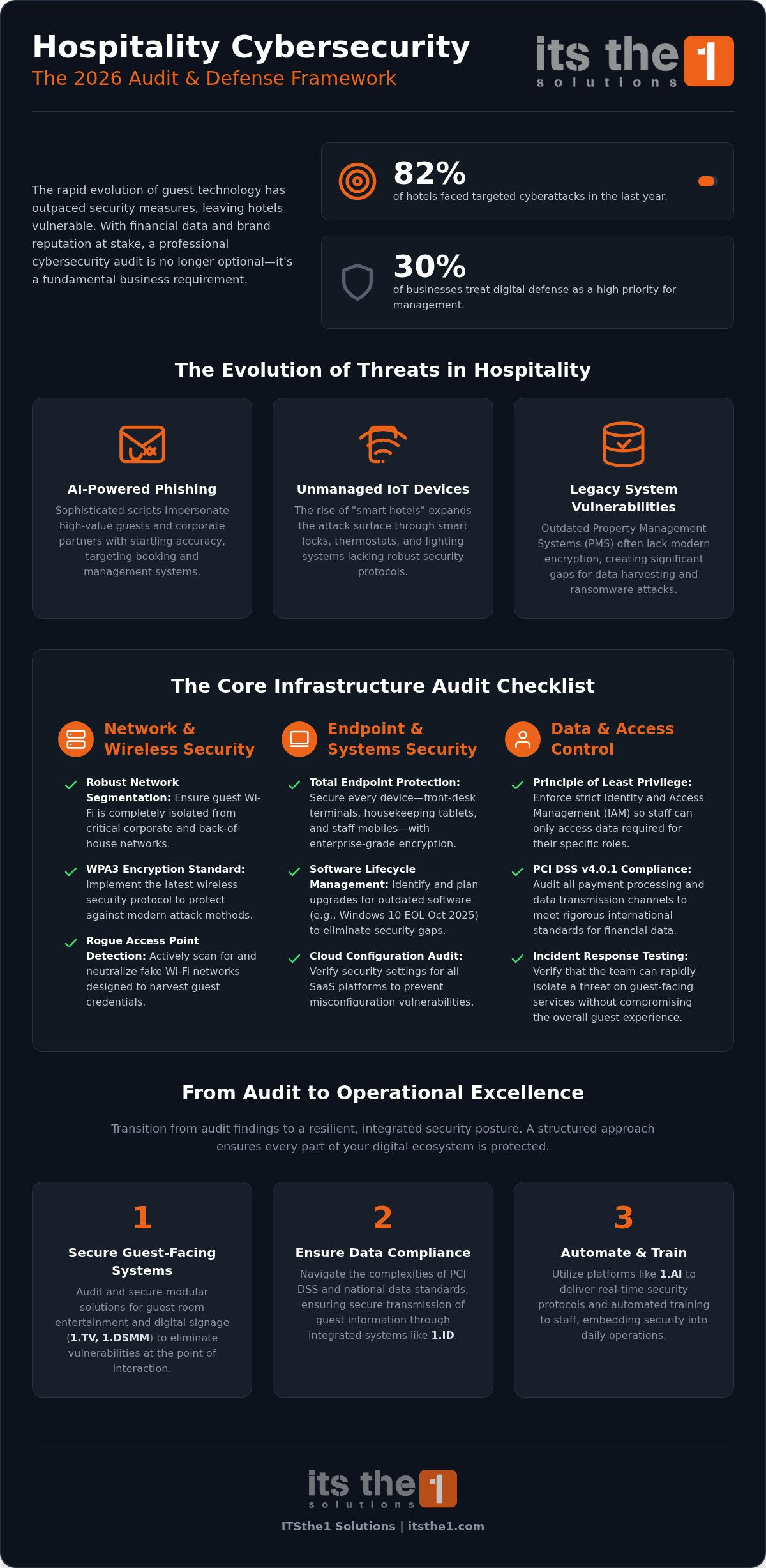
Did you know that in 2026, only 30 percent of hospitality businesses treat digital defense as a high priority for senior management, despite 82 percent of hotels facing targeted cyberattacks in the previous year? For many owners and operators, the rapid evolution of guest technology has outpaced the security measures meant to protect it. You’re likely managing a complex ecosystem of IPTV, Wi-Fi, and property management systems from multiple vendors, all while worrying about the catastrophic reputational damage of a data breach. It’s a heavy burden to carry alone.
We understand that maintaining compliance with standards like PCI DSS v4.0.1 can feel like a moving target. This guide provides a definitive framework for a professional hospitality cybersecurity audit, offering you a clear roadmap to secure every digital touchpoint. By following this structured approach, you’ll align your property with international security standards and minimize operational risks. We’ll examine how integrated systems like 1.Hotel and 1.Support can reduce technical silos, ensuring your digital infrastructure remains resilient against the sophisticated threats of the modern era.
Key Takeaways
- Understand why a hospitality cybersecurity audit serves as the strategic foundation for your property’s digital transformation and protection against sophisticated ransomware.
- Learn the technical requirements for robust network segmentation and cloud security to isolate guest-facing services from critical corporate assets.
- Secure guest room entertainment and meeting room displays by auditing modular solutions like 1.TV and 1.DSMM for potential vulnerabilities.
- Navigate the complexities of PCI DSS v4.0.1 and national data standards to ensure the secure transmission of sensitive guest information through 1.ID.
- Transition from audit findings to operational excellence by utilizing 1.AI to deliver real-time security protocols and training to your staff.
Hospitality Cybersecurity Audits: Why Critical in 2026?
A hospitality cybersecurity audit is a systematic evaluation of a hotel’s information systems, internal policies, and guest-facing technologies. It’s the primary tool for identifying gaps in a property’s digital defenses before they are exploited. In 2026, this process has evolved into a fundamental business requirement rather than a niche IT task. Hotels remain high-value targets for ransomware and data harvesting due to the sheer volume of financial and personal data they process daily. Recent data indicates that 82 percent of hotels faced targeted cyberattacks in the summer of 2025, yet only 30 percent of hospitality businesses treat cybersecurity as a high priority for senior management.
The financial impact of a security failure is staggering. Beyond the immediate costs of remediation and potential national data protection fines, the loss of guest trust can be terminal for a brand. A single breach can negate years of reputation building. Modern audits must now account for a shift in infrastructure. We’ve moved away from isolated server rooms to expansive, cloud-based hospitality ecosystems where every connected device is a potential liability. This requires a professional-grade Information security audit that spans the entire digital footprint of the property.
The Evolution of Threats in the UAE Hospitality Sector
Cybercriminals in the UAE are increasingly leveraging AI and large language models to craft sophisticated phishing scripts. These attacks often target booking systems by impersonating high-value guests or corporate partners with startling accuracy. The rise of “smart hotels” has expanded the attack surface through unmanaged IoT devices. Smart locks, thermostats, and lighting systems often lack the robust security protocols found in enterprise hardware. A hospitality cybersecurity audit serves as a strategic brand-protection mechanism for 2026 that ensures your property’s digital evolution remains secure and resilient.
Core Objectives of a Professional Audit
A primary goal of any audit is uncovering vulnerabilities in legacy Property Management Systems (PMS) that may not support modern encryption. The audit ensures guest data remains secure through its entire lifecycle, from the moment a guest interacts with 1.Hotel for check-in until their final bill is settled. We also focus on testing incident response times for guest-facing services. If a breach occurs, your team must know exactly how to isolate the threat without compromising the guest experience. This involves verifying that systems like 1.TV and 1.Support are properly segmented from the core corporate network, preventing lateral movement by attackers.
The Core Infrastructure Checklist: Securing the Foundation
Establishing a robust foundation is the primary objective of a professional hospitality cybersecurity audit. Without a secure core, advanced guest-facing applications remain vulnerable to lateral movement by attackers. A comprehensive audit focuses on network segmentation to ensure guest Wi-Fi remains entirely separate from corporate and back-of-house networks. This isolation prevents a compromised guest device from accessing sensitive property management systems or financial data. Additionally, auditing cloud configurations is essential as hotels increasingly rely on modular SaaS ecosystems for daily operations.
Endpoint protection requires meticulous attention to every device connected to the network. Front-desk terminals, mobile tablets used for housekeeping, and staff devices must all be secured with enterprise-grade encryption and monitoring. It’s vital to verify that all operating systems are current; for instance, Windows 10 reached its end of support in October 2025, and Windows Server 2016 will follow in January 2027. Using outdated software creates significant security gaps that an audit must identify and remediate. Identity and Access Management (IAM) should follow the principle of least privilege, ensuring hotel staff only have access to the specific data required for their roles.
Network and Wireless Security Standards
Wireless security is the “digital heart” of the modern hotel. Your audit checklist must prioritize the implementation of WPA3 encryption and the deployment of rogue access point detection systems. These measures protect guests from “man-in-the-middle” attacks where hackers create fake Wi-Fi networks to harvest credentials. Maintaining a secure environment requires professional Network Infrastructure Management in the UAE Market to ensure that hardware is optimized and monitored for unusual traffic patterns. Regular wireless surveys help identify coverage gaps where security protocols might be bypassed.
Cloud and Managed IT Integration
As hospitality moves toward cloud-based modules, evaluating the security of third-party integrations becomes a critical compliance step. The PCI Security Standards Council provides clear guidelines for protecting cardholder data, which must be mirrored in your cloud configurations. Utilizing managed IT support through solutions like 1.Support allows for centralized vulnerability reporting and a disciplined patching schedule. This approach ensures that every server and cloud asset is updated against known threats. By integrating your security reporting, you reduce silos and create a unified defense posture that is easier to manage and audit effectively. For properties considering how to scale this capability, exploring enterprise IT support outsourcing provides a strategic roadmap for transitioning to a high-performance managed model.
Auditing Guest-Facing Technology: IPTV, Signage, and Apps
Modern guest experiences rely on a seamless digital journey, but every guest-facing interface represents a potential entry point for malicious actors. A professional hospitality cybersecurity audit must extend beyond the back office to evaluate the security posture of in-room entertainment, public displays, and mobile applications. These systems often bridge the gap between the guest’s personal devices and the hotel’s internal network, making their isolation critical. By scrutinizing these touchpoints, operators can ensure that guest convenience doesn’t come at the cost of data integrity.
Managing these technologies requires a rigorous adherence to hotel cybersecurity best practices, particularly when integrating third-party hardware. The audit should specifically examine the API security between guest engagement apps, such as 1.Hotel, and the Property Management System (PMS). If these connections aren’t properly encrypted and authenticated, they can expose sensitive guest profiles or booking data. Similarly, IoT device management for smart thermostats, locks, and voice assistants must be centralized to prevent “shadow IT” from creating unmonitored vulnerabilities within the guest room.
Securing the In-Room Experience
The in-room television is no longer just a display; it’s a sophisticated networked computer. Our 1.TV solution is designed with security as a priority, ensuring that guest room entertainment systems don’t become gateways to the corporate network. An effective audit checklist includes verifying IPTV encryption protocols and ensuring that all guest credentials or streaming data are cleared automatically upon checkout. To maintain system integrity, 1.TV prevents the “side-loading” of unauthorized applications that could harbor malware. In 2026, unencrypted guest-room IoT devices represent a significant risk because they provide persistent, unmonitored access points that can bypass traditional perimeter defenses.
Digital Displays and Signage Integrity
Public-facing displays are high-visibility targets for unauthorized content takeovers or “brandjacking.” When conducting a hospitality cybersecurity audit, it’s essential to test both physical and remote tampering protections for 1.DSMM meeting room booking displays. Centralized signage management provides a superior security posture compared to decentralized setups, as it allows for immediate, property-wide content lockdowns during a security incident. The audit should also cover digital menus like 1.Menu to prevent unauthorized manipulation of pricing or ingredient information. This level of technical scrutiny ensures that your digital signage remains a trusted source of information rather than a liability for your brand’s reputation.
Data Privacy and Compliance: PCI DSS and National Standards
Data privacy has become the defining metric of guest trust in 2026. A comprehensive hospitality cybersecurity audit must verify that every byte of information, from a guest’s credit card number to their passport details, is handled with the highest level of cryptographic integrity. Compliance is no longer a periodic checkbox; it’s a continuous operational requirement. With the full implementation of PCI DSS v4.0.1 now mandatory, hotels must audit their payment processing pipelines from the initial booking engine interaction through to the final point-of-sale (POS) transaction. This ensures that sensitive cardholder data is never stored in a way that risks exposure during a breach.
Adhering to UAE national regulations requires a disciplined approach to data residency. Guest data must be stored and processed in alignment with specific local standards, particularly when dealing with sensitive identity information. Integrating “Privacy by Design” into your digital ecosystem ensures that data protection isn’t an afterthought but a core component of your software development lifecycle. This proactive stance reduces the complexity of managing multiple vendors and creates a unified defense against data harvesting attempts.
Automated Identity Scanning and Data Safety
One of the most significant vulnerabilities in hospitality is the “human element” involved in handling physical guest IDs. Manual photocopying or unsecured scanning creates massive compliance gaps that traditional audits often overlook. Our 1.ID solution addresses this by using encrypted OCR data capture to securely transmit passport and ID scans directly to the relevant authorities. This automation removes the risk of staff mishandling sensitive documents and ensures that guest information is never stored on unsecured local drives. When auditing your registration software, you must verify that all captured data is encrypted at rest and in transit. You can learn more about establishing Secure Identity Verification for UAE Hospitality Standards to protect your property’s reputation.
Compliance Frameworks for UAE Hotels
Mapping ISO 27001 requirements to your daily hospitality operations provides a structured methodology for risk management. A professional hospitality cybersecurity audit evaluates how well your property maintains these standards across all departments. Our 1.Support module plays a vital role here by maintaining a detailed audit trail of all technical interventions and helpdesk tickets, which is essential for compliance reporting. Preparing for a third-party audit requires meticulous documentation and evidence gathering; having a centralized system to track security protocols makes this process significantly more efficient. To ensure your property meets every national and international standard, consider exploring our comprehensive Cyber Security consulting services.
Implementation: Moving from Audit to Operational Excellence
Completing a hospitality cybersecurity audit is only the first phase of a broader brand protection strategy. The true value of the process lies in the systematic execution of the remediation plan. Findings from the audit must be categorized by their potential operational impact and risk level. High-priority vulnerabilities, such as unpatched servers or exposed guest databases, require immediate intervention. Lower-risk items can be integrated into a long-term digital transformation roadmap. This methodical approach ensures that your resources are allocated where they provide the most significant protection for your property and its guests.
A “one-and-done” audit is insufficient for the 2026 threat landscape. Cybercriminals constantly refine their tactics, meaning a security posture that is effective today may be obsolete in six months. Continuous monitoring and regular micro-audits are necessary to maintain a hardened infrastructure. This ongoing cycle of assessment and improvement identifies new vulnerabilities as they emerge, ensuring that your defenses evolve alongside the sophisticated threats targeting the UAE hospitality sector. By treating security as a continuous operational process rather than a periodic event, you build a resilient ecosystem that discourages attackers. Many operators find that partnering with a specialist through enterprise IT support outsourcing is the most effective way to sustain this level of continuous vigilance without overstretching internal teams.
Building a Culture of Security with AI
Staff members act as the primary defense against social engineering and phishing attempts. We leverage 1.AI to provide your team with instant, accurate answers to security queries, effectively turning every employee into a vigilant protector of guest data. This real-time support is essential for reducing human error during complex guest request handling. When integrated with 1.Support, which centralizes technical issue tracking and helpdesk tickets, you create a transparent environment where security protocols are clearly defined and followed. Ongoing staff awareness remains the cornerstone of any successful 2026 security strategy, as technical barriers are only as strong as the people who operate them.
Remediation Roadmap and Managed Services
Transitioning from a vulnerability report to a fully hardened infrastructure requires a clear and documented remediation roadmap. This process involves isolating legacy systems, upgrading encryption protocols for in-room technology like 1.TV, and verifying the security of all third-party integrations. For many operators, the ROI of outsourcing cybersecurity to a specialized hospitality IT firm is substantial. It provides access to global expertise and proprietary tools within the 1.Series family that are specifically engineered for the unique challenges of the hotel environment. A strategic partnership with a seasoned advisor ensures that your digital evolution remains focused on stability, compliance, and long-term growth.
Contact ITSthe1 for a professional hospitality cybersecurity audit to secure your property’s digital infrastructure and protect your brand’s reputation.
Securing the Future of Guest Trust in 2026
Protecting your hotel’s digital infrastructure is no longer a technical choice; it’s a fundamental commitment to your brand’s longevity. By implementing a professional hospitality cybersecurity audit, you move beyond reactive patching toward a state of operational excellence. We’ve explored how network segmentation, secure guest-facing modules like 1.TV, and rigorous data residency compliance form a unified defense. These layers of protection ensure your property remains a trusted destination in an increasingly complex threat landscape.
ITSthe1 Solutions brings over 25 years of global hospitality technology expertise to every engagement. Our proprietary 1.Series software family is trusted by leading regional brands to deliver both innovation and security. With comprehensive support offices in the UAE and Sri Lanka, we act as a steady partner in your digital evolution. It’s time to transform your security vulnerabilities into strategic strengths. We’re ready to help you navigate this transition with precision and care.
Secure Your Property with ITSthe1 Professional Consulting
Frequently Asked Questions
How long does a typical hospitality cybersecurity audit take?
A typical hospitality cybersecurity audit generally takes between two and four weeks to complete. This timeline depends on the scale of your property and the complexity of your integrated digital systems. The process includes a thorough documentation review, vulnerability scanning of your network, and physical inspections of on-site hardware. We ensure the evaluation is methodical and purposeful, providing a clear roadmap for remediation without overwhelming your internal administrative staff.
Does our hotel need to close or stop check-ins during the audit?
No, your property remains fully operational throughout the entire process. A professional hospitality cybersecurity audit is designed to run in the background without impacting the guest experience. Most technical assessments occur on the network backend or during low-traffic periods. Our team coordinates closely with your IT department to ensure that testing of front-desk terminals or mobile apps like 1.Hotel doesn’t interfere with your daily check-in and check-out cycles.
What is the difference between a general IT audit and a hospitality-specific audit?
A hospitality-specific audit focuses on the unique, high-traffic digital touchpoints specific to the industry, such as IPTV, guest Wi-Fi, and Property Management Systems. General IT audits often overlook the vulnerabilities inherent in guest-facing technologies like 1.TV or digital signage. We prioritize the protection of sensitive guest data and the integrity of the guest journey. This specialized approach ensures that every connected device, from smart locks to meeting room displays, is properly secured.
Is PCI DSS compliance enough to protect our hotel from all cyber threats?
While PCI DSS v4.0.1 is a critical standard for protecting payment card data, it isn’t a comprehensive defense against all modern threats. A full hospitality cybersecurity audit addresses broader risks like ransomware, AI-powered phishing, and IoT exploits that fall outside the scope of payment security. Total protection requires a layered strategy that includes identity verification through 1.ID and continuous monitoring of all cloud-based modules to ensure guest privacy remains intact across all departments.
How often should a large-scale resort conduct a full cybersecurity audit?
We recommend conducting a comprehensive audit at least once a year, with targeted micro-audits every six months or after significant system upgrades. Large resorts manage vast, evolving ecosystems of IoT devices and vendor integrations, making them persistent targets for data harvesting. Regular assessments are necessary to identify new vulnerabilities in the 2026 threat landscape. This disciplined frequency ensures your security posture remains aligned with international standards and protects your brand from sudden reputational damage.
Can our existing managed IT provider perform their own security audit?
While internal reviews are helpful, an independent third-party audit provides an objective perspective that internal teams might miss. A specialized partner brings deep industry expertise and proprietary research that your general provider may lack. We often collaborate with existing IT teams, using tools like 1.Support to track remediation efforts. This strategic alliance ensures your digital infrastructure is evaluated against the most current hospitality-specific threats without any internal bias or oversight.
What are the specific UAE regulations regarding guest data residency?
UAE national regulations require that sensitive guest information and identity data be processed and stored in accordance with local data protection laws. This often necessitates that primary data storage remains within the country’s borders. Our solutions, including 1.ID for passport scanning, are engineered to align with these residency requirements. We ensure that your digital transformation strategy respects national standards, providing you with the confidence that your guest data handling is both secure and compliant.
How do guest engagement apps like 1.Hotel impact our security posture?
Guest engagement apps like 1.Hotel improve your security posture by centralizing guest interactions and reducing the use of unverified third-party platforms. However, they also create a new digital entry point that must be audited for API security and data encryption. We ensure these applications are properly integrated with your PMS and that guest credentials are never exposed. By using a unified modular system, you reduce technical silos and make it easier to monitor guest data safely.