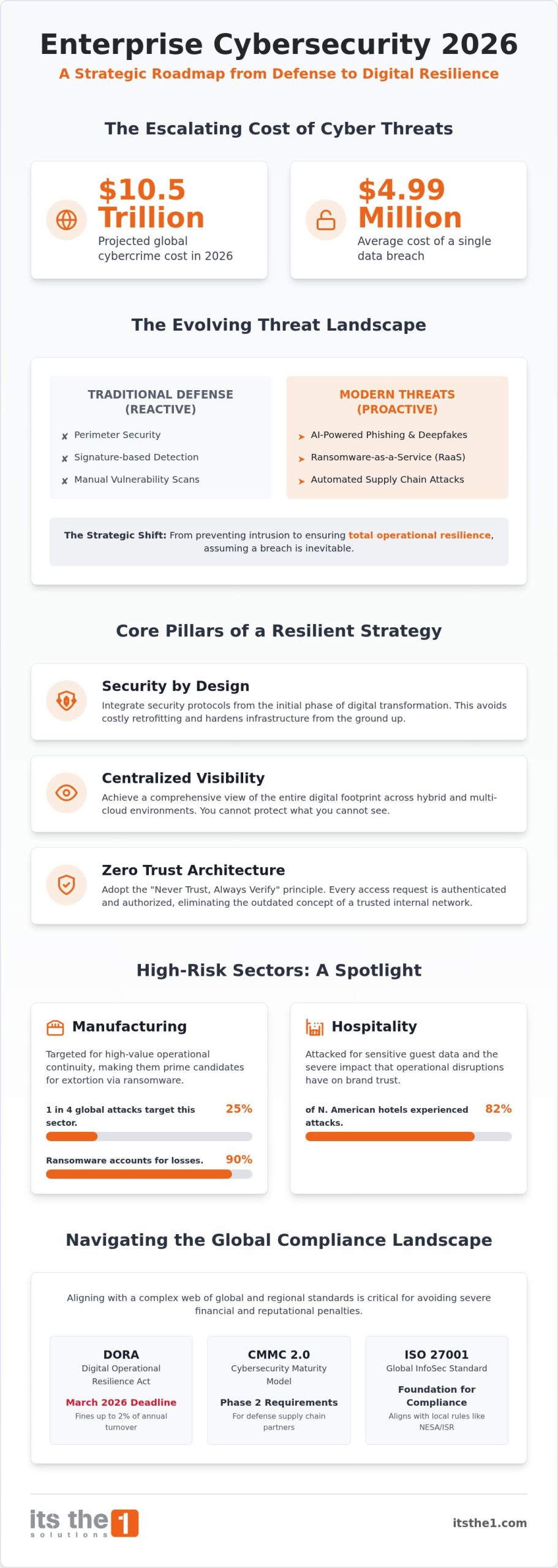
With global cybercrime costs projected to reach $10.5 trillion in 2026, the strategic focus for leadership has shifted from simple prevention to total digital resilience. You likely feel the pressure of managing security across fragmented hybrid clouds while racing to meet strict regulatory milestones, such as the March 2026 DORA reporting deadlines. It’s a complex environment where the average cost of a single data breach has climbed to $4.99 million. Scaling operations while defending against AI-powered threats requires more than just reactive tools; it demands sophisticated cybersecurity services for enterprises that align with long-term growth. We understand that security is not a barrier to innovation but the foundation of it. This guide provides a clear roadmap for building a resilient infrastructure that protects your reputation and ensures global compliance. We will examine the transition to zero-trust architectures, the requirements of CMMC 2.0 Phase 2, and the methodology for aligning your security posture with overarching business goals.
Key Takeaways
- Understand the shift from reactive defense to proactive, AI-driven threat hunting as a necessity for maintaining operational continuity in 2026.
- Discover how to implement a “Security by Design” philosophy using integrated cybersecurity services for enterprises to centralize management across complex hybrid cloud environments.
- Identify the unique risk profiles of the hospitality and manufacturing sectors and how to secure critical data without compromising service delivery.
- Navigate the 2026 regional compliance landscape by aligning global ISO 27001 standards with local UAE requirements such as NESA and ISR.
- Evaluate the strategic advantages of a single-partner approach to managed services, which simplifies infrastructure while strengthening your overall security posture.
The Evolution of Enterprise Cyber Threats in 2026
Modern enterprise security is no longer a peripheral IT function; it’s a multi-layered strategic discipline integrated into the core of business operations. By 2026, the traditional perimeter has dissolved, requiring organizations to transition from reactive defense models to proactive, AI-driven threat hunting. This evolution requires sophisticated cybersecurity principles to be applied at every level of the digital infrastructure. Effective cybersecurity services for enterprises now focus on identifying anomalies and neutralizing lateral movement before they escalate into full-scale incidents. With global cybercrime costs projected to reach $10.5 trillion this year, the shift toward an intelligence-led posture is a fundamental requirement for stability.
Large-scale organizations remain the primary targets for Ransomware-as-a-Service (RaaS) operations because of their complex supply chains and the high value of their operational continuity. Attackers recognize that even a few hours of downtime in a production facility or a global resort network can result in millions of dollars in losses. In 2025, the manufacturing sector accounted for over one in four cyberattacks globally, with ransomware representing 90% of those losses. These enterprises are targeted not just for their data, but for the sheer pressure that operational paralysis exerts on leadership to settle extortion demands quickly.
AI-Powered Attacks and the New Phishing Frontier
Attackers now leverage generative AI to orchestrate indistinguishable corporate communications. These deepfake audio and video messages bypass traditional email filters by mimicking the specific tone and vocabulary of C-suite executives. Malicious actors also use automated vulnerability scanning to identify weaknesses in hybrid cloud environments at a speed that manual teams cannot match. Because these tools can generate thousands of unique phishing variants in seconds, legacy security layers are often insufficient for comprehensive protection. Protecting the enterprise requires a defense-in-depth approach that includes identity-first security and real-time behavioral analysis.
The True Cost of a Breach: Beyond the Ransom
While the immediate financial demand is significant, the true cost of a breach in 2026 extends to long-term reputational damage and the erosion of customer trust. The global average cost of a data breach has reached an all-time high of $4.99 million. For the hospitality industry, where 82% of North American hotels experienced attacks in late 2025, the impact includes the loss of sensitive guest data and severe operational disruptions. Beyond the immediate recovery, enterprises face substantial legal ramifications and regulatory fines. Under frameworks like the Digital Operational Resilience Act (DORA), non-compliance can result in fines of up to 2% of total annual worldwide turnover. Investing in robust cybersecurity services for enterprises is therefore a prerequisite for maintaining market position and ensuring regulatory compliance.
Core Pillars of a Modern Enterprise Cybersecurity Strategy
Building digital resilience begins with a “Security by Design” philosophy. This approach ensures that protection is not an afterthought but a core component of the initial digital transformation phase. When organizations engage in professional IT consulting, security must be integrated into the architecture of every new system, from cloud migrations to on-site infrastructure. By embedding these protocols early, enterprises avoid the high costs associated with retrofitting security measures after a vulnerability is discovered. Centralizing management across hybrid and multi-cloud environments is essential, as fragmented systems often create blind spots that attackers exploit.
Full visibility is the first step toward a hardened infrastructure. You cannot protect what you cannot see. Mapping the entire enterprise digital footprint allows leadership to understand exactly where data resides and how it moves across the network. Comprehensive cybersecurity services for enterprises provide the tools necessary to maintain this oversight, ensuring that every endpoint and cloud instance is accounted for. This level of clarity is vital for organizations operating within the Critical Manufacturing Sector, where physical and digital assets are deeply intertwined.
Zero Trust Architecture and Identity Management
The “Never Trust, Always Verify” principle has become the standard for modern identity management. In an era of remote work and global collaboration, the traditional network perimeter no longer exists. Zero Trust ensures that every access request is authenticated and authorized, regardless of whether it originates from inside or outside the corporate network. Robust Multi-Factor Authentication (MFA) and biometric identity verification are critical components of this framework. Proprietary modules like 1.ID (Passport & ID Scanning) can be integrated into these secure identity workflows to ensure that only verified individuals gain access to sensitive physical or digital locations.
Managed Detection and Response (MDR)
Traditional antivirus solutions are often insufficient against the sophisticated threats of 2026. Modern Managed Detection and Response (MDR) goes beyond basic scanning by utilizing behavioral analysis and real-time intervention. By leveraging a 24/7 Security Operations Center (SOC), enterprises can identify and neutralize threats before they impact production or guest services. Our 1.Support module acts as a centralized hub for reporting security anomalies, allowing staff to flag suspicious activity through a familiar helpdesk ticketing interface. If you’re looking to unify your defense strategy, exploring integrated cloud and security solutions can provide the necessary foundation for long-term stability.
Industry-Specific Security: Hospitality and Manufacturing
Generic solutions often fail because they don’t account for the operational nuances of specific sectors. Hospitality and manufacturing present two of the most challenging environments for modern security teams. While hotels must balance open guest access with data privacy, manufacturers must protect proprietary designs from industrial espionage. Utilizing CISA’s framework for national cybersecurity helps align these disparate needs with global standards. Effective cybersecurity services for enterprises in these fields require a deep understanding of industry-specific software, such as IPTV systems and ERP platforms, to ensure that protection doesn’t hinder performance. ITSthe1’s 25 year history in the Middle East and Indian Ocean provides the specialized insight needed to bridge the gap between technical requirements and business outcomes.
Securing the Guest Experience: IPTV and Mobile Apps
Modern resorts rely on integrated technology to drive guest satisfaction. However, every smart room control and mobile check-in feature represents a potential entry point for attackers. Protecting guest data within the 1.TV (IPTV) and 1.Hotel (Guest App) ecosystems is a priority for digital resilience. These platforms must be hardened against unauthorized access to prevent malicious actors from compromising hotel Wi-Fi or manipulating smart room devices. Ensuring PCI-DSS compliance for every in-app and in-room transaction is a non-negotiable requirement. By implementing a security-by-design approach, properties can offer high-tech convenience without exposing guests to identity theft. This balance is critical for maintaining guest loyalty in an environment where 82% of North American hotels experienced a cyberattack in the summer of 2025.
Protecting Intellectual Property in Garment Manufacturing
In the garment industry, digital transformation has made intellectual property more vulnerable than ever. Securing 1.ERP production data is essential to prevent industrial espionage and protect proprietary manufacturing processes. Large-scale factory environments require rigorous network segmentation to isolate production lines from administrative networks. This prevents a single compromised workstation from halting an entire facility. Managing access for global vendors and remote supply chain partners adds another layer of complexity. Using advanced cybersecurity services for enterprises allows leadership to grant granular permissions. This ensures that partners have the data they need without gaining unnecessary access to the broader corporate core. A disciplined execution of these protocols protects both the physical output and the digital assets that drive growth.
Navigating Enterprise Compliance and Security Audits
Compliance in 2026 has evolved from a checkbox exercise into a critical pillar of operational excellence. For organizations operating in the Middle East, the synergy between global standards like ISO 27001 and local frameworks, such as the UAE’s NESA and ISR, creates a comprehensive security posture. Regular auditing serves as a competitive advantage by demonstrating a commitment to data integrity that builds trust with global partners. Professional cybersecurity services for enterprises ensure that these complex regulatory requirements are met without disrupting core business functions. By maintaining continuous alignment with regional mandates, leadership can focus on strategic growth rather than the risk of non-compliance penalties.
Vulnerability Assessment and Penetration Testing (VAPT) is a cornerstone of a proactive defense strategy. An enterprise-level penetration test simulates real-world attack scenarios to identify weaknesses in your digital perimeter. This process examines external networks, internal systems, and specialized web applications. Interpreting VAPT results is about more than just listing bugs; it involves prioritizing security investments based on the level of risk to business operations. Remediation tracking and follow-up audits are necessary to confirm that vulnerabilities have been effectively addressed. By integrating regular VAPT into your lifecycle, you ensure that your cybersecurity services for enterprises are always one step ahead of malicious actors.
Achieving and Maintaining Regional Standards
Aligning enterprise infrastructure with UAE cybersecurity frameworks requires a methodical roadmap. This begins with understanding data residency requirements, which are particularly strict for cloud-based hospitality and ERP solutions. Whether you’re managing guest profiles in a resort or production schedules in a garment factory, data must be stored and processed according to local regulations. Preparing for mandatory government security disclosures and reporting is also essential. A disciplined approach to these standards ensures that your organization remains resilient in the face of increasing regulatory scrutiny. If you need assistance with these complex requirements, you can consult with our expert team on compliance and security audits.
The VAPT Process: Finding Weaknesses Before Hackers Do
The scope of a penetration test must be clearly defined to cover all critical assets, including legacy systems and new cloud deployments. Once the assessment is complete, the focus shifts to the efficacy of the response. Detailed reporting allows you to understand not just where the holes are, but how they could be exploited to impact your reputation or growth. This intelligence-driven approach ensures that your security budget is spent on the most impactful defenses. Regular testing is a stylistic hallmark of a mature security organization, reflecting a commitment to quality and high-level performance that mirrors our own philosophy of research and testing.
Building a Resilient Future with ITSthe1 Solutions
Selecting a single-partner approach for your digital infrastructure reduces the friction inherent in managing fragmented vendors. ITSthe1 Solutions has acted as a trusted advisor since 1999, helping organizations navigate the complexities of digital evolution across the Middle East and Indian Ocean. By consolidating your managed IT support and cybersecurity services for enterprises, you gain a unified defense posture where every software module and cloud service is designed to work in harmony. This integration doesn’t just lower costs; it provides the operational stability required for long-term growth. Our proprietary “1.” suite, including 1.TV and 1.ERP, reflects a commitment to quality that comes from decades of meticulous research and testing.
The transition to a resilient future begins with a clear understanding of your current security maturity. We provide the strategic guidance necessary to align your technology stack with your overarching business goals. Our role is to ensure that your infrastructure is robust enough to withstand the AI-powered threats of 2026 while remaining flexible enough to support innovation. By choosing comprehensive cybersecurity services for enterprises, you invest in a partnership that prioritizes reliability, global reach, and high-level value. We don’t just provide tools; we deliver the expertise required to manage them effectively.
Strategic IT Consulting as a Security Enabler
Strategic IT consulting is the bridge between technical capability and business achievement. We move beyond the traditional “break-fix” model to provide a security-first infrastructure management strategy. Every solution we deploy undergoes rigorous testing to ensure it meets the highest performance standards before it reaches your environment. To further strengthen your human firewall, our 1.AI module acts as an intelligent assistant for staff, helping them maintain security hygiene and identify potential threats in real time. This proactive stance ensures that your team is an active part of your defense strategy rather than a vulnerability.
Seamless Integration of Security and Operations
Security protocols should never become a bottleneck for your staff or guests. We specialize in ensuring that protection enhances workflows in high-pressure environments like resorts and factories. For example, our 1.Support module integrates helpdesk ticketing with security reporting, allowing for rapid incident response through a single, familiar interface. Whether you’re managing guest experiences via 1.Hotel or production lines through 1.ERP, our integrated approach ensures seamless continuity. To begin your journey toward total digital resilience, the next step is booking a comprehensive security and infrastructure review to assess your current maturity level and define a roadmap for the future.
Securing Your Strategic Foundation for 2026 and Beyond
The transition toward digital resilience requires a fundamental shift in perspective. Security is no longer a reactive measure but a strategic pillar that enables safe innovation and sustainable growth. By adopting zero-trust architectures and proactive threat hunting, your organization can effectively navigate a landscape defined by AI-powered risks and complex regulatory mandates. Leveraging specialized cybersecurity services for enterprises ensures that your protection is integrated directly into your operational workflows, from the guest experience in hospitality to the production lines of manufacturing. This alignment protects your reputation while meeting strict regional standards like the UAE’s NESA and the global DORA requirements.
With a 25 year pedigree in digital transformation and a global footprint, ITSthe1 Solutions acts as a steady guide through these technical complexities. Our proprietary 1.Suite provides an integrated software ecosystem that prioritizes stability and operational excellence. We combine deep regional knowledge with a disciplined approach to research and testing to deliver high-level value to our partners. Secure your enterprise with ITSthe1 Solutions’ expert cybersecurity consulting to build a resilient infrastructure that serves your long-term ambitions. Your path to a secure and innovative future is well within reach.
Frequently Asked Questions
What are the most critical cybersecurity services for large enterprises in 2026?
The most critical cybersecurity services for enterprises in 2026 include Managed Detection and Response (MDR), Zero Trust identity management, and proactive, AI-driven threat hunting. These services transition organizations from a reactive posture to an intelligence-led defense. By utilizing real-time behavioral analysis, enterprises can identify anomalies before they escalate into full-scale breaches. This comprehensive approach is essential for protecting complex hybrid cloud environments against the rising frequency of sophisticated, automated cyber attacks.
How does managed IT support improve an enterprise’s overall security posture?
Managed IT support improves security by providing a centralized, “Security by Design” foundation for all digital operations. Instead of managing fragmented vendors, a single-partner approach ensures that every software module and network component is hardened from the initial implementation. This methodology reduces infrastructure complexity and eliminates the blind spots often found in uncoordinated systems. It allows for a more disciplined execution of security protocols and ensures that maintenance is always aligned with global standards.
Why is industry-specific cybersecurity important for the hospitality sector?
Industry-specific security is vital for hospitality because of the sector’s unique risk profile involving high-volume guest data and interconnected IoT devices. Modern resorts must protect sensitive information across multiple touchpoints, including guest apps and smart room controls. Since 82% of North American hotels experienced attacks in late 2025, generic solutions are no longer sufficient. Specialized protocols ensure that guest convenience is maintained without compromising PCI-DSS compliance or data privacy requirements.
What is the difference between a security audit and penetration testing (VAPT)?
A security audit is a high-level review of policies and compliance, while penetration testing (VAPT) is a simulated attack designed to find exploitable weaknesses. Audits confirm that you’re meeting regulatory standards like ISO 27001 or NESA. In contrast, VAPT involves active testing of your digital perimeter to see how a malicious actor might gain access. Both are necessary components of professional cybersecurity services for enterprises seeking to build a truly resilient infrastructure.
How can enterprises ensure compliance with UAE-specific cybersecurity regulations?
Enterprises ensure compliance by aligning their infrastructure with the UAE’s NESA and ISR frameworks while addressing strict data residency requirements. This involves a methodical roadmap that covers everything from cloud storage to mandatory incident reporting. Regular maturity assessments help leadership identify gaps in their current posture. By working with a partner who understands the regional regulatory landscape, businesses can avoid the substantial fines associated with non-compliance in 2026.
Can cloud-based hospitality solutions like IPTV be truly secure?
Cloud-based hospitality solutions like 1.TV (IPTV) can be highly secure when built with a security-first architecture. Achieving this requires rigorous network segmentation and encrypted data transmission to isolate guest services from the core corporate network. Proprietary modules should be tested extensively to ensure they resist unauthorized access attempts. This approach allows hotels to offer advanced digital amenities while maintaining the integrity of their broader IT infrastructure and protecting guest privacy.
What role does AI play in modern enterprise cybersecurity defense?
AI plays a dominant role in modern defense by automating the detection of sophisticated, high-speed threats that manual teams might miss. It powers behavioral analysis tools that flag unusual network activity in real time. Additionally, modules like 1.AI assist staff by identifying phishing attempts and maintaining security hygiene across the organization. This intelligent automation is a necessity in 2026 to counter the evolution of multi-extortion ransomware and automated social engineering attacks.
How do I choose between an in-house security team and a managed security service provider?
Choosing between an in-house team and a managed provider often depends on the need for specialized expertise and 24/7 coverage. Managed providers offer access to a global Security Operations Center (SOC) and a broader range of talent than most individual companies can maintain internally. This model is typically more cost-effective for large enterprises. It provides the stability of a long-term partnership with an established expert who acts as a trusted advisor for your digital evolution.





9 Comments on “Enterprise Cybersecurity: 2026 Digital Resilience Guide”