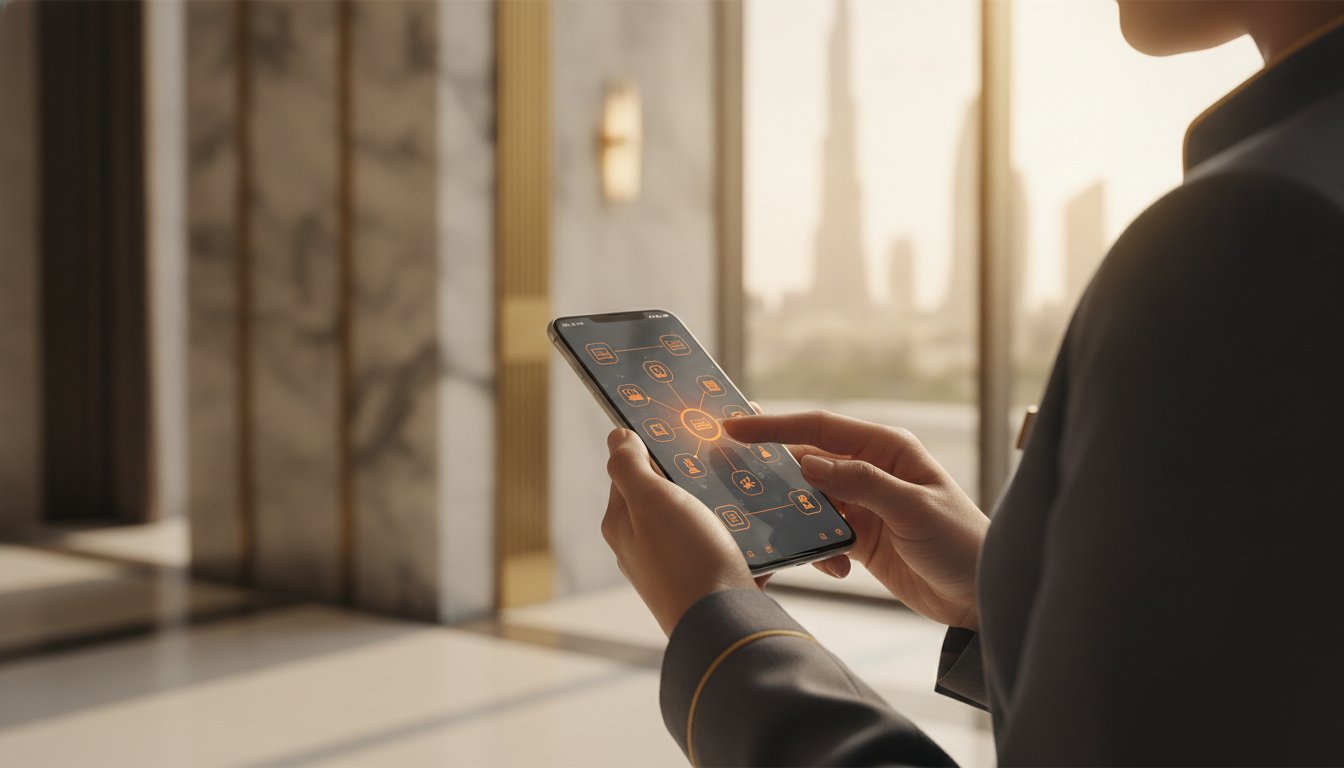
If your housekeeping team still relies on personal messaging apps or handwritten logs to manage guest requests, is your hotel truly prepared for the operational demands of 2026? You likely recognize the persistent friction caused by information silos where front-of-house requests and back-of-house execution remain disconnected. This fragmentation often results in slow response times and preventable staff burnout. We understand that maintaining excellence in a high-pressure environment requires more than just a chat app; it requires a disciplined, technical framework that ensures accountability.
This article explores the essential hospitality staff communication tools designed to transform internal operations into integrated, AI-driven ecosystems. You’ll discover how sophisticated platforms like 1.Hotel and 1.AI bridge the gap between guest engagement and task tracking. We’ll examine how modular helpdesk logic, such as the 1.Support ticketing system, creates a centralized data stream for precise operational audits. By the end of this roundup, you’ll have a clear roadmap for implementing technology that reduces service delays and secures your digital infrastructure for long-term strategic growth.
Key Takeaways
- Understand why traditional hardware and informal messaging apps create security vulnerabilities and operational silos within your property.
- Identify the four technology pillars required to build a modern suite of hospitality staff communication tools that scale with your property’s needs.
- Evaluate the return on investment by comparing legacy hardware maintenance costs against the accountability of timestamped, integrated workflows.
- Learn a structured five-step roadmap for transitioning from fragmented apps to a unified digital ecosystem, starting with a critical infrastructure audit.
- Discover how the 1.Series, including 1.Hotel and 1.AI, creates a seamless bridge between guest requests and back-of-house execution.
The Evolution of Hospitality Staff Communication: From Radios to Ecosystems
The transition from analog to digital in the hospitality sector is no longer a matter of convenience; it’s a strategic necessity. For decades, two-way radios and DECT phones served as the primary hospitality staff communication tools. While these devices provided immediate voice contact, they offered zero data visibility and created significant noise pollution in quiet guest corridors. In a modern resort environment, relying on “push-to-talk” technology means critical requests are often overheard but never recorded. This lack of a digital paper trail makes it impossible to conduct operational audits or identify bottlenecks in service delivery. When messages are missed or forgotten, the result is inevitably a negative guest review and lost revenue.
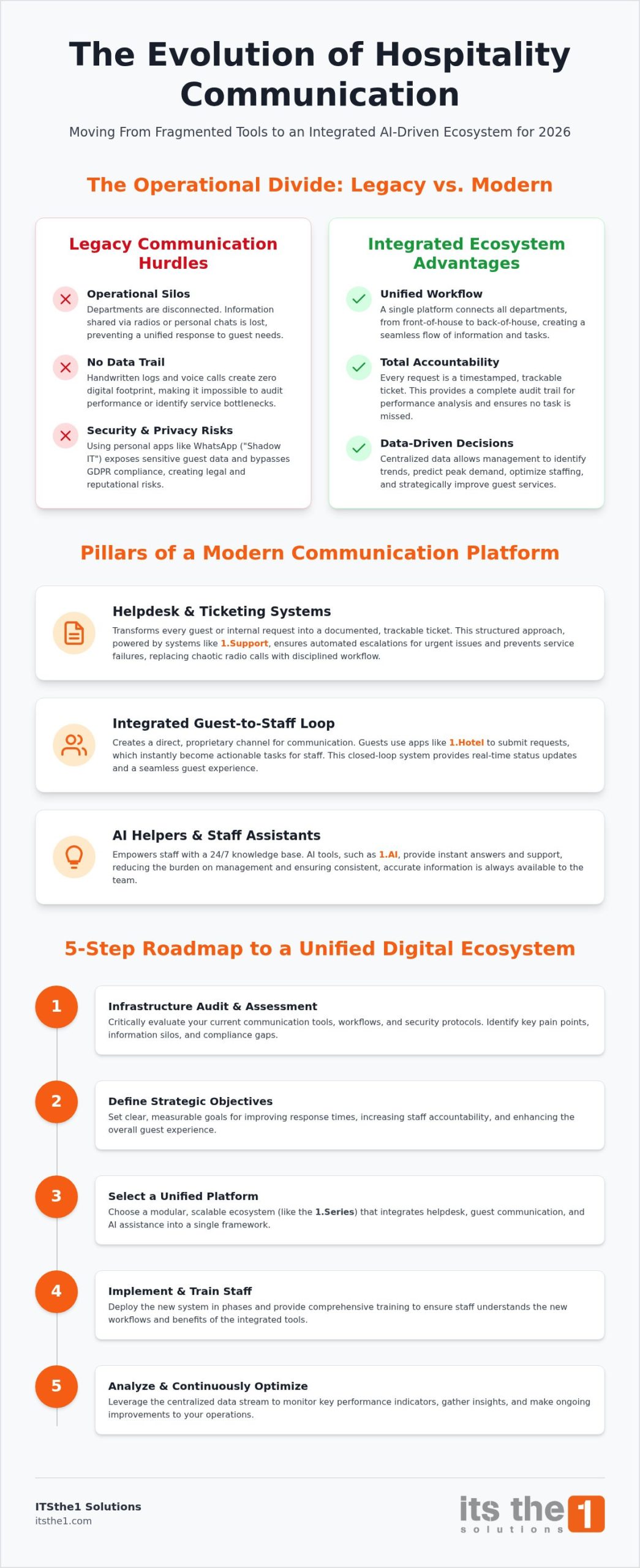
When legacy hardware fails to meet modern demands, staff often turn to “Shadow IT” solutions like WhatsApp or Telegram. While these apps are familiar, they introduce severe security risks and fragmented workflows that hinder long-term growth. The 2026 standard demands a move toward unified, trackable, and AI-enhanced communication that prioritizes data integrity and operational transparency.
Why Informal Apps are a Risk to Enterprise Hospitality
Personal messaging accounts lack the enterprise-grade security required for professional hotel operations. Data privacy remains a primary concern, as guest information shared over informal channels often bypasses GDPR and local compliance protocols. These platforms offer no centralized ownership. If an employee leaves the organization, the history of their communications and guest interactions vanishes with them. Operational silos occur when critical information is trapped within isolated departments or unmonitored chat groups, preventing a unified response to guest needs. Without a structured environment, accountability disappears into a sea of unread notifications and unverified “seen” receipts.
The Shift Toward Integrated Guest-Staff Loops
The next generation of hospitality staff communication tools involves a closed-loop system where guest requests and staff actions exist in a single, proprietary ecosystem. Modules like 1.Hotel allow guests to submit requests directly from their mobile devices, which then populate as actionable tasks in the staff interface. This shifts the focus from simply notifying a team member to assigning a trackable ticket with a clear deadline.
By utilizing helpdesk logic through modules like 1.Support, management can monitor the entire lifecycle of a request. Real-time status updates ensure that guests aren’t left wondering about the progress of their room service or maintenance call. This integrated approach, supported by the 1.Series family of software, replaces fragmented messaging with a disciplined workflow. It ensures that every interaction contributes to a centralized data pool, allowing for precise performance mapping and improved staff accountability.
Essential Categories of Hospitality Staff Communication Tools in 2026
Modern operational excellence relies on a structured architecture of hospitality staff communication tools. Instead of isolated apps, successful properties adopt a modular approach that allows their technology stack to evolve alongside their business objectives. This ensures that every component, from guest-facing interfaces to back-of-house management, operates within a unified framework. To achieve this, your communication infrastructure must integrate seamlessly with existing Property Management Systems (PMS) and your 1.TV guest entertainment platform. A fragmented system is an inefficient one; true value lies in the synergy between different software modules.
Hospitality Helpdesk and Ticketing Systems
Applying rigorous IT helpdesk logic to hotel operations transforms how departments interact. With 1.Support, every housekeeping or maintenance request becomes a documented ticket rather than a fleeting radio call. This system introduces automated escalation protocols. If a “Priority 1” guest request remains unacknowledged for a specific duration, the system notifies a supervisor immediately to prevent service failure. This level of oversight allows management to use historical ticket volume to predict peak hours, ensuring staffing levels match actual operational demand rather than guesswork.
AI Helpers and Staff Assistants
AI-driven assistants are vital to the 2026 operational standard. Tools like 1.AI serve as a 24/7 knowledge base for staff, providing instant answers regarding Standard Operating Procedures (SOPs) and safety protocols. These assistants bridge communication gaps in multicultural teams through real-time language translation, ensuring instructions are understood across all departments. By handling routine internal inquiries and summarizing task lists, a dedicated hotel staff AI assistant significantly reduces the cognitive load on front-desk managers. This allows leadership to focus on high-value guest interactions rather than answering repetitive procedural questions.
Digital Signage for Internal Coordination
Effective communication extends to visual interfaces in staff-only areas. Utilizing 1.DSMM for digital signage in breakrooms, kitchens, and corridors allows for the real-time display of Key Performance Indicators (KPIs) and daily specials. This visual layer keeps teams aligned without requiring constant mobile device checks, which can be distracting in guest-facing roles. In the event of an emergency, these screens provide immediate, high-visibility safety alerts across the entire property. Implementing such a comprehensive ecosystem is simpler when you partner with a trusted advisor who understands the nuances of hospitality digital transformation.
Comparing Traditional vs. Integrated Communication Ecosystems
Transitioning from legacy hardware to modern hospitality staff communication tools involves a shift in both financial strategy and operational culture. Traditional hardware, such as radios or DECT phones, requires significant capital expenditure and ongoing physical maintenance. In contrast, integrated software ecosystems operate on scalable models that prioritize long-term utility over hardware durability. Beyond the balance sheet, the move to digital creates a definitive culture of accountability. A request “heard on radio” is often lost in the noise; a timestamped entry in a professional application provides a permanent record of who acknowledged a task and exactly when it was completed.
Employee retention is directly influenced by the efficacy of the tools provided to your team. In high-pressure environments, inefficient or fragmented communication causes friction that leads to staff burnout and turnover. By providing an integrated ecosystem, you reduce the daily frustration associated with chasing information across departments. Modular software suites like the 1.Series outperform standalone gadgets because they grow alongside the property. You don’t need to replace your entire infrastructure as your needs expand; you simply activate new modules to meet emerging operational goals.
The ‘Single Pane of Glass’ Approach
A unified staff experience is essential for maintaining operational speed. Providing a single login for tasking, ticketing, and AI assistance ensures that employees don’t waste time switching between disconnected interfaces. 1.Hotel exemplifies this by integrating guest-facing requests directly with staff execution modules. This consistency in UI/UX facilitates rapid onboarding for new hires, as they only need to master one intuitive system rather than a collection of disparate, unsecure apps. When every department uses the same digital language, the entire property functions as a single, cohesive unit.
Data and Analytics: The Hidden Advantage
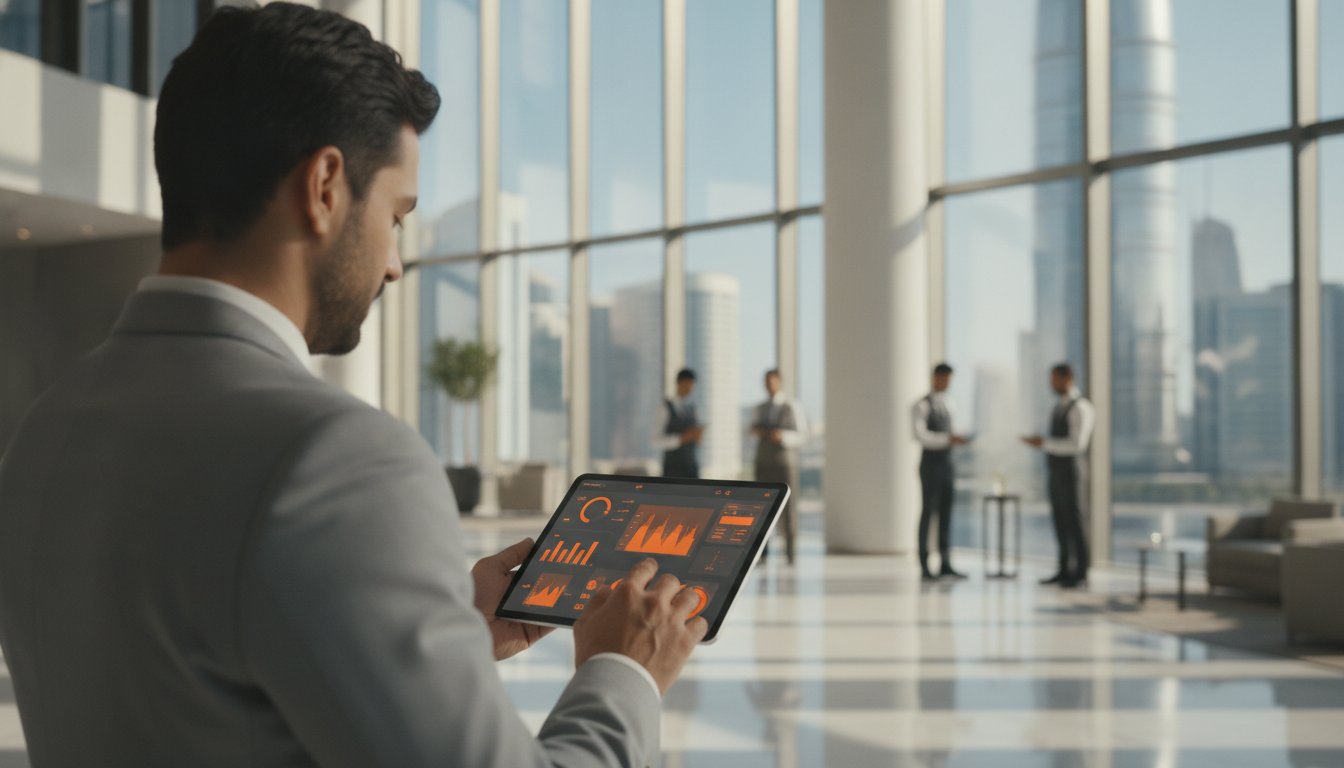
While traditional hospitality staff communication tools offer zero visibility into performance, integrated ecosystems provide actionable operational intelligence. Management can identify specific bottlenecks in housekeeping or room service by reviewing response time reports generated within the system. These communication logs serve a dual purpose. They provide a clear record for guest dispute resolution and act as a reliable source of truth during insurance audits or internal performance reviews. This transition from simply notifying staff to actively analyzing workflows is what defines a truly modern, data-driven operation.
Implementation Strategy: Moving Beyond Fragmented Apps
Moving from informal messaging to a professional ecosystem requires a structured methodology. This transition ensures that your property avoids the pitfalls of data silos and security breaches discussed previously. A phased rollout allows for zero downtime, maintaining high guest service standards throughout the digital evolution. By adopting a disciplined roadmap, management can transform communication from a source of friction into a driver of operational excellence.
Step 1 & 2: Infrastructure Audit and Cybersecurity Alignment
Before deploying hospitality staff communication tools, you must verify that your network infrastructure can support 100% digital communication. A comprehensive Wi-Fi audit is the first priority. This identifies dead zones in back-of-house areas, such as laundry rooms or basement maintenance hubs, where connectivity often fails. Cybersecurity is equally critical. Enterprise tools require dedicated oversight to ensure regional compliance and data residency requirements are met. Professional consulting ensures that your communication data remains protected within a secure, managed environment rather than on personal, unsecure servers. This alignment protects both the property and the guest from potential data vulnerabilities.
Step 3 & 4: Module Selection and Staff Training
Success depends on selecting the right modular components for your specific operational needs. You might begin with 1.Hotel to bridge guest and staff interactions, then integrate 1.Support for maintenance ticketing. The full 1.Series suite offers a unified experience across all departments. Training should follow a “Train the Trainer” model. In this approach, departmental heads become internal experts who guide their teams through the new workflows. You can encourage adoption by gamifying the transition, using performance metrics from the app to reward the most efficient teams. This creates positive reinforcement and ensures the technology is viewed as a supportive tool rather than a burden.
Step 5: Review and Optimise
The final step involves a rigorous 30-day review of initial ticket response data. This period allows you to identify any lingering bottlenecks and refine 1.AI responses based on the actual queries your staff submit. Once the core communication loop is stable, you can expand the ecosystem to include 1.DSMM for digital signage coordination. This methodical progression ensures that each new layer of technology adds measurable value to the guest experience. To begin your property’s digital evolution, consult with our expert team to design a custom roadmap for your operations.
Future-Proofing with ITSthe1 Integrated Solutions
The 1.Series represents a significant advancement in how properties manage their internal workflows. By adopting a proprietary modular software family, hotels avoid the limitations of “one-size-fits-all” platforms that often fail to scale in complex environments. ITSthe1 Solutions acts as a trusted advisor, guiding properties through the intricacies of digital evolution with a focus on stability and high-level value. This modular approach allows management to select the specific hospitality staff communication tools that align with their current operational maturity while ensuring compatibility for future infrastructure expansions.
1.Hotel creates a seamless bridge between the guest journey and back-of-house execution. It transforms guest engagement into operational efficiency by feeding real-time data directly into the 1.Support ticketing system. This integration ensures that every department, from maintenance to housekeeping, operates with the precision and accountability of an enterprise helpdesk. 1.AI further enhances this ecosystem by serving as an intelligent hotel staff AI assistant and knowledge management tool. It manages institutional memory, ensuring that even new hires have immediate access to complex protocols without requiring constant oversight from front-desk managers. This reduces the cognitive load on leadership while maintaining high service standards.
Why Global Brands Trust ITSthe1 Solutions
Reliability is the cornerstone of our partnership model. Established in 1999 with a global head office in Dubai since 2003, we possess the longevity and geographical footprint required to support international enterprise-level hospitality. Our comprehensive model covers everything from software licensing to managed IT support and cybersecurity. This steady, grounded delivery instills confidence that your complex technical needs are in capable hands. We understand the nuances of regional compliance and the performance demands of large-scale operations across the Middle East and globally.
The Path Forward: Customised Digital Transformation
The transition to 2026 standards requires moving away from generic products toward researched, cost-effective solutions. We prioritize a philosophy of meticulous testing to ensure every module in the 1.Series delivers measurable results. Ongoing professional consulting is a vital component of this process, helping properties maintain a competitive edge as technology evolves. Strategic growth is achieved when hospitality staff communication tools serve overarching business goals rather than just acting as messaging platforms.
Discover how ITSthe1 can transform your staff communication today.
Mastering Operational Excellence Through Strategic Integration
Adopting modern hospitality staff communication tools is no longer a luxury for enterprise hotels; it’s a strategic requirement for maintaining excellence. We’ve explored how transitioning from legacy hardware to integrated ecosystems reduces service response times and eliminates the security risks of informal messaging. By prioritizing a data-driven approach through ticketing and AI assistance, management gains the transparency needed for precise operational audits. A successful implementation depends on a disciplined roadmap that aligns your network infrastructure with your long-term business goals.
ITSthe1 Solutions has been a leader in this evolution since 1999. As specialists in hospitality digital transformation, we provide the proprietary 1.Series modular suite to ensure your technology stack grows with your property. Our global expertise and commitment to research make us a steady partner for your digital journey. We invite you to Streamline Your Hotel Operations with ITSthe1 Solutions and build a more resilient, efficient team. Your path to operational excellence is well within reach.
Frequently Asked Questions
What are the most essential hospitality staff communication tools for large hotels?
Large hotels require a modular suite of hospitality staff communication tools that integrate guest requests with back-of-house execution. Essential components include guest-facing apps like 1.Hotel, which feed directly into ticketing platforms like 1.Support. These systems replace fragmented messaging with trackable workflows. Additionally, AI-driven assistants such as 1.AI provide real-time support for staff, ensuring that Standard Operating Procedures are accessible across all departments without constant managerial intervention.
How can AI improve internal communication for hotel employees?
AI improves internal coordination by acting as a 24/7 knowledge repository for staff protocols and emergency procedures. Using 1.AI, employees can receive instant answers to complex queries regarding room service standards or maintenance workflows. This technology also facilitates real-time language translation, which is vital for multicultural hospitality teams. By automating routine internal information requests, AI significantly reduces the cognitive load on front-desk managers, allowing them to prioritize high-value guest interactions.
Is it safe for hotel staff to use WhatsApp for work-related communication?
Using WhatsApp for professional communication introduces significant security risks and compliance vulnerabilities. Personal messaging apps lack enterprise-grade encryption and centralized ownership, meaning guest data shared on these platforms often bypasses GDPR or local privacy protocols. Informal chats don’t provide the audit trails necessary for operational accountability or insurance reviews. Transitioning to a secure, proprietary environment like 1.Hotel ensures that all staff interactions remain protected and within the property’s digital control.
What is the difference between a task management app and a hospitality ticketing system?
While task management apps provide simple checklists, a hospitality ticketing system like 1.Support utilizes helpdesk logic to manage the entire lifecycle of a request. Ticketing systems include automated escalation protocols that notify supervisors if a priority task remains unacknowledged. They also generate detailed response-time reports, providing the operational intelligence needed to identify bottlenecks. This transition from notifying to assigning ensures that every guest request is timestamped, tracked, and verified for completion.
Can communication tools integrate with my existing Hotel PMS?
Yes, professional hospitality staff communication tools are designed to integrate seamlessly with your existing Property Management System (PMS) and guest entertainment platforms like 1.TV. This synchronization ensures that guest data, room status, and service requests flow between systems without manual entry. Integration eliminates information silos and prevents errors caused by disconnected data. By choosing a modular suite like the 1.Series, you create a unified digital ecosystem where every tool shares critical operational information.
How much does it cost to implement a professional staff communication system?
Implementation costs vary based on the specific modules selected and the scale of your property’s operations. Professional systems typically operate on a scalable subscription model, which avoids the high capital expenditure associated with legacy hardware maintenance. This modular approach allows you to start with essential components, such as 1.Hotel or 1.Support, and expand as your budget and operational needs evolve. Investing in an integrated ecosystem provides a higher long-term return through improved staff retention.
What happens if our Wi-Fi goes down? Do these communication tools have offline modes?
Reliability is a core priority for enterprise-grade hospitality technology. While these tools rely on network connectivity, professional implementations begin with a thorough infrastructure audit to identify and eliminate dead zones. Many modules within the 1.Series utilize local caching to ensure that critical data remains accessible even during temporary network interruptions. Maintaining a robust and redundant Wi-Fi network is essential for the seamless performance of any digital communication framework in a modern resort environment.
How do digital signage systems support internal staff communication?
Digital signage systems like 1.DSMM provide a visual layer for coordination in back-of-house areas such as kitchens and breakrooms. These displays broadcast real-time Key Performance Indicators, daily specials, and departmental updates without requiring staff to check their mobile devices constantly. In emergency scenarios, the digital signage network can deliver immediate safety alerts and protocols across the entire property. This ensures that every team member, regardless of their role, remains aligned with the hotel’s operational objectives.

One comment on “The Best Hospitality Staff Communication Tools for 2026: A Comprehensive Roundup”