The right hotel technology partner is one whose systems fit your hotel’s priorities, integrate with the technology you already use and support your plans. Knowing how to choose a hotel technology partner means assessing both the solutions and the provider, not comparing features alone.
It is natural to focus first on the tools: property management, guest services and hotel operations all rely on technology working smoothly. But a feature list is useful only when it addresses a clear need and fits your wider setup.
This guide explains how cloud-based systems, provider comparisons and a practical SWOT analysis can inform your decision. It also outlines the functions hotel technology can support, helping you connect each investment to an operational priority and choose with confidence.
Key Takeaways
- Use a SWOT analysis to compare each platform’s strengths, weaknesses, opportunities and risks against your hotel’s priorities.
- Prioritise cloud-based systems that integrate with your existing technology and can adapt as your operations develop.
- Map technology functions to practical needs, from property management and distribution to guest services and staff workflows.
- Assess a provider’s experience through relevant project examples and references, focusing on how well its work aligns with your hotel’s requirements.
2. Comparing provider features and conducting a SWOT analysis
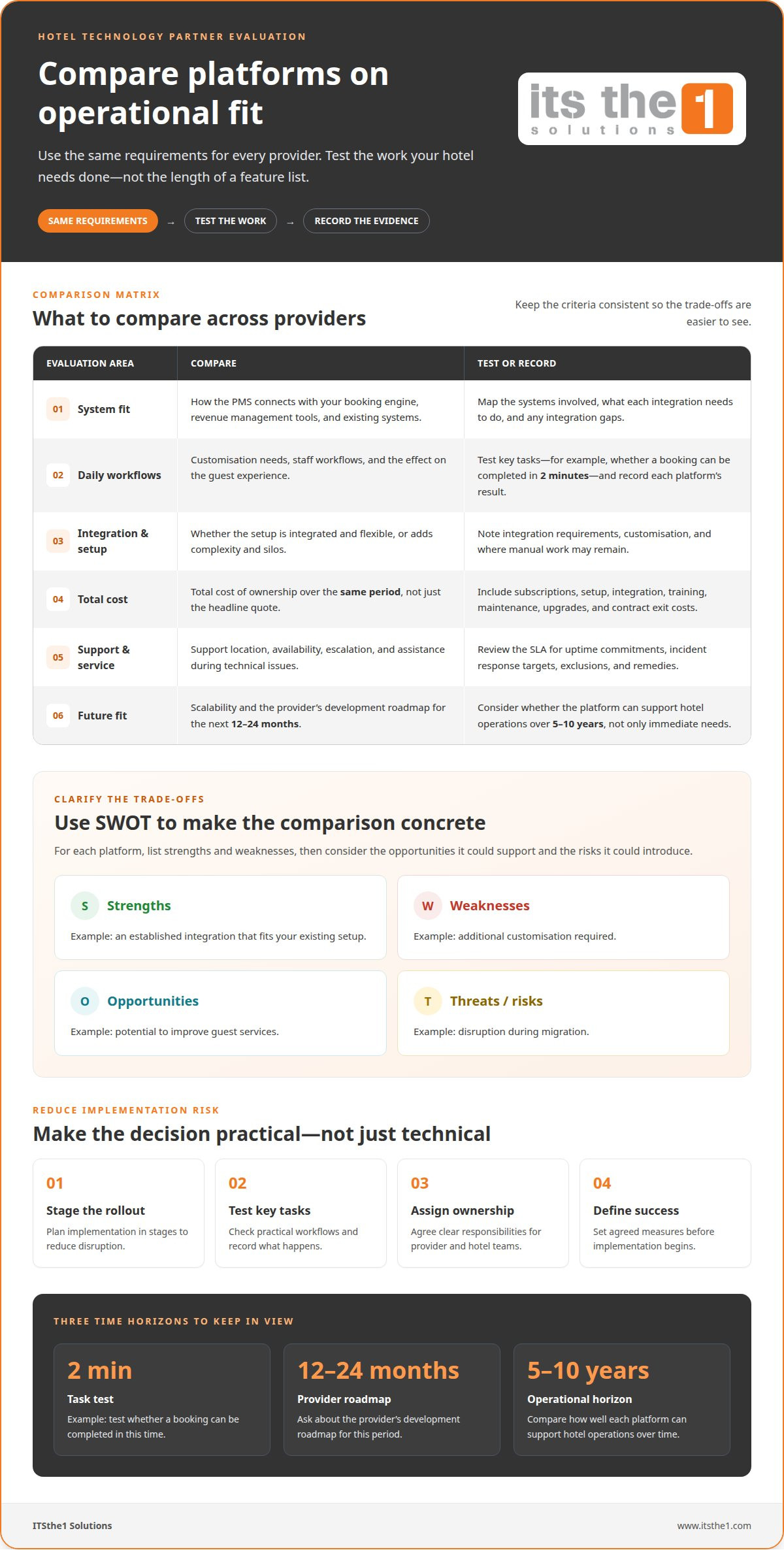
Compare providers against the same operational requirements, not the length of their feature lists. For example, assess whether a property management system integrates with your booking engine and revenue management tools. Include existing systems, customisation needs, staff workflows, and the guest experience in the comparison. Cloud-based infrastructure can offer flexibility, while a simpler, integrated setup can reduce silos. Test key tasks, such as whether a booking can be completed in 2 minutes, and record the result for each platform.
Use a SWOT analysis to clarify trade-offs. List each platform’s strengths and weaknesses, then consider the opportunities it could support and the risks it could introduce. A strength might be an established integration; a weakness, additional customisation. An opportunity could be improving guest services, while a risk could be disruption during migration. Compare total cost of ownership over the same period, including subscriptions, setup, integration, training, maintenance, upgrades and contract exit costs. This reveals costs beyond the initial quote, rather than relying on the headline price alone.
Assess customer support through its location, availability, escalation process, and active assistance during technical issues. Review the service-level agreement for defined uptime commitments, incident response targets, exclusions, and remedies. The right standard depends on how each system affects hotel operations, so distinguish critical services from tools with a lower operational impact.
The wrong partner can leave integration gaps, increase manual work, disrupt service, or constrain future growth. Reduce these risks through a staged implementation plan, practical testing, clear responsibilities, and agreed success measures. Assess scalability and ask about the provider’s development roadmap for the next 12-24 months. Compare each platform’s ability to support operations over 5-10 years, rather than choosing solely for immediate needs.
3. Hotel technology functions and solutions
Start with the property management system (PMS), which can serve as the operational backbone. Map how it should connect with a central reservation system (CRS), point-of-sale (POS) platform, channel manager, booking engine and revenue management system. For example, reservation and rate updates should pass between relevant systems without repeated manual entry. Confirm what data each integration sends, how errors are flagged and which team is responsible for follow-up.
Then connect functions to business outcomes. A channel manager supports online distribution, while revenue management tools help teams make pricing decisions. Automated reporting can reduce spreadsheet preparation and give managers structured information to act on. Assess guest-facing technology, such as mobile check-in, against the guest journey and staff workflows. Define success measures before selecting functions, such as fewer duplicate entries or faster access to operational reports.
For cybersecurity and privacy, set clear requirements for access permissions, data handling, retention, audit records, backups and incident response. Ask the provider to document its controls and responsibilities, and ensure contract terms cover data access and security incidents. Tailor these controls to the hotel’s information flows and operational priorities.
In the UAE, identify the privacy and cybersecurity obligations that apply to the hotel’s jurisdiction and data handling, then translate them into documented system and contract requirements. A generic checklist is not a substitute for this assessment. A practical next step is to map each data type, its users and the systems that receive it.
Connect the functions as one platform rather than isolated tools. A hospitality app for guests and staff can support guest and employee workflows; hotel technology solutions can help frame those requirements alongside the wider system design.
3. How to assess a hotel technology partner’s experience and references?
Assess experience by looking for projects that resemble your hotel’s operational needs, rather than focusing only on provider size. A resort managing several guest services may need different capabilities from a business hotel focused on streamlined check-in. Compare the project scope, systems involved, implementation approach and outcomes with your priorities. This makes relevant experience easier to assess than broad claims about hospitality expertise.
Use references to understand how the partnership works after implementation. Ask hoteliers in your professional network about their experience, focusing on concrete examples: how the provider handled integration challenges, communicated during deployment and responded when operational needs changed. Ask how long the property has worked with the provider, as a sustained relationship can offer useful context about ongoing delivery.
Keep a consistent record for each reference. Note the hotel’s operating model, technology, original business need and lessons shared. For example, a reference using a different property management system may help explain the provider’s project communication, but may not demonstrate compatibility with your setup. Separate transferable evidence from details specific to that property.
Finally, compare references with the proposed project plan. Check whether the provider can explain its responsibilities, your team’s role, key implementation stages and how success will be assessed. If a reference describes smooth delivery but your plan leaves integration ownership unclear, resolve that gap before proceeding. This evidence-based approach helps you evaluate both technical fit and the working relationship.
Ready to discuss your hotel’s technology priorities? Start a conversation about your requirements.
ITSthe1 Solutions: 1.Hotel – Hospitality App for Guests and Staff
ITSthe1 Solutions offers 1.Hotel – Hospitality App for Guests and Staff for hotels assessing how an app could support guest and staff needs. It is a relevant next step when your technology review identifies a requirement for a hospitality app, rather than another standalone operational system.
Before planning its role, define the workflows the app should support and the needs it must address for guests and employees. This gives your hotel a clear basis for discussing how the app fits its wider technology priorities. ITSthe1 Solutions also offers 1.TV for enterprise and hospitality IPTV, 1.DSMM for digital signage and meeting rooms, and 1.ID for passport and ID scanning.
Share your hotel’s priorities and the technology goals you’ve identified to discuss a suitable next step. Contact ITSthe1 Solutions to discuss your hospitality technology requirements.
Turn your technology priorities into a practical next step
How you choose a hotel technology partner can shape more than a software decision. It can set a clearer direction for guest and staff services, with each investment tied to an operational need. Start by identifying the workflow you want to improve, then define how a suitable solution should fit your hotel’s broader plans.
For hospitality requirements, ITSthe1 Solutions offers 1.TV for enterprise and hospitality IPTV, 1.DSMM for digital signage and meeting rooms, and 1.ID for passport and ID scanning. These offerings address distinct functions, so your next step is to connect your priority to the solution that best fits it.
Discuss your hotel’s objectives and planned technology direction with ITSthe1 Solutions. A focused conversation can help you move from evaluation to a considered next step for your property.
Frequently Asked Questions
How to choose the right technology partners for your hotel?
To choose a hotel technology partner, match the provider’s role to your hotel’s priorities. Involve the teams that will use each solution, such as reception or housekeeping. Agree who will own decisions, training and ongoing administration, and distinguish guest-facing needs from back-office requirements.
How To Make The Right Choice?
Choosing a hotel technology partner starts with setting clear operational outcomes and documenting why the selected option meets them. For instance, a hotel preparing for a renovation may prioritise solutions that can be introduced in phases. Record the trade-offs, internal owner and first outcome to review after launch. This provides a useful reference if priorities or project scope change.
What hotel technology solutions should a technology partner provide?
A partner’s solutions should fit the hotel’s actual requirements; no property needs every option in a provider’s portfolio. Consider whether your priorities call for operational platforms, guest-facing services, staff tools, digital communication or security capabilities. A focused provider may suit a defined project, while a broader portfolio may help coordinate several related needs. Judge suitability by function and fit, not breadth alone.
How to compare hotel technology partner pricing, implementation fees, and contract terms?
Compare proposals by separating recurring charges from implementation work and identifying what each item covers. Pricing depends on the project and is provided after a quote request; cost factors include licensing, integrations, configuration, training, and support scope. Review contract renewal, price-change provisions, data export, termination, and transition responsibilities. Ask for assumptions and exclusions to be written clearly, so proposals can be compared on equivalent scope.
What are typical hotel technology implementation timelines and onboarding steps?
The article gives no typical implementation duration. It recommends a staged plan that clarifies responsibilities and success measures, tests integrations and key tasks, and defines implementation stages with the provider before proceeding.