Technology proposals gain support when they connect a clear operational or guest-experience need to a credible return on investment, rather than focusing on cost alone. Convincing hotel owners to invest in technology means showing how scalable cloud systems can adapt as business needs change, while linking guest-facing automation to practical service and workflow improvements.
It’s reasonable to scrutinise new spending, especially when teams are balancing day-to-day priorities. A stronger case brings operations, marketing and sales into the planning early, so the investment addresses shared goals instead of competing departmental requests. This article explains how to build that case, assess cloud systems for current and future needs, and present automation in terms of the work it can support. It also shows how coordinated planning can help decision-makers evaluate the broader value of a technology investment.
Key Takeaways
- Frame cloud investment around return on investment and the hotel’s current and longer-term needs, not cost alone.
- Assess guest-facing automation by how it can streamline routine work and give staff more capacity to focus on service.
- Bring operations, marketing and sales into planning early to align priorities and present a coordinated business case.
- Consider ITSthe1 Solutions’ 1.Hotel hospitality app for guests and staff when evaluating technology to support hotel teams and guest interactions.
1. Cloud-based systems and scalable investment
Cloud-based hotel systems let teams access software and information through internet-connected services. Software as a service (SaaS) typically provides access through a subscription, while implementation and integration shape the wider investment. For UAE hotels operating across properties, shared cloud access can help teams use consistent systems without relying on separate installations at each site.
Build the proposal around the hotel’s current needs and medium- to long-term vision. A scalable platform should support changing demand, new properties, and additional integrations without forcing a complete replacement. Accor’s stated strategy and vision to 2025 was to move all its applications to the cloud, illustrating how cloud adoption can form part of a broader hospitality transformation. Frame success around operational fit and return on investment, not technology alone.
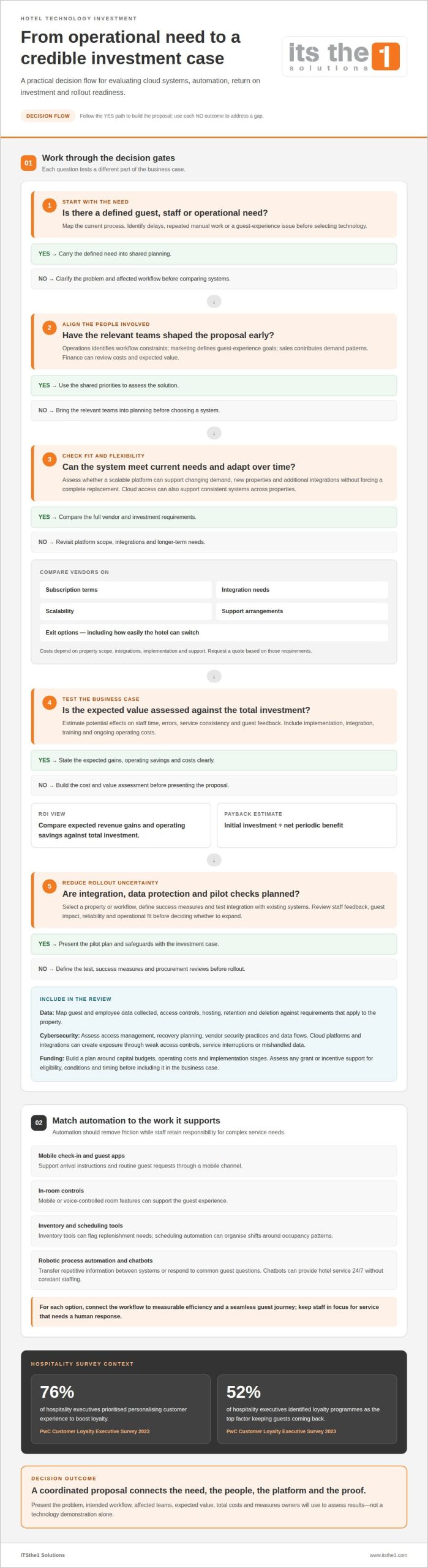
How do hotel technology costs and vendors compare in the UAE? Costs depend on property scope, integrations, implementation and support, so request a quote based on those requirements. Compare vendors by subscription terms, integration needs, scalability, support arrangements and exit options, including how easily the hotel can switch.
What UAE regulations and data protection rules apply to hotel technology? Map the guest and employee data each system collects, along with access controls, hosting, retention and deletion processes, against requirements that apply to the property. Include privacy and cybersecurity reviews in procurement, rather than leaving them until later.
How can hotels pilot new technology before committing to a full rollout? Select a property or workflow, define success measures and test integration with existing systems. Review staff feedback, guest impact, reliability and operational fit before deciding whether to expand.
What are the risks and cybersecurity concerns of hotel technology investments? Cloud platforms and integrations can create exposure through weak access controls, service interruptions or mishandled data. Assess access management, recovery planning, vendor security practices and data flows before rollout.
What financing, grants or incentives are available for hotel technology investments in the UAE? Build a funding plan around capital budgets, operating costs and implementation stages. Treat grant or incentive support as programme-specific, and assess eligibility, application conditions and timing before including it in the business case.
2. Mobile apps, self-check-in and in-room automation
Mobile check-in, guest apps, and in-room controls can simplify common steps, from arrival instructions to room requests. Automation works best when it removes friction without making hospitality feel impersonal. For example, guests can use a mobile channel for routine requests while staff retain responsibility for complex service needs. PwC’s Customer Loyalty Executive Survey 2023 found that 76% of hospitality executives prioritised personalising customer experience to boost loyalty.
Convincing hotel owners to invest in technology starts with a defined guest or staff need. Map the current process and identify delays or repeated manual work. Then estimate how automation could affect staff time, errors, service consistency and guest feedback. Include implementation, integration, training and ongoing operating costs in the return-on-investment assessment. A pilot can test a workflow, such as mobile arrival or room-service requests, before expansion.
Present the proposal as an operational decision, not a technology demonstration. Explain the problem, intended workflow, affected teams, and measures owners will use to assess results. Operations can assess workload and service impact; marketing can consider guest engagement; finance can review costs and expected value. This shared view helps those convincing hotel owners to invest in technology connect innovation with measurable business priorities.
Inventory tools can flag replenishment needs, while scheduling automation can organise shifts around occupancy patterns. Robotic process automation can transfer repetitive information between systems, and chatbots can respond to common guest questions. These tools should complement staff, not obscure responsibility for service. A guest-and-staff app such as 1.Hotel hospitality app can be considered when evaluating mobile guest interactions and team workflows. Tie the proposal to measurable efficiency and a seamless guest journey.
Mobile check-ins and voice-controlled room features can improve the guest experience. Smart systems can personalize guest experiences with data collected through those systems, while chatbots can provide hotel service 24/7 without constant staffing, allowing staff to focus on guest service.
3. Involving operational, marketing and sales teams
Bring operations, marketing and sales into the proposal before selecting a system. Operations identifies workflow constraints, marketing defines guest-experience goals, and sales contributes demand patterns. These perspectives help owners distinguish a strategic need from technology for its own sake. Shared planning also connects operational efficiency with commercial priorities.
Which hotel technologies deliver the highest ROI? Prioritise systems that address a measurable property need, such as automating repetitive work, supporting targeted offers, or protecting guest data. PwC’s Customer Loyalty Executive Survey 2023 found that 52% of hospitality executives identified loyalty programmes as the top factor keeping guests coming back. Calculate ROI by comparing expected revenue gains and operating savings against total investment; estimate payback by dividing initial investment by net periodic benefit.
Technology can support revenue and guest satisfaction when teams use guest preferences to shape relevant offers and service improvements. Revenue and marketing leaders should plan budgets together, then align promotions with demand and pricing decisions. AI-powered revenue tools can analyse market trends and demand patterns to inform price adjustments, while marketing teams coordinate campaigns around those decisions.
What are the costs of property management systems, automation and AI tools? They depend on property scope, integrations, implementation, training and ongoing operating needs. The project requirements shape the estimate, which is provided after a quote request.
Owners can assess proposals against baseline occupancy, revenue, labour hours, guest feedback, and campaign performance. Compare the same measures after implementation, alongside market demand and seasonal conditions, to understand contribution rather than assume causation. To align guest and staff workflows, explore hospitality app solutions.
ITSthe1 Solutions: 1.Hotel – Hospitality App for Guests and Staff
ITSthe1 Solutions offers 1.Hotel, a hospitality app for guests and staff. It is a relevant option when a hotel’s investment priorities include app-based guest and team experiences. Use the operational goals established in the business case to define how an app fits alongside existing workflows, then assess its role within the wider technology plan.
A focused evaluation helps owners connect the proposed app with the needs of both guests and employees, rather than treating it as a standalone purchase. It also gives operational and commercial stakeholders a shared basis for discussing the investment and its intended value. For hotels considering guest-facing digital services, 1.Hotel provides a practical next step for that discussion.
Contact ITSthe1 Solutions to discuss how 1.Hotel could fit your hotel’s technology priorities.
Move from approval to an actionable roadmap
A proposal becomes actionable when it has a defined scope, a clear owner and a way to assess progress. Connect each investment decision to a coordinated technology roadmap, then sequence priorities around operational readiness and guest needs. This makes convincing hotel owners to invest in technology an ongoing planning discipline, not a one-time presentation.
ITSthe1 Solutions offers 1.TV for IPTV in enterprise and hospitality, 1.DSMM for digital signage and meeting rooms, and 1.ID for passport and ID scanning. These solutions can help shape a discussion about which guest or operational touchpoints belong in the hotel’s roadmap.
Start a focused conversation about your hotel’s technology priorities and next steps. Contact ITSthe1 Solutions to discuss a practical path forward and move your plans ahead with clarity.