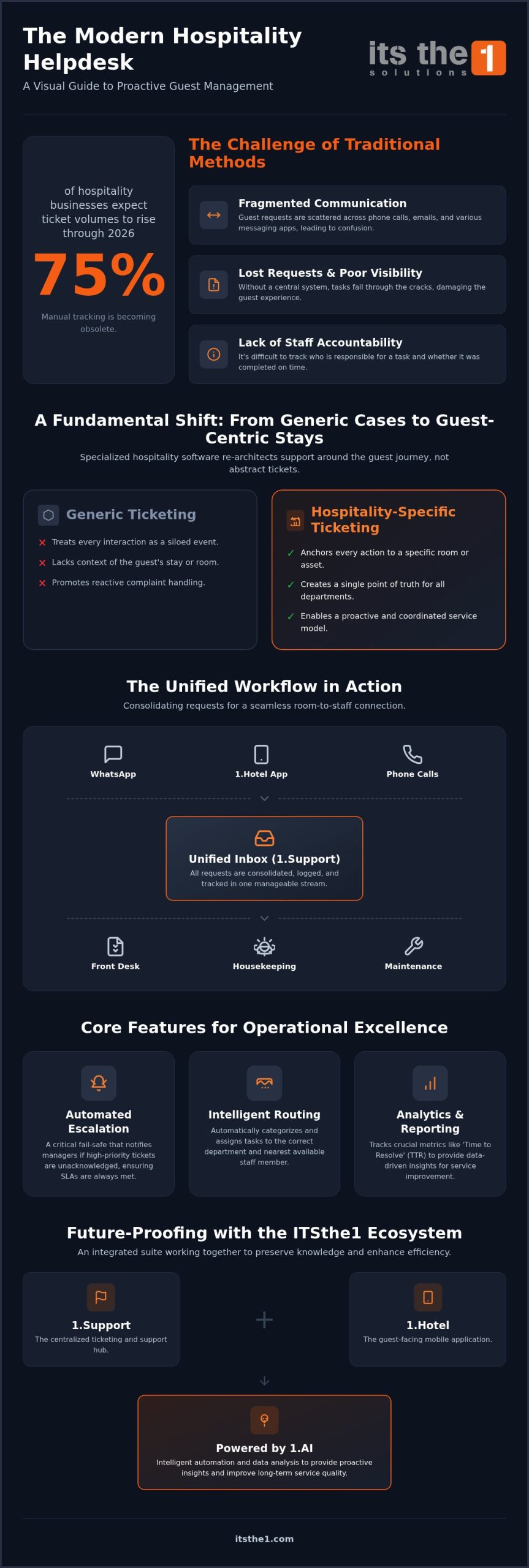
Recent industry research indicates that 75% of hospitality businesses expect ticket volumes to rise significantly through 2026. Managing this increased demand is difficult when guest requests are fragmented across phone calls, emails, and various mobile messaging apps. Without a robust hospitality helpdesk ticketing software, properties often suffer from lost requests and a lack of clear staff accountability. You likely understand that manual tracking is no longer sufficient for maintaining the high service standards required in today’s competitive market.
This guide explains how specialized tools provided by ITSthe1 Solutions, such as 1.Support, streamline complex workflows and empower your team with 1.AI. You’ll discover how to transition from reactive troubleshooting to a proactive service model by consolidating all requests into a unified dashboard. We preview how automated escalation prevents missed service level agreements and how data-driven insights improve long-term service quality. This roadmap provides the technical clarity needed to transform guest service into a measurable strategic asset, ensuring every interaction is handled with precision and professional care.
Key Takeaways
- Understand the fundamental shift from generic case-based support to stay-centric logic that prioritizes the guest journey.
- Discover how hospitality helpdesk ticketing software unifies fragmented communication channels into a single, actionable dashboard for your entire team.
- Identify the critical features of a ticket-driven workflow, including automated routing and intelligent escalation to ensure every service level agreement is met.
- Explore the strategic advantages of an integrated ecosystem where 1.Support, 1.Hotel, and 1.AI work together to preserve institutional knowledge and enhance staff efficiency.
What is Hospitality Helpdesk Ticketing Software?
At its core, hospitality helpdesk ticketing software serves as the centralized nervous system for guest engagement and operational management. While it shares foundational technology with a standard Issue tracking system, its architecture is uniquely designed for the nuances of service-based environments. Instead of managing abstract “cases,” this software tracks the dynamic requirements of a guest’s stay, ensuring that every request is logged, assigned, and resolved within strict brand standards.
The distinction between generic customer service tools and specialized hospitality solutions lies in room-centric logic. Generic platforms often treat every interaction as a siloed event. In contrast, hospitality ticketing anchors every action to a specific room or property asset. This allows teams to transition from reactive complaint handling to a proactive service model. If a guest identifies a maintenance issue, the system doesn’t just record a problem; it triggers a coordinated response across departments. This ensures that front desk agents, concierge teams, housekeeping supervisors, and maintenance technicians all work from a single point of truth.
The Core Concept: Room-to-Staff Connectivity
A primary function of this technology is establishing a direct link between the guest’s physical location and the staff’s mobile devices. Tickets are anchored to specific rooms, providing technicians and attendants with immediate context before they even arrive. Real-time status updates allow front-of-house teams to monitor progress without making repeated phone calls to back-of-house departments. This connectivity is managed through a Unified Inbox, a feature central to 1.Support, which consolidates requests from WhatsApp, the 1.Hotel app, and legacy phone systems into one manageable stream.
Why 2026 Demands a Digital Support Strategy
The hospitality sector faces a dual challenge in 2026: rising guest expectations and persistent labor shortages. Research indicates that 75% of hospitality businesses expect ticket volumes to increase this year, making manual tracking obsolete. Guests now demand instant gratification and personalized experiences as a standard requirement. Implementing a robust hospitality helpdesk ticketing software strategy allows leaders to scale their service without proportional increases in headcount. Automation isn’t just a luxury; it’s a necessity for maintaining operational continuity when staffing levels are lean. Hospitality ticketing is the bridge between guest desire and operational execution.
Essential Features of a Modern Hospitality Ticketing System
Effective hospitality helpdesk ticketing software must go beyond simple digital logging. It requires a deep architectural understanding of the property’s physical layout and departmental hierarchy. While generic tools treat every request with equal weight, a hospitality-specific system prioritizes tasks based on their impact on the guest experience and operational safety. This ensures that resources are allocated where they’re needed most, maintaining the high standards expected in the luxury and enterprise sectors.
Intelligent Routing and Task Escalation
The efficiency of a modern hotel relies on the speed of its back-of-house response. Intelligent routing ensures that a request for a “leaking tap” is automatically categorized as a high-priority maintenance task rather than a general housekeeping query. The software identifies the specific room number and routes the ticket directly to the nearest available technician’s mobile device. This eliminates the need for manual dispatching by front desk managers, who are then free to focus on guest check-ins and face-to-face interactions.
Automatic escalation serves as a critical fail-safe. If a high-priority ticket remains unacknowledged for a predetermined period, the system triggers a notification to the department head. This mechanism ensures that no guest request is overlooked, even during peak occupancy periods or shift changes. By establishing clear digital accountability, properties can maintain strict adherence to their internal service level agreements (SLAs). For organizations seeking to modernize these workflows, exploring the modular capabilities of 1.Support provides a clear path toward operational maturity.
Analytics and Performance Reporting
Data-driven insights allow management to move from anecdotal observations to empirical evidence. Modern systems track “Time to Resolve” (TTR) across every department, providing a clear picture of staff efficiency and resource gaps. If the data shows a recurring maintenance issue in a specific wing of the building, it signals a need for structural repairs rather than temporary fixes. This proactive approach to asset management prevents minor inconveniences from escalating into costly guest compensation scenarios.
Performance reporting also plays a vital role in staff engagement. By identifying high-performing team members through objective data, managers can implement reward programs that are fair and transparent. Multilingual support further enhances this ecosystem by bridging communication gaps between international guests and a diverse workforce. When a guest submits a request in their native language, the software translates the ticket for the staff member, ensuring that the intent and urgency are never lost in translation. This level of technical sophistication is what defines guest service excellence in 2026.
Hospitality-Specific vs. Generic Ticketing: The Critical Differences
Enterprise leaders often assume that a standard customer service platform can be adapted for hotel operations with minor configurations. However, the fundamental architecture of specialized hospitality helpdesk ticketing software differs significantly from traditional SaaS models. While generic software manages isolated “cases,” hospitality solutions are built around the concept of “stays.” This distinction ensures that every interaction is contextualized within the guest’s current visit, historical preferences, and specific room assignment, rather than treating them as a random support ticket in a queue.
The PMS Integration Advantage
A seamless connection with the Property Management System (PMS) is a non-negotiable requirement for modern operational efficiency. This integration allows the ticketing system to automatically sync guest names, room numbers, and VIP statuses, which eliminates manual data entry errors. When a guest checks out, the system can automatically close pending non-critical tickets or transfer them to a post-stay workflow for follow-up. This automation ensures that staff can view a comprehensive guest history directly within the ticket interface, facilitating the kind of personalized service that generic tools simply cannot provide.
Mobile-First Design for Field Staff
Generic helpdesks typically prioritize desktop-heavy interfaces designed for centralized call centers. In contrast, hospitality-specific software is optimized for staff members who are constantly on the move. Housekeeping and maintenance teams require intuitive mobile interfaces that function flawlessly on tablets and handheld devices. High-performance systems like 1.Support enable staff to attach photos directly to tickets, providing visual documentation of maintenance needs or room readiness. In a fast-paced environment, push notifications replace traditional email alerts, ensuring that urgent requests reach the correct team member instantly without requiring them to check a workstation.
Specialized systems also integrate directly with guest-facing touchpoints to capture requests at the source. This includes in-room 1.TV systems and the 1.Hotel mobile app, which feed directly into the central ticketing engine. By providing guests with these digital channels, properties reduce the administrative burden on the front desk while gathering cleaner data for performance analytics. This ecosystem approach ensures that your technology serves the overarching business goal of providing a frictionless guest journey from arrival to departure.
Implementing a Ticket-Driven Workflow for Operational Excellence
Adopting a hospitality helpdesk ticketing software involves more than a simple technical deployment. It requires a fundamental shift in how teams perceive their daily tasks. For many staff members, digital tools can initially feel like an added administrative burden rather than a support mechanism. Success depends on demonstrating how these systems reduce repetitive inquiries and provide a clear record of their hard work. When staff see that the system protects them from “lost” requests and provides the data needed for resource allocation, adoption becomes a natural progression.
Operational excellence begins with mapping the guest journey from pre-arrival to post-departure. Requests made via a booking confirmation or a pre-stay email should automatically generate tickets. This ensures the room is prepared exactly to the guest’s specifications before they step onto the property. Once the guest arrives, the system maintains a continuous feedback loop. If a service level agreement (SLA) is breached, the system provides the transparency needed to identify whether the delay was due to staffing levels or a process bottleneck. This objective data allows management to set realistic performance targets based on their specific hotel category and current labor capacity.
Phase 1: Mapping Departmental Workflows
The first step in implementation is identifying the top ten most common guest requests. These typically include items like extra towels, late check-out inquiries, and Wi-Fi assistance. By standardizing these workflows, properties can define clear “ownership” for tickets that cross departmental lines. For example, a request for a room move involves both the front desk and housekeeping. A standardized Response Library ensures that staff provide consistent, professional answers across all digital channels, maintaining the brand’s authoritative voice regardless of which employee is responding. Selecting the right hospitality staff communication tools is equally critical to ensuring these standardized workflows reach every team member in real time.
Phase 2: Leveraging AI and Self-Service
Modern hospitality environments rely heavily on automation to maintain standards during labor shortages. Research indicates that 1.AI assistants can resolve approximately 70% of basic guest questions without human intervention. This significant reduction in volume allows the front desk to act as a true concierge rather than a switchboard. A seamless handoff protocol is essential; when a request becomes complex or emotionally sensitive, the AI must instantly alert a human staff member with a full transcript of the interaction. This ensures the guest never has to repeat themselves, preserving the premium experience. To see these workflows in action, you can explore the integrated capabilities of 1.Support.
The ITSthe1 Ecosystem: Future-Proofing with 1.Support
The evolution of guest service requires a shift from isolated tools to a cohesive digital ecosystem. 1.Support stands as the specialized engine within this framework, providing a robust hospitality helpdesk ticketing software solution designed for the complexities of modern enterprise operations. This module isn’t merely a standalone application; it’s a fundamental component of a broader family of solutions sharing a common technical architecture. Such a design ensures that data flows seamlessly between departments. It creates a unified record of service that enhances both daily operational oversight and long-term strategic planning for global hospitality brands. ITSthe1 Solutions has engineered this modularity to allow properties to scale their digital capabilities without disrupting existing workflows.
A Unified Guest Experience
True digital transformation is achieved when technology becomes invisible to the guest while remaining indispensable to the staff. By connecting the 1.Hotel guest app directly to the 1.Support backend, properties empower guests to communicate their needs without physical barriers. Whether it’s a request for a late checkout or a specific in-room amenity, the system generates a ticket instantly. 1.AI then assists staff by analyzing these incoming requests. It prioritizes them based on urgency and guest profile data during peak operational hours. Additionally, the integration of 1.TV allows guests to raise tickets directly from their in-room screens. This ensures that every touchpoint in the room serves as a professional portal to your service team, reducing friction at every stage of the guest journey.
Why Global Enterprises Choose ITSthe1 Solutions
Since 1999, ITSthe1 Solutions has established a reputation for corporate reliability and technical excellence across multiple global regions. This longevity is the result of a rigorous philosophy centered on meticulous research and testing. Every module within the ecosystem undergoes extensive validation to ensure stability in high-traffic environments. This disciplined approach provides enterprise leaders with the confidence that their critical infrastructure is supported by a partner who understands the high-stakes nature of international hospitality. We don’t just provide software; we provide a foundation for excellence.
By acting as a trusted advisor, ITSthe1 Solutions helps organizations navigate the complexities of digital evolution through strategic alliances and modular software design. We prioritize stability and high-level value over temporary trends. Our commitment to operational excellence ensures that your property is equipped with the tools needed for sustainable growth and superior guest satisfaction. To begin your journey toward a more efficient service model, Consult with our experts on 1.Support and discover the value of a truly integrated hospitality stack.
Advancing Toward Operational Maturity in 2026
The path to operational maturity in 2026 requires a transition from siloed tools to a truly integrated framework. Implementing a specialized hospitality helpdesk ticketing software serves as the catalyst for this transformation. By moving beyond basic task tracking, properties establish a digital culture where every guest interaction is logged, analyzed, and optimized. This ensures that brand standards are maintained consistently across all departments. It creates a resilient operational structure that thrives despite the complexities of modern travel and shifting labor markets.
Since 1999, ITSthe1 Solutions has acted as a stable partner for enterprises navigating these technical shifts. Our 1.Support module, when combined with 1.Hotel and 1.AI, provides a future-proof foundation for guest service excellence. It’s an integrated ecosystem that allows you to maintain a high-level service register while maximizing staff efficiency through intelligent automation. We invite you to Explore 1.Support and the Integrated Hospitality Suite to learn how our global expertise can support your strategic growth. The journey toward a more sophisticated service model begins with the right technical alliance.
Frequently Asked Questions
What is the primary benefit of helpdesk software in the hospitality industry?
The primary benefit is the consolidation of fragmented guest requests into a single, actionable stream. It replaces chaotic communication via phone, email, and chat with a structured workflow that ensures no request is overlooked. This centralization allows managers to monitor performance in real time while providing staff with a clear set of priorities. By establishing digital accountability, properties can maintain consistent service quality regardless of occupancy levels or departmental shifts.
Can hospitality ticketing software integrate with our existing PMS?
Yes, modern hospitality helpdesk ticketing software is designed to integrate seamlessly with Property Management Systems (PMS). This connection allows the software to pull live guest data, including room numbers, guest names, and VIP statuses, directly into every ticket. Automated synchronization ensures that tickets are contextualized by the guest’s stay history. It also enables the system to trigger specific workflows, such as closing non-essential tickets automatically upon guest checkout or room transfer.
How does ticketing software help reduce guest wait times?
Ticketing software reduces wait times by automating the routing of requests to the correct department instantly. Instead of a front desk agent manually calling maintenance or housekeeping, the system identifies the request type and alerts the nearest staff member via their mobile device. This direct communication pathway eliminates administrative bottlenecks. Real-time tracking also allows supervisors to intervene if a request exceeds its allotted response time, ensuring prompt resolution for every guest.
Is 1.Support suitable for both large resorts and boutique hotels?
1.Support is a modular solution designed to scale according to the specific needs of any property size. For large resorts, it manages complex multi-departmental escalations and high ticket volumes across sprawling estates. Boutique hotels benefit from its ability to provide a high-touch, personalized experience without requiring a large administrative team. The software’s flexibility allows owners to activate only the features they need, ensuring a cost-effective path to operational maturity for any business.
How does AI assist hotel staff in managing guest tickets?
AI assists staff by handling high volumes of routine inquiries and categorizing complex tickets based on urgency. Tools like 1.AI can resolve standard guest questions regarding breakfast times or Wi-Fi passwords without human intervention. For more intricate issues, the AI analyzes the sentiment and request type to route the ticket to the most qualified team member. This reduces the cognitive load on staff, allowing them to focus on high-value guest interactions and complex problem-solving.
Does the software support multiple languages for international guests?
The software includes robust multilingual support to bridge the gap between international guests and a diverse workforce. When a guest submits a request in their native language through the 1.Hotel app or 1.TV, the system can translate the text for the staff member in real time. This ensures that the technical details of a request are understood perfectly. It also allows staff to respond in their preferred language while the guest receives a translated, professional reply.
What kind of reporting can I expect from a hospitality ticketing system?
You can expect comprehensive analytics from high-performance hospitality helpdesk ticketing software, covering departmental response times and recurring maintenance trends. These reports provide empirical evidence of staff performance and identify areas where additional training or resources may be required. Management can track “Time to Resolve” metrics to ensure adherence to brand standards. By analyzing historical data, properties can move from reactive troubleshooting to a proactive strategy that anticipates guest needs and optimizes labor allocation.
How does a digital ticketing system improve staff accountability?
A digital system improves accountability by creating a transparent, time-stamped record of every action taken on a request. Every ticket is assigned to a specific individual or team, making it clear who is responsible for the resolution. Managers can view the entire lifecycle of a request, from the moment it was raised to its final closure. This visibility encourages high performance and provides a fair basis for staff evaluations based on objective, data-driven outcomes.