A larger technology budget doesn’t automatically create a more capable hotel. For hotel leaders in the UAE, hotel technology budget planning 2026 means directing investment towards connected operational outcomes, not simply adding tools.
It can be difficult to reconcile competing priorities: guest experience, staff efficiency, integration and ongoing support all need attention. Purchase costs tell only part of the story. Recurring fees, implementation work and system dependencies also shape the investment over time.
This guide explains how to prioritise technology needs, map total ownership requirements and build a phased roadmap. It also shows how to assess solutions for guest and staff operations, from interactive television with 1.TV to guest and staff apps with 1.Hotel, as part of the wider technology environment.
Key Takeaways
- Use hotel technology budget planning 2026 to connect investment choices with guest experience, staff workflows, infrastructure, security and management priorities.
- Assess ownership needs beyond acquisition, including implementation, integration, licensing, maintenance, support and infrastructure.
- Build a practical roadmap by confirming priorities, mapping dependencies, defining scope, phasing delivery and reviewing outcomes.
- Match solutions such as 1.TV, 1.DS, 1.Hotel and 1.Support to distinct operational requirements rather than treating them as a single technology project.
Hotel Technology Budget Planning for 2026: Start with Business Priorities
Hotel technology budget planning 2026 is the process of aligning investment decisions with business priorities and day-to-day operating needs. The goal isn’t to fund every proposed tool. It’s to direct resources towards initiatives that address defined requirements, fit the hotel’s operating environment and support connected outcomes.
A wish list names what teams want; a prioritised roadmap shows what the hotel needs, why it matters and what should happen first. This distinction helps decision-makers compare proposals by their contribution to service, efficiency, resilience and longer-term plans.
Which hotel technology priorities should shape the 2026 plan?
Gather input from finance, IT, operations and guest-facing teams before ranking initiatives. Finance can clarify budget constraints and value expectations, IT can identify system dependencies, operations can highlight workflow friction, and guest-facing teams can describe service needs.
Group the resulting needs into five areas:
- Guest experience: Consider how digital touchpoints support the stay. For context, see this hotel guest engagement app guide.
- Staff operations: Identify repetitive tasks, handoff delays or communication gaps that affect daily workflows.
- Infrastructure: Review the network, connectivity and system foundations required to support proposed technology.
- Security: Include the safeguards and responsibilities needed to protect systems and information.
- Business continuity: Identify technology dependencies that support essential hotel operations and plan how they will be maintained.
Make each proposed investment specific before comparing it. Record the operational need, the teams affected, the systems it depends on and the outcome the hotel expects to review. Interoperability should also inform priorities. The work of Hospitality Technology Next Generation (HTNG) reflects the hospitality industry’s focus on technology standards, a useful consideration when assessing how systems may work together. Rank initiatives by business need and dependencies, not by department preference alone.
Build a Hotel Technology Budget Around Total Ownership Needs
A useful budget looks beyond the initial purchase. For each proposed system, map the full ownership picture: implementation, integration, recurring commitments and infrastructure can all shape the investment. Requirements depend on project scope, existing hotel systems, deployment choices and service arrangements, so generic price benchmarks won’t provide a reliable comparison. Use the same cost categories for every proposal to make differences easier to see.
| Budget area | What to account for |
|---|---|
| Acquisition | Equipment or software included in the project scope. |
| Implementation | Configuration, deployment, testing and staff preparation. |
| Integration | Connections to existing systems and the work needed to support data exchange. This hotel IPTV and PMS integration guide explores the considerations involved. |
| Licensing | Recurring software access or subscription commitments. |
| Maintenance | Planned upkeep and any maintenance contract obligations. |
| Support | Ongoing assistance, ticket handling and ownership responsibilities. |
| Infrastructure | Connectivity, hosting and other foundational requirements. |
How can hotels compare one-time and recurring technology commitments?
Separate project-related spending from subscriptions, maintenance contracts and support obligations. For each initiative, record what is included, what depends on other systems, who owns each responsibility and when the commitment will be reviewed. Note any assumptions that could change the scope, such as required integrations or staff preparation. This creates a clearer basis for comparing proposals and planning future commitments. Project-specific figures become meaningful only once scope and service arrangements are defined.
For a practical framework on aligning guest and staff feedback with investment decisions, see Shiji Group’s perspective on how to shape hotel technology investment. ITSthe1 Solutions’ hospitality technology approach brings consultancy, implementation, maintenance and support into the planning conversation.
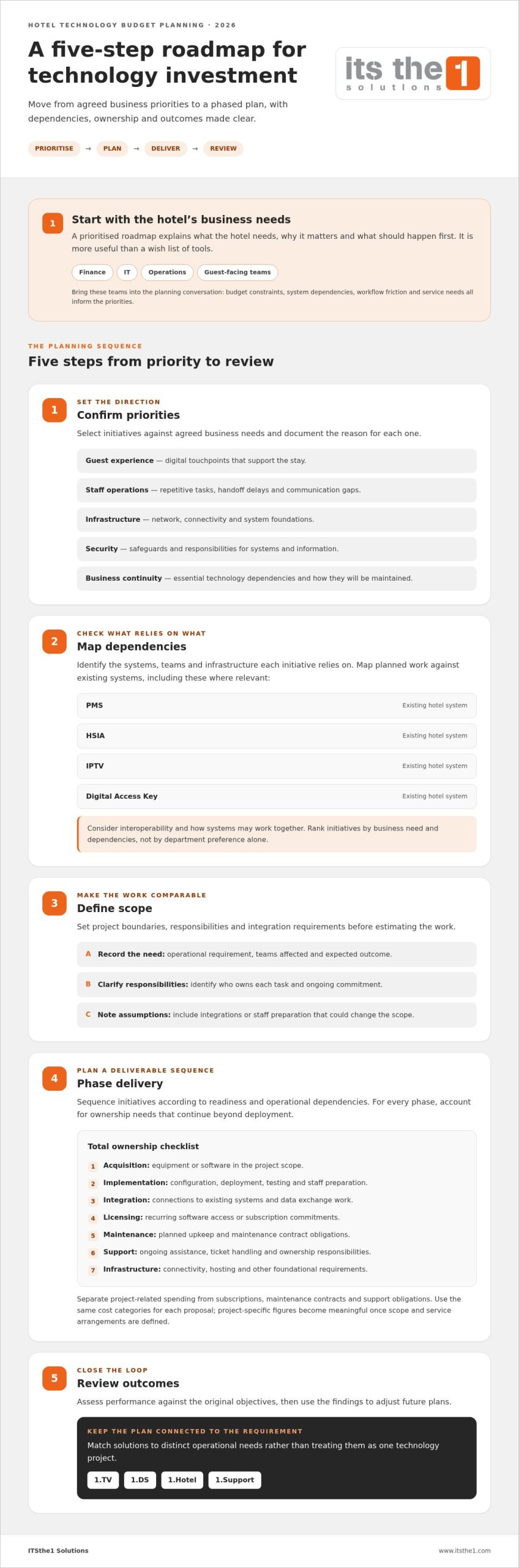
Turn the 2026 Hotel Technology Budget into a Phased Roadmap
Turn priorities and ownership requirements into a delivery sequence. For hotel technology budget planning 2026, a phased roadmap helps teams see what must be ready before a project begins, who is responsible and how ongoing support will fit after implementation.
- Confirm priorities: Select initiatives against agreed business needs and document the reason for each one.
- Map dependencies: Identify the systems, teams and infrastructure each initiative relies on.
- Define scope: Set project boundaries, responsibilities and integration requirements before estimating the work.
- Phase delivery: Sequence initiatives according to readiness and operational dependencies.
- Review outcomes: Assess performance against the original objectives and use the findings to adjust future plans.
For each phase, account for Total cost of ownership, including implementation, training and support considerations. This connects project decisions with the commitments that continue beyond deployment.
How should hotels sequence integrations, implementation, and ongoing support?
Map planned work against existing systems, including PMS, HSIA, IPTV and Digital Access Key where relevant. For example, a guest-facing project that relies on information or services from another system needs its connections and responsibilities defined before implementation begins. Put integration design and testing into the project scope, then assign owners for ongoing support. Phasing makes these dependencies visible earlier and helps teams coordinate delivery with hotel operations.
Match solutions to distinct requirements: 1.TV supports hospitality IPTV, 1.DS supports digital signage, 1.Hotel provides guest and staff apps, and 1.Support is a helpdesk ticketing system. If signage is part of the roadmap, explore this hotel digital signage software guide.
ITSthe1 provides consultancy, turnkey implementation, maintenance contracts and ongoing support for hospitality technology projects. Learn more about ITSthe1’s hospitality technology solutions.
Put Your 2026 Hotel Technology Roadmap into Action
Effective hotel technology budget planning 2026 starts with business priorities, not a list of requested tools. Align stakeholder needs, account for ownership requirements beyond acquisition and phase implementation around dependencies, integration and ongoing support.
A clear roadmap helps teams understand what to fund, why it matters and how each initiative fits the hotel’s wider operating environment. With more than 20 years of expertise in IPTV and related hospitality technologies, ITSthe1 provides consultancy, turnkey implementation, maintenance contracts and ongoing support for hotel technology projects.
Ready to shape your next technology investment? Discuss your hotel technology priorities with ITSthe1 and take the next step towards a considered, connected plan.
Frequently Asked Questions
What should a hotel technology budget include in 2026?
A 2026 hotel technology budget should include acquisition and deployment costs, integration work, licensing, infrastructure, maintenance, support and security requirements. Include staff preparation and business continuity needs where relevant. In hotel technology budget planning 2026, assess each proposal against guest experience, staff workflows and operational priorities. Record its scope, dependencies, accountable owner and review point to capture commitments across the full lifecycle.
How can hotels prioritise technology investments when budgets are limited?
Prioritise initiatives by their connection to agreed business needs, operational importance and readiness to proceed. Gather input from finance, IT, operations and guest-facing teams, then identify dependencies that could delay or complicate a project. Compare proposals by expected contribution, scope and required effort. Phase delivery so foundational work comes before dependent systems, and keep lower-priority requests visible for future review.
What is the difference between technology implementation costs and ongoing costs?
Implementation costs relate to setting up a project, such as configuration, deployment, testing, integration and staff preparation. Ongoing costs are commitments that continue after launch, including software licensing, maintenance contracts, infrastructure and support. Separate these categories in the budget, and document who owns each responsibility and when it will be reviewed. Project-specific figures depend on a clearly defined scope and service arrangements.
How can hotels plan technology integrations with existing systems?
Begin by documenting the systems a project may need to connect with, such as the PMS, HSIA, IPTV or Digital Access Key. Map the required workflows, dependencies, responsible teams and integration sequence before setting the delivery phase. Include testing and ongoing support arrangements in the plan. This gives stakeholders a clearer view of scope and helps coordinate implementation with hotel operations.