What if a service that makes a stay more convenient also creates another route for guest information to travel? A practical approach to guest data protection for hotels starts with understanding what each system collects, why it needs that information, and who can access it. Booking, payment, identity, Wi-Fi and in-room entertainment systems may handle different types of data. Integrations can extend access beyond the system where information was first collected.
This guide explains how to map guest data flows, reduce unnecessary collection, and set clear controls for access, retention and vendor relationships. It also looks at how privacy-aware technology can support convenience and trust. For example, 1.Cast is a Chromecast-based Bring Your Own Content solution. No guest data or credentials are stored or logged on the TV system. The same principle informs the practical steps ahead: consider privacy as part of the guest experience from the outset.
Key Takeaways
- Guest data protection for hotels begins with tracing what information each guest journey collects and where it moves.
- Limit access according to staff roles, use strong authentication, and remove permissions when they’re no longer needed.
- Set clear retention and deletion processes that reflect the purpose of the data and applicable obligations.
- Assess guest-facing technology by its data collection, purpose, access, retention, and system boundaries to balance privacy with convenience.
Guest Data Protection for Hotels Starts with Knowing What Information Flows
Guest data protection for hotels covers the policies and controls that govern information from collection through use, sharing, storage and deletion. Start by tracing the guest journey: booking, check-in, payment, service requests and digital interactions. For each stage, record what information is collected, which system collects it, why it is needed, who can access it, and where it goes next. For example, a reservation platform may pass booking details to the property management system (PMS), while payment information is handled through a payment processor.
Include integrations in the map, not just the systems guests interact with directly. Note the information shared at each connection, the team or vendor with access, and the purpose of that access. This makes it easier to spot duplicate collection, information sent to systems that do not need it, and access that has continued after its original purpose ended. Mapping also helps teams understand which privacy rules may apply. The General Data Protection Regulation (GDPR) is one reference point for understanding data protection principles and individual rights; hotels should assess obligations against their circumstances.
Which guest data does a hotel need to map?
Build the inventory by category, then connect each item to the systems that handle it and the teams responsible for it:
- Identity and contact: names, passport details, email addresses and phone numbers, collected through booking channels, at the front desk or by identity-scanning tools. See this guide to mobile passport scanning for hotels.
- Booking and payment: stay dates, room details and transaction records, handled by reservations, the PMS, finance and payment systems.
- Preferences and service requests: room preferences, accessibility needs or requests for assistance, recorded through guest-service channels and shared with relevant teams, such as housekeeping or food service.
For every item, distinguish information required to deliver a booked service from optional data used for personalisation, marketing or entertainment. Record the purpose and access path for each. This helps teams identify information they do not need to collect or share, without losing sight of the service the guest expects.
Practical Hotel Guest Data Protection Controls for Daily Operations
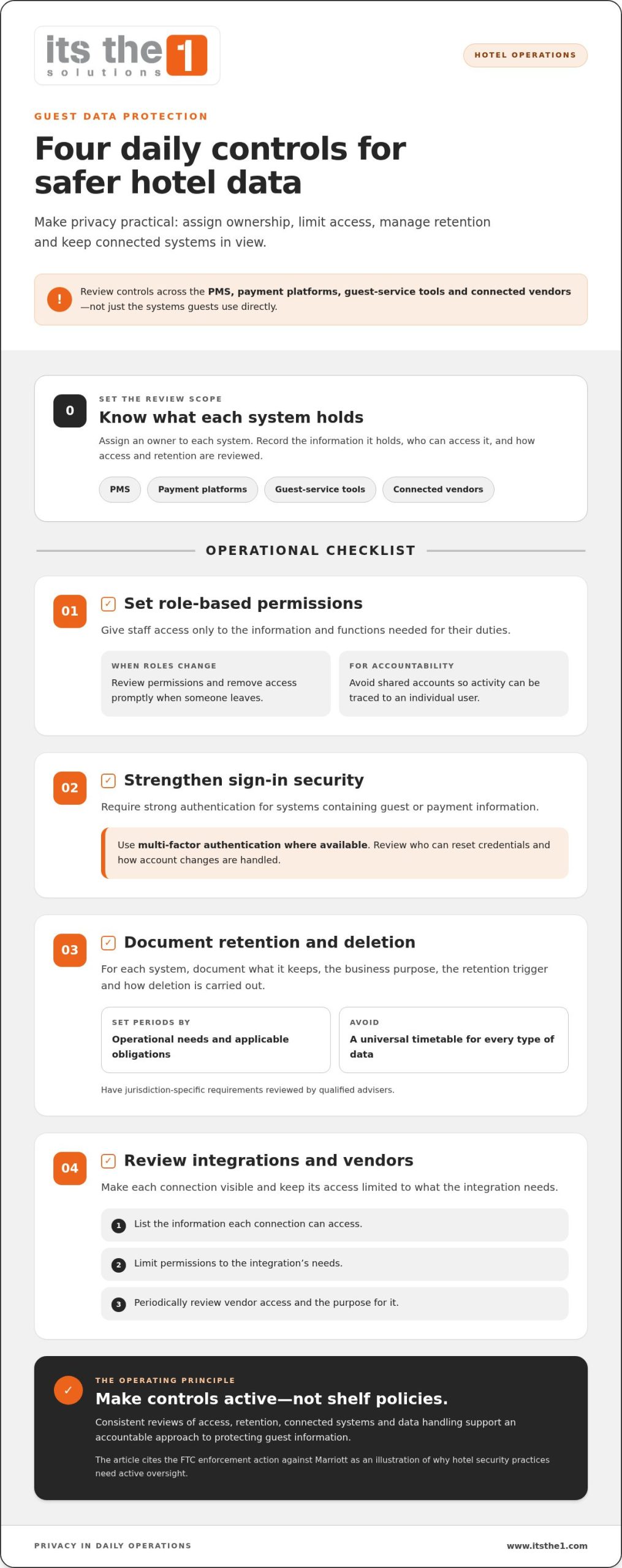
Effective guest data protection for hotels depends on controls staff can apply consistently, not policies that sit unused. Begin with a review of access and retention across the PMS, payment platforms, guest-service tools and connected vendors. Assign an owner to each system and record what information it holds, who has access, and how access and retention are reviewed.
How can hotels reduce unnecessary access and data retention?
Use this checklist to make the review part of routine operations:
- Set role-based permissions: Give staff access only to the information and functions needed for their duties. Review permissions when responsibilities change, and remove access promptly when someone leaves. Avoid shared accounts so activity can be traced to an individual user.
- Strengthen sign-in security: Require strong authentication, such as multi-factor authentication where available, for systems containing guest or payment information. Review who can reset credentials and how account changes are handled.
- Document retention and deletion: For each system, record what it keeps, the business purpose, the retention trigger, and how deletion is carried out. Set periods according to operational needs and applicable obligations, not a universal timetable. Have jurisdiction-specific requirements reviewed by qualified advisers.
- Review integrations and vendors: List the information each connection can access, limit permissions to what the integration needs, and periodically review vendor access. The enterprise cybersecurity guidance offers wider context for managing connected systems.
These controls support an accountable operating model. The FTC enforcement action against Marriott illustrates why hotel security practices need active oversight, including attention to systems and data handling. Hotels can also include hospitality technology and cybersecurity solutions in a considered approach to protecting guest information.
Privacy-Aware Hotel Technology: Protect Guest Trust Without Losing Convenience
Guest-facing technology should make a stay easier without collecting more information than its purpose requires. To support guest data protection for hotels, assess each tool before deployment. Identify what data it collects, why it needs it, who can access it, how long it is retained, and which systems it can reach. Ask the team responsible for the system to explain its data flows and access requirements. This makes it easier to identify unnecessary collection or access before a new service becomes part of the guest journey.
What should hotels ask when evaluating guest-facing technology?
- What information is collected? Separate details needed to provide the service from optional data used for personalisation or entertainment.
- Where does it go? Map connections to hotel systems and vendors, and clarify which party can access the information.
- What happens after use? Establish how long information remains and how it is removed when no longer needed.
- What are the system boundaries? Identify which systems communicate and what data passes between them. Do not assume information stays within the guest-facing tool.
For in-room entertainment, 1.Cast offers a specific Bring Your Own Content (BYOC) example. It is a Chromecast-based solution, and no guest data or credentials are stored or logged on the TV system. This statement applies to the TV system; it should not be taken as a description of how other technologies or connected services handle data. For broader integration considerations, see the hotel PMS and IPTV integration guide.
Privacy and convenience can be designed together. ITSthe1 Solutions provides hospitality technology solutions that can form part of a connected guest experience shaped around the hotel’s systems and needs.
Make Privacy Part of Every Guest Experience
Strong guest data protection for hotels begins with visibility: understand what information each system collects, where it moves, and who can access it. Clear permissions, thoughtful retention and deletion practices, and regular reviews of integrations help reduce avoidable exposure. Privacy-aware technology can also support convenient service when its data practices and system boundaries are clear.
For example, 1.Cast is a Chromecast-based Bring Your Own Content solution. No guest data or credentials are stored or logged on the TV system. This specific safeguard shows how technology design can address privacy alongside guest convenience, while keeping the claim within the boundaries of the TV system.
Build trust through deliberate choices across both operations and guest-facing systems. Explore hospitality technology solutions from ITSthe1 Solutions to consider connected experiences that align with your hotel’s needs. With a clear view of data flows and practical controls in place, your team can make informed decisions and serve guests with confidence.
Frequently Asked Questions
What guest data do hotels typically collect?
Hotels may collect different information at each stage of a stay. Booking can involve guest names, contact details and reservation preferences; check-in may involve identity information; payments generate transaction data; and service requests or digital guest experiences may capture preferences and requests. The systems and purposes vary by property, so map your own data flows rather than assuming every hotel collects the same information.
How can hotels protect guest data across multiple systems?
Start by mapping the systems that collect, store or transfer guest information, including integrations and vendor connections. Limit access by staff role, remove permissions when responsibilities change, document retention and deletion processes, and train relevant teams to handle information appropriately. These are practical risk-reduction controls, not a guarantee of compliance. For jurisdiction-specific legal questions, seek advice from a qualified adviser.
Can hotel guest-room technology protect privacy while providing entertainment?
Yes, if the specific technology is designed and assessed with privacy in mind. Review what data a solution collects, where it travels, who can access it and whether it remains on the room’s TV system. For example, 1.Cast is a Chromecast-based Bring Your Own Content solution. No guest data or credentials are stored or logged on the TV system.
How long should hotels keep guest data?
There is no single retention period that suits every type of hotel data. The appropriate timeframe depends on the information, its purpose, operational requirements and applicable obligations. Document what each system retains, why it is needed, when retention ends and how deletion is handled. Hotels should obtain qualified advice on requirements that apply in their jurisdictions rather than rely on a universal schedule.