What if the quickest route to better hotel service is not asking staff to do more, but removing the friction that slows them down? Repeated manual tasks, unclear ownership and inconsistent information between departments can make routine work harder than it needs to be. Improving staff efficiency in hotels starts with identifying where those delays occur and clarifying how daily tasks should flow.
Technology can help when it supports a defined process rather than adding another layer of complexity. This guide explains how to spot operational bottlenecks, improve coordination across teams and make everyday workflows more consistent while keeping guest service central. It also looks at digital tools for hospitality, including 1.Hotel, a guest and staff app; 1.AI, an AI helper for hospitality staff; and 1.Support, a helpdesk ticketing app. The aim is practical: simplify work where possible and give staff more room to focus on guests.
Key Takeaways
- Map the guest journey to find repeated data entry, unclear handoffs and avoidable follow-up that can slow daily work.
- Improve one workflow at a time: involve the staff who do the work, clarify ownership, test a change and review the result.
- Use existing operational observations as a baseline so the team can assess changes without relying on arbitrary targets or generic benchmarks.
- Match digital tools to defined needs: 1.Hotel is a guest and staff app, 1.AI is an AI helper for hospitality staff, and 1.Support is a helpdesk ticketing app.
Improving Staff Efficiency in Hotels Starts with Finding Workflow Friction
Improving staff efficiency in hotels means helping employees complete necessary work clearly and consistently while preserving attentive guest service. The goal is not simply to increase the pace of each task. It is to make responsibilities, information and next steps clear, so staff can respond without unnecessary repetition or confusion.
Start by mapping a typical guest journey, from booking and arrival through the stay and departure. At each stage, record what triggers a task, who owns it, what information they need, who receives the handoff and how completion is communicated. Note where information is entered more than once, a message depends on someone remembering to pass it on, or an employee has to follow up just to learn whether a task is complete. These details reveal friction across the workflow, not just isolated delays.
Hotel operations involve connected roles and responsibilities, as outlined in this overview of hotel operations management. A workflow problem may stem from unclear process design, inconsistent communication, gaps in training or tools that do not support the way work is organised. Identifying the cause helps managers avoid treating every delay as a question of staff effort alone.
Which hotel tasks create the most avoidable friction?
Review front-desk coordination, room-status updates, guest requests and communication between departments. For example, if reception cannot readily see whether a room is ready, staff may need to make repeated calls or give a guest an uncertain update. If a request moves between teams without a clear owner, follow-up can be missed or duplicated.
For each example, trace the information from the person who first receives it to the person responsible for acting on it. Check whether the request includes enough detail, where its status is recorded and how the next team knows it is their turn. Clear workflows help staff understand who owns each task, what information to share and when to update colleagues. Employees can then act on shared expectations instead of relying on guesswork.
How to Improve Hotel Staff Efficiency Without Adding Unnecessary Complexity
Once a friction point is visible, improve it through a controlled cycle rather than changing several procedures at once. This makes it easier to see what helped and where further adjustment is needed. A practical sequence for improving staff efficiency in hotels is:
- Select one workflow where information is repeated, a handoff is unclear or follow-up is frequently needed.
- Consult the staff involved and ask which steps cause delays, missing information or uncertainty.
- Clarify ownership by defining who acts, what information they need and when the next person takes over.
- Test one change on a manageable scale before extending it to other workflows.
- Review what happened with the team and decide whether to keep, adjust or stop the change.
Before testing, establish a baseline using observations the hotel already records. Depending on the workflow, note how often staff follow up, where handoffs are delayed or which steps are repeated. Use the same kind of information before and after the change, and compare like with like. Avoid imposing an arbitrary target or assuming one benchmark suits every property.
How can managers test a workflow improvement?
Choose a recurring task, such as passing a guest request from reception to another department, and write down its current steps. Ask the employees involved where information goes missing or the process becomes unclear. For example, check whether the request has a named owner, includes the details needed to act and has a clear way to communicate its status. Explain that staff feedback will shape the test and review, not serve as an assessment of individual effort. Then trial one defined adjustment and revisit the same observations.
Adding software alone will not resolve unclear ownership or inconsistent steps. Define the process first, then assess whether a digital tool fits the specific need. For a related check-in workflow, see mobile passport scanning for hotels. You can also explore hospitality technology solutions as part of a process-led review.
Where Hotel Technology Can Support More Efficient Staff Workflows
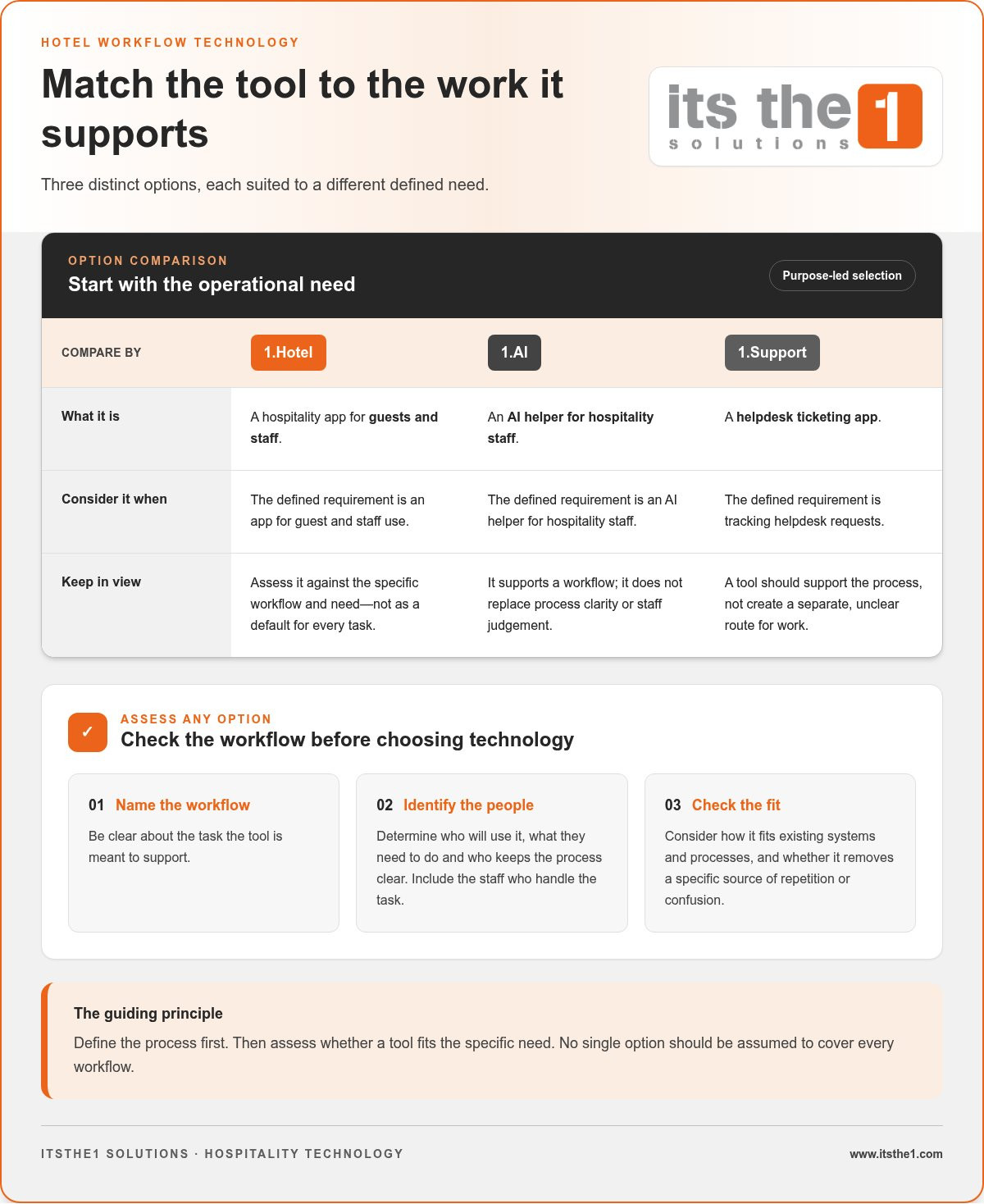
Technology is most useful when it addresses a specific, documented need. If staff need an app for guest and staff use, consider whether 1.Hotel fits that requirement. If the need is an AI helper for hospitality staff, assess 1.AI. For tracking helpdesk requests, 1.Support is a helpdesk ticketing app. Start with the task and the people responsible for it, then consider whether the tool fits the process. The aim is to support the workflow, not create a separate, unclear route for completing work.
ITSthe1 Solutions hospitality options include 1.Hotel, a hospitality app for guests and staff; 1.AI, an AI helper for hospitality staff; and 1.Support, a helpdesk ticketing app. Each has a distinct purpose. Assess the relevant option against the need at hand rather than assuming one tool covers every workflow.
How should hotels assess technology for staff efficiency?
Before adopting a tool, name the workflow it is meant to support. Identify who will use it, what task they need to complete and who is responsible for keeping the process clear. Include the staff who handle the task in the assessment. Consider how the proposed tool fits alongside the systems and processes already in use, and whether it removes a specific source of repetition or confusion. For a discussion of guest and staff apps, read the guide to hotel guest engagement app.
Technology supports a workflow; it does not replace process clarity or staff judgement. Employees still need clear responsibilities and the discretion to respond appropriately to guests. Keeping that distinction in view is central to improving staff efficiency in hotels without making daily work harder to follow.
For a closer look at technology options for hospitality operations, explore hospitality technology solutions as part of your workflow review.
Build More Consistent Hotel Workflows
Improving staff efficiency in hotels begins with finding where everyday work creates avoidable friction, then refining one workflow at a time. Clear ownership, staff input and a review based on existing operational observations help managers make practical changes without adding unnecessary complexity. The aim is not simply to move faster, but to give employees clear processes that support attentive guest service.
Technology can support that work when it matches a defined need. 1.Hotel is a guest and staff app, 1.AI is an AI helper for hospitality staff, and 1.Support is a helpdesk ticketing app. Each serves a distinct purpose within a clearly defined workflow. Explore ITSthe1 hospitality technology solutions to learn more. Start with one process, listen to the team and build on what works. Steady, thoughtful improvements can help create a more coordinated day for staff and guests.
Frequently Asked Questions
How can hotels improve staff efficiency without reducing guest service?
Hotels can protect guest service by improving specific workflows rather than simply asking employees to work faster. Identify repeated steps or unclear handoffs, consult the staff who perform the tasks and test a focused adjustment. Review the process with the team afterward. The aim of improving staff efficiency in hotels is to make service more consistent while preserving the personal attention guests expect, not to reduce human interaction.
Can technology improve staff efficiency in hotels?
Digital tools can support staff efficiency when they fit a defined task and the way employees work. 1.Hotel is a hospitality app for guests and staff, 1.AI is an AI helper for hospitality staff, and 1.Support is a helpdesk ticketing app. Assess each against a specific operational need. First clarify the process and staff responsibilities; technology should support that workflow, not stand in for it.
What hotel processes should managers review first to improve efficiency?
Start with recurring tasks and handoffs that directly shape guest service. Examine front-desk coordination, room-status updates and the handling of guest requests. Ask the employees involved which steps require repeated information, extra follow-up or unclear responsibility. Their observations can help identify a practical workflow to review, without assuming every hotel has the same bottlenecks or relying on generic efficiency benchmarks.
How can hotel managers tell whether a staff efficiency change is working?
Define the workflow, note relevant existing observations before the test and review the same process afterward with the staff involved. Depending on the task, observations might include repeated follow-ups or unclear handoffs. Compare like with like and consider other factors that may have affected the process. The review can guide whether to keep, adjust or stop the change without treating limited evidence as proof of causation.