Is your hotel’s guest experience being held hostage by a room full of overheating servers and tangled cables? Many operators find that maintaining traditional on-site headend hardware is a primary source of technical friction and escalating costs. You likely already recognize that clunky, slow interfaces frustrate guests who expect a seamless, personalized streaming experience. Transitioning to a cloud based hotel IPTV architecture represents a fundamental shift from treating television as a hardware appliance to viewing it as a modular, scalable software service.
This definitive reference explores how decentralizing your entertainment system maximizes operational agility and ensures long-term reliability. We’ll demonstrate how solutions like 1.TV eliminate the risk of on-site hardware failures while providing centralized management for your entire portfolio. You’ll learn how to leverage a cohesive digital ecosystem to provide the “at-home” feel guests crave. By the end of this article, you’ll understand why modern hospitality leaders are moving toward cloud-driven models to simplify their infrastructure and focus on guest satisfaction. We’ll outline the strategic steps to transition from legacy systems to a future-proof digital environment that scales effortlessly.
Key Takeaways
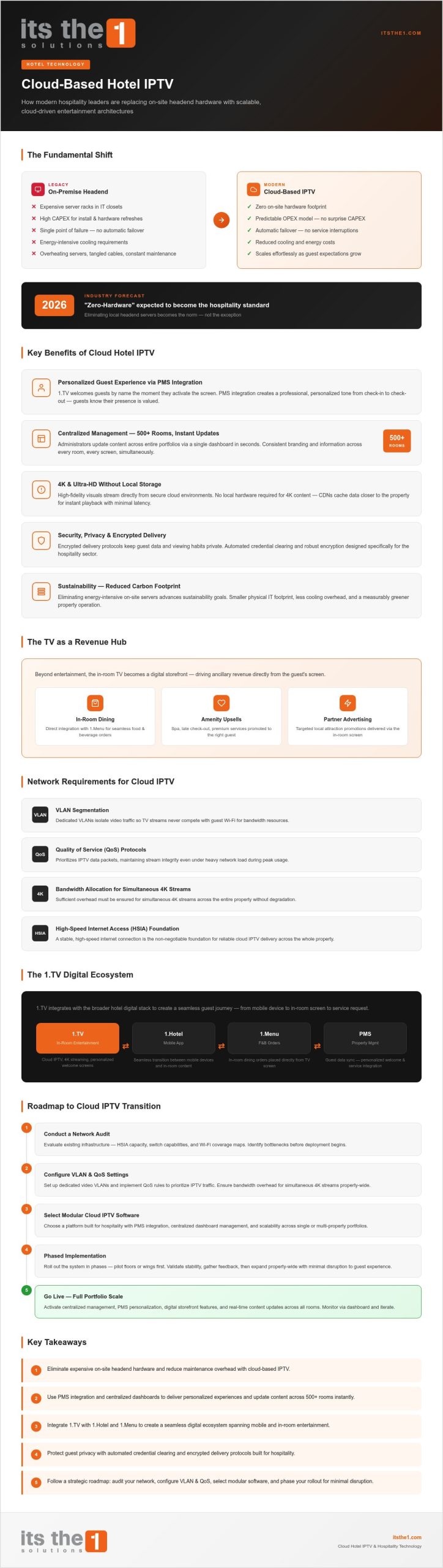
- Transitioning to a cloud based hotel IPTV architecture eliminates the need for expensive on-site headend hardware, significantly reducing maintenance overhead.
- Leverage PMS integration and centralized dashboards to deliver personalized guest experiences and update content across hundreds of rooms instantaneously.
- Discover how integrating 1.TV with the broader digital ecosystem, including 1.Hotel, creates a seamless transition between mobile devices and in-room entertainment.
- Ensure guest data privacy and stream security through automated credential clearing and robust encryption protocols designed specifically for the hospitality sector.
- Follow a strategic roadmap for digital transformation by conducting a network audit and selecting modular software for a phased implementation.
Understanding Cloud Based Hotel IPTV Architecture
A cloud based hotel IPTV system delivers television and multimedia content via the internet protocol suite through a decentralized, cloud-managed network. This architecture represents a significant departure from traditional setups that rely on physical racks of servers located in on-site IT closets. By moving the processing power and content storage to the cloud, hotels can provide a sophisticated entertainment experience without the burden of maintaining complex local hardware. This shift allows for more agile deployments and ensures that the system stays current with evolving digital standards.
The industry is moving rapidly toward a “Zero-Hardware” footprint, which is expected to become the hospitality standard by 2026. This model eliminates the need for local headend servers, reducing the physical space required for IT infrastructure and lowering cooling costs. Modern solutions like 1.TV leverage this architecture to support 4K and Ultra-HD content without requiring local storage. The system streams high-fidelity visuals directly from secure cloud environments, ensuring that guests enjoy a premium viewing experience that matches or exceeds what they have at home.
Cloud vs. On-Premise Headends
Traditional on-premise headends involve substantial capital expenditure (CAPEX) for initial installation and periodic hardware refreshes. Transitioning to a cloud model shifts these costs to an operational expenditure (OPEX) framework, providing greater financial predictability for ownership. Reliability is significantly improved through cloud redundancy. If a server node encounters an issue, failover mechanisms ensure that guest services remain uninterrupted. Content Delivery Networks (CDNs) further enhance this by caching data closer to the property, which minimizes latency and ensures that playback starts instantly when a guest selects a program.
Network Requirements for Cloud IPTV
A successful deployment requires a stable foundation built on High-Speed Internet Access (HSIA). Since the content is delivered via the cloud, the internal network must be optimized to handle high-bandwidth video traffic alongside standard guest and staff operations. Proper configuration is essential to prevent bottlenecks during peak usage times. Key technical considerations include:
- VLAN Segmentation: Dedicated VLANs should be established to isolate video traffic, ensuring that TV streams don’t compete with guest Wi-Fi for resources.
- Quality of Service (QoS): Implementing QoS protocols prioritizes IPTV data packets, maintaining stream integrity even when the network is under heavy load.
- Bandwidth Allocation: IT managers must ensure sufficient overhead to support simultaneous 4K streams across the entire property.
By focusing on these network essentials, hotels can ensure that 1.TV operates as a reliable component of their digital ecosystem. This structured approach to architecture allows properties to scale their entertainment offerings effortlessly as guest expectations continue to grow.
Key Benefits of Modern Hospitality IPTV Systems
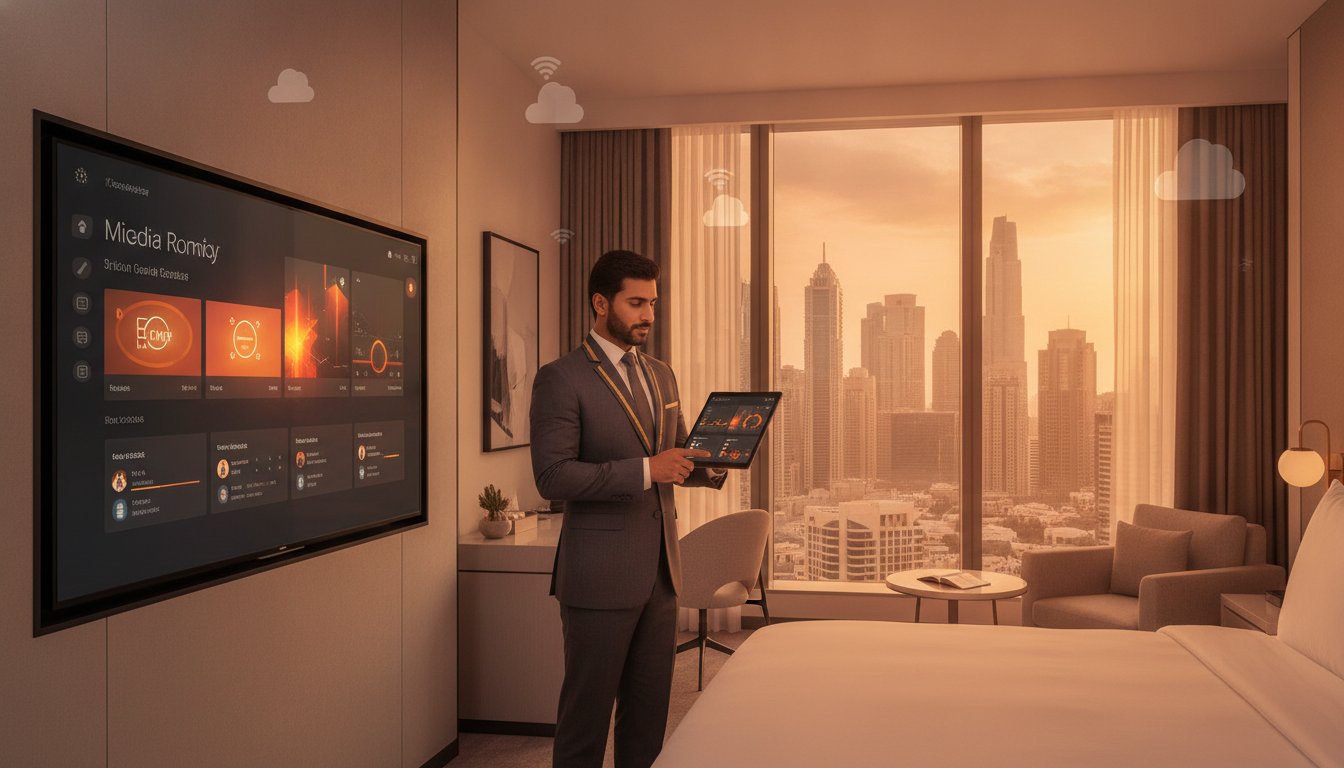
Deploying a cloud based hotel IPTV solution offers more than just a visual upgrade. It transforms the television into a central intelligence hub for the guest room. Through seamless Property Management System (PMS) integration, 1.TV welcomes guests by name the moment they activate the screen. This level of personalization sets a professional tone for the stay. It signals to the guest that their presence is valued and their experience is being managed with precision.
Operational control becomes centralized. Administrators can update content across 500+ rooms in seconds via a single dashboard, ensuring consistent branding and information. Beyond entertainment, the system acts as a digital storefront. Key revenue opportunities include:
- Direct integration with 1.Menu for in-room dining orders.
- Promotion of on-site amenities like spa services or late check-out options.
- Targeted advertising for local partner attractions.
By eliminating energy-intensive on-site servers, hotels also advance their sustainability goals. This reduces both the physical footprint in the IT closet and the overall carbon footprint of the property. Security remains a critical component of this digital evolution. Unlike legacy systems that often overlook data protection within the stream, modern cloud architectures prioritize cybersecurity. Encrypted delivery protocols ensure that guest data and viewing habits remain private. This focus on secure digital transformation is a hallmark of a reliable technology partner with over 25 years of experience.
Enhancing the Guest Experience
Modern travelers require interfaces that reflect their global lifestyle. 1.TV provides multilingual support to cater to diverse demographics. It also facilitates “Bring Your Own Content” (BYOC) capabilities, allowing guests to securely pair their personal streaming accounts with the in-room display. Real-time weather updates and flight information are integrated directly into the dashboard. Guests receive essential data without needing to consult a separate device, creating a smoother, more intuitive stay.
Operational ROI for Hotel Owners
The transition to cloud-managed systems significantly reduces the frequency of in-room hardware maintenance. Because the system is software-defined, updates and patches are deployed remotely. Staff workflows are further optimized as guests use the TV to submit automated service requests. This reduces the burden on front-desk personnel and ensures faster response times. Over time, the ability to scale and update the system without physical hardware overhauls results in substantial cost savings and long-term asset protection. For properties operating across the UAE and wider region, understanding how leading hospitality IPTV providers in the Middle East approach scalability and compliance is essential to making a sound long-term investment.
Integrating 1.TV with the Hotel Digital Ecosystem
Modern hospitality requires more than isolated software. It demands a cohesive digital ecosystem where every component communicates effectively. 1.TV functions as the primary interaction point within the guest room, bridging the gap between entertainment and operational services. A cloud based hotel IPTV system isn’t just a content delivery tool; it’s the interface for the entire hotel experience. By centralizing guest interaction, properties can deliver a sophisticated, “at-home” streaming environment that scales across global portfolios without the need for redundant local infrastructure.
When paired with 1.Hotel, guests experience a seamless transition from their mobile devices to the in-room screen. They can cast content or browse hotel services on the large display with ease. Integrating 1.Menu allows guests to browse high-definition images of culinary offerings and place orders directly through the television interface. This reduces friction and increases capture rates for in-room dining. For real-time assistance, 1.AI serves as a digital helper, answering guest queries via the IPTV portal. This ensures that guest needs are met instantly, reflecting the commitment to excellence expected from a brand with over 25 years of industry experience.
The Power of Modular Integration
1.TV extends its utility through modular connections that serve overarching business goals. By linking with 1.DSMM, properties maintain consistent branding across guest rooms and public area signage. This creates a unified visual identity that reinforces brand trust. Synchronizing guest data with 1.CRM enables the system to display targeted promotions based on individual preferences and past behaviors. When it’s time to depart, the check-out process is streamlined via 1.TV in conjunction with 1.Hotel. Guests can review their folio and confirm their departure from the comfort of their room, reducing congestion at the front desk.
Unified Management Dashboards
Managing a multi-national property portfolio requires centralized oversight and meticulous control. Our platform provides a single-pane-of-glass view for IT managers, allowing them to monitor various modules from one location. This centralized approach is critical for maintaining operational excellence. Real-time analytics track guest engagement and content preferences, providing data-driven insights for strategic growth. Remote troubleshooting capabilities mean technicians can resolve IPTV issues without entering the guest room. This maintains guest privacy and significantly reduces operational downtime. This disciplined approach to management ensures that your digital infrastructure remains a reliable asset rather than a maintenance burden.
Security and Compliance in Cloud IPTV Delivery
Security is not merely a technical requirement; it is the foundation of guest trust in a digital environment. As properties transition to a cloud based hotel IPTV architecture, protecting both the content and the user becomes a primary operational priority. 1.TV utilizes sophisticated encryption and Digital Rights Management (DRM) to secure every stream. These protocols prevent unauthorized access and ensure that the property remains compliant with the strict requirements of international content providers. By moving these security layers to the cloud, hotels benefit from real-time updates that address emerging threats without the need for manual hardware intervention.
Content protection relies on robust delivery standards. Our systems employ advanced encryption to safeguard high-definition streams from the cloud to the in-room display. This approach prevents content piracy and maintains the integrity of the viewing experience. It also ensures that the property meets the legal obligations set by production studios and broadcasters. This disciplined focus on asset protection is a core component of our role as a trusted advisor in the hospitality sector.
Network segmentation remains a vital strategy for risk mitigation. We advise keeping the IPTV VLAN strictly isolated from the corporate management network and the guest Wi-Fi. This separation prevents lateral movement by potential intruders, ensuring that a vulnerability in one segment doesn’t compromise the entire property’s infrastructure. By maintaining dedicated pathways for video traffic, hotels also ensure that stream quality remains high even during periods of heavy guest internet usage.
Cybersecurity Best Practices for IPTV
Maintaining a secure ecosystem requires proactive management and regular oversight. Firmware updates for Smart TVs and set-top boxes must be deployed consistently to patch known vulnerabilities. 1.TV facilitates this through its centralized management portal, allowing IT staff to push updates across the entire property simultaneously. Secure API connections are also essential when integrating the IPTV cloud with the Property Management System (PMS). We implement encrypted handshakes to ensure that guest data remains protected as it moves between different software modules.
Guest Data Sovereignty
Guests expect their viewing habits and personal information to be handled with strict confidentiality. Our architecture ensures that all interactions are processed within a secure framework that aligns with international data protection standards like GDPR. When guests use the TV to access personal streaming accounts, their credentials must be handled with care. Automated session clearing is the most critical factor in maintaining guest trust in a digital environment. 1.TV integrates with 1.Hotel to trigger an automatic wipe of all third-party logins and browsing history the moment a guest checks out. For properties seeking to fortify their digital defenses, our Cyber Security solutions provide a comprehensive framework for long-term risk management.
The Roadmap to Transitioning to Cloud IPTV
Successful migration to a cloud based hotel IPTV architecture follows a disciplined sequence of evaluation and execution. It’s a journey that moves from high-level strategic planning to granular operational adjustments. By adhering to a structured framework, properties can avoid common pitfalls and ensure their digital infrastructure serves as a reliable asset from day one. This process demands a partner with historical longevity and a commitment to meticulous research. A well-mapped transition minimizes guest disruption while maximizing the long-term efficacy of the solution.
Phase 1: Infrastructure Assessment
Before any software is deployed, a comprehensive audit of the property’s network foundation is mandatory. IT teams must test current bandwidth capacity to ensure it can handle the demands of peak-hour 4K streaming. A single high-definition stream requires consistent throughput; scaling this across hundreds of rooms requires precise calculation. We also evaluate the compatibility of existing in-room hardware with our cloud software. In many cases, modern Smart TVs can host 1.TV natively, while older displays might require modular set-top boxes. Identifying potential network bottlenecks, such as aging switches or insufficient VLAN segmentation, allows for remediation before the rollout begins.
Phase 2: Modular Rollout and Testing
A phased implementation is often the most prudent path for large-scale properties. We recommend implementing 1.TV in a pilot group of rooms to gather real-world performance data. During this phase, we finalize the integration with the Property Management System (PMS) to ensure data flows correctly to the cloud portal. This is also the time to refine the user interface. We tailor the custom branding and UI/UX design to reflect the hotel’s specific identity, ensuring a consistent aesthetic across all digital touchpoints. This disciplined testing phase serves as a stylistic hallmark of our commitment to quality and performance.
The final stage of the transition focuses on human capital and continuous improvement. Staff training is essential; both the concierge and IT teams must be proficient in managing the new platform via the centralized dashboard. They need to understand how to monitor system health and update guest-facing content instantly. After the full launch, the focus shifts to post-launch optimization. We use guest engagement analytics and direct feedback to refine the interactive interface and content offerings. This iterative approach ensures that the entertainment system remains aligned with evolving guest expectations and continues to drive operational efficiency. By following this roadmap, hotels can confidently navigate the complexities of digital evolution and achieve long-term strategic growth.
Future-Proofing Your Hospitality Digital Strategy
The transition toward a cloud based hotel IPTV model is no longer a luxury; it’s a strategic necessity for properties aiming to maintain a competitive edge. By eliminating hardware bloat and centralizing content management, you empower your staff to focus on guest engagement rather than technical troubleshooting. This architecture ensures your entertainment system remains agile, allowing for seamless updates and the integration of new digital modules as guest expectations evolve. Each phase of this journey, from network assessment to final launch, reinforces the reliability of your digital infrastructure.
As a seasoned global expert, ITSthe1 Solutions provides the authoritative guidance required to navigate this digital evolution. Our industry-leading 1.TV modular solution is designed to integrate effortlessly with your existing ecosystem while prioritizing hospitality cybersecurity at every touchpoint. We offer expert digital transformation consulting to ensure your infrastructure is secure, scalable, and meticulously managed. Discover how 1.TV can modernize your property’s entertainment strategy and provide the personalized experience your guests deserve. We’re ready to serve as your long-term partner in achieving operational excellence.
Frequently Asked Questions
What is the main difference between cloud-based IPTV and traditional IPTV?
The primary difference lies in the distribution architecture and hardware requirements. Traditional systems rely on on-site headend servers to process and distribute signals, whereas a cloud based hotel IPTV system centralizes these functions in a remote data center. This shift eliminates the need for expensive local server racks and cooling infrastructure. By moving to the cloud, hotels transition from a capital-heavy hardware model to a scalable software service that updates automatically.
Does cloud-based hotel IPTV require a high-speed internet connection?
Yes, a robust High-Speed Internet Access (HSIA) connection is the essential backbone for delivering high-quality video content from the cloud. To support 4K and Ultra-HD streaming across hundreds of rooms simultaneously, properties must ensure sufficient bandwidth overhead. We recommend a dedicated VLAN and Quality of Service (QoS) protocols to prioritize video traffic. This prevents guest Wi-Fi usage from compromising the stability or visual fidelity of the 1.TV stream during peak hours.
Is cloud IPTV compatible with existing hotel Smart TVs?
Compatibility depends on the specific model and age of your current displays. Most modern Smart TVs can host the 1.TV application natively without additional hardware. For older or non-smart displays, we utilize modular set-top boxes to bridge the gap. Our infrastructure assessment phase includes a detailed evaluation of your in-room hardware to determine the most cost-effective path. This ensures a seamless rollout that maximizes the utility of your existing technological assets.
How does cloud IPTV help in reducing hotel operational costs?
Operational costs are reduced by shifting from a capital expenditure (CAPEX) model to an operational expenditure (OPEX) framework. By eliminating on-site headend hardware, you remove the costs associated with server maintenance, physical space, and electricity for cooling. Because 1.TV allows for remote troubleshooting and automated software updates, it significantly decreases the frequency of in-room maintenance visits. This allows your engineering and IT teams to focus on higher-priority strategic growth initiatives.
Can guests cast their own content from their phones to a cloud IPTV system?
Yes, our architecture supports “Bring Your Own Content” (BYOC) through secure casting protocols. Guests can pair their mobile devices with 1.TV to stream content from personal accounts directly to the room’s display. This feature meets the growing demand for a personalized, at-home entertainment experience. Because the system is cloud-managed, we ensure that the casting process is both intuitive for the guest and secure for the hotel’s network, maintaining high performance during peak usage.
What happens to the guest’s personal login data after they check out?
Guest privacy is protected through automated session clearing protocols. The moment a guest checks out, 1.TV integrates with the Property Management System to trigger an immediate wipe of all personal credentials, browsing history, and third-party app logins. This automated process is a critical component of our commitment to hospitality cybersecurity. It ensures that no sensitive data remains on the device, maintaining guest trust and complying with international data protection standards consistently.
How does cloud IPTV integrate with the Hotel Property Management System (PMS)?
Integration occurs through secure API connections that allow real-time data exchange between the cloud portal and the PMS. This synergy enables 1.TV to welcome guests by name upon room entry and display their folio for easy review. It also facilitates the automation of guest services, such as processing in-room dining orders placed via 1.Menu. This unified digital ecosystem ensures that guest interactions are personalized and operational workflows remain highly efficient across your entire property portfolio.
Is cloud-based IPTV reliable during internet outages?
While the system is cloud-driven, we implement redundancy and failover mechanisms to maintain service continuity. In the event of an external internet disruption, local caching and Content Delivery Networks (CDNs) can support certain functions. However, a stable HSIA connection remains vital for live streaming. We work with properties to establish secondary backup connections or SD-WAN solutions to ensure that the entertainment system remains a reliable asset even during unforeseen network challenges or peak traffic.