The Middle East and Africa IPTV market is projected to reach a valuation of 36.69 billion AED by the close of 2026. This rapid expansion reflects a fundamental shift in guest expectations across the United Arab Emirates and the wider region. As a hotelier, you’ve likely realized that selecting from the available hospitality IPTV providers Middle East is no longer a simple hardware procurement. It’s a strategic decision to find a partner who can eliminate high latency and navigate the strict data security requirements of regional compliance systems.
It’s a common frustration when streaming services lag or when your TV system fails to integrate seamlessly with your Property Management System. We recognize that operational stability and professional execution are essential to maintaining your brand’s reputation in a competitive market. This guide will demonstrate how to select a partner that transforms your guest room screens into sophisticated, high-revenue digital gateways. We’ll examine the requirements for future-proofed 4K infrastructure and AI-driven personalization that enhances the guest journey while directly increasing your property’s ancillary income.
Key Takeaways
- Understand the necessary transition from legacy SMATV systems to interactive platforms to meet the sophisticated expectations of the UAE luxury hospitality sector.
- Learn how to evaluate hospitality IPTV providers Middle East by prioritizing middleware flexibility and seamless Property Management System (PMS) integration for streamlined operations.
- Identify the strategic differences between hardware-centric distributors and end-to-end integrators to ensure your property secures reliable, long-term local support.
- Explore essential infrastructure requirements, including network segmentation and regional data privacy compliance, to protect guest information and optimize system performance.
- Discover how a modular digital ecosystem transforms standard in-room entertainment into a high-revenue gateway through integrated guest services and AI-driven support.
The Evolving Landscape of Hospitality IPTV in the Middle East
The digital transformation of the Middle Eastern hospitality sector is moving far beyond simple connectivity. For years, properties relied on Satellite Master Antenna Television (SMATV) to deliver a fixed set of linear channels to guest rooms. Today, the industry is rapidly adopting Internet Protocol television (IPTV) as the new standard for guest engagement. This transition isn’t just about better picture quality. It represents a strategic move toward data-driven service delivery that aligns with the region’s vision for technological excellence.
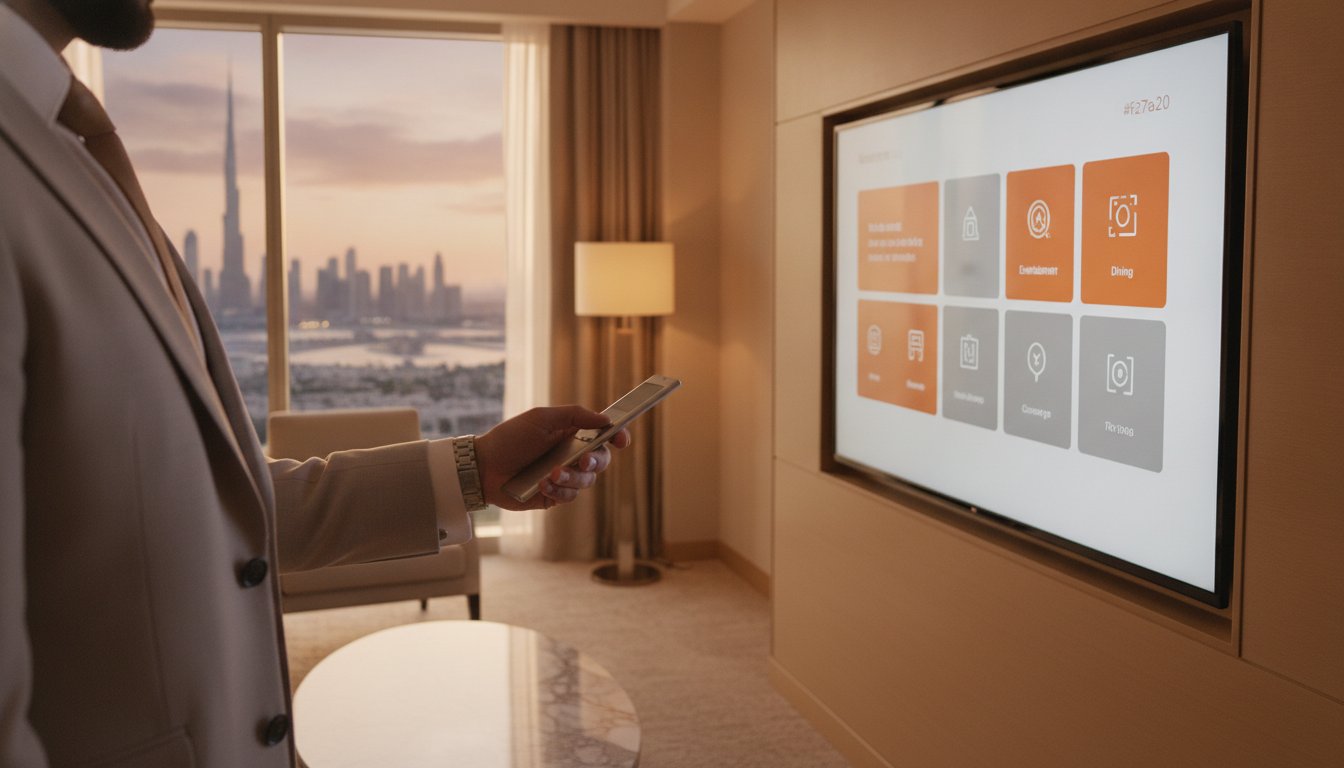
Luxury guests in the United Arab Emirates expect an experience that mirrors their sophisticated home setups. They demand 4K streaming, interactive interfaces, and immediate access to services. Thanks to the expansion of high-speed regional fiber networks, hospitality IPTV providers Middle East can now deliver 8K content and AI-enhanced features with zero latency. The television is no longer a passive device. It has become a “Guest Portal,” acting as the central hub for room service, spa bookings, and local information. Selecting the right hospitality IPTV providers Middle East ensures your property remains competitive as these digital standards evolve.
From Content Distribution to Guest Engagement
Modern IPTV platforms serve as the primary touchpoint for guest-staff communication. A personalized welcome screen that greets a guest in their native language significantly impacts satisfaction scores. In a diverse market like the UAE, offering multilingual interfaces is a necessity, not a luxury. This system allows hotels to integrate local cultural elements directly into the UI, creating a sense of place. Beyond entertainment, the platform facilitates real-time communication, allowing guests to request amenities or provide feedback instantly, which streamlines operations and improves service recovery.
Regional Market Trends for 2026
As we move toward 2026, several key trends are redefining the regional landscape:
- Bring Your Own Content (BYOC): Secure casting solutions allow guests to stream their personal subscriptions directly to the room’s screen without sharing login credentials.
- Cloud-Hosted Middleware: Properties are moving away from heavy on-site hardware in favor of cloud-based systems that offer remote updates and lower maintenance costs.
- Mega-Project Standards: Regional developments are setting new benchmarks for in-room technology, pushing for deeper integration between the TV and smart room controls.
These trends highlight a shift toward modular, scalable systems that can adapt to future technological shifts without requiring a complete infrastructure overhaul. By focusing on these outcomes, hoteliers can transform their entertainment systems into powerful tools for guest retention and operational efficiency.
5 Critical Selection Criteria for IPTV Providers
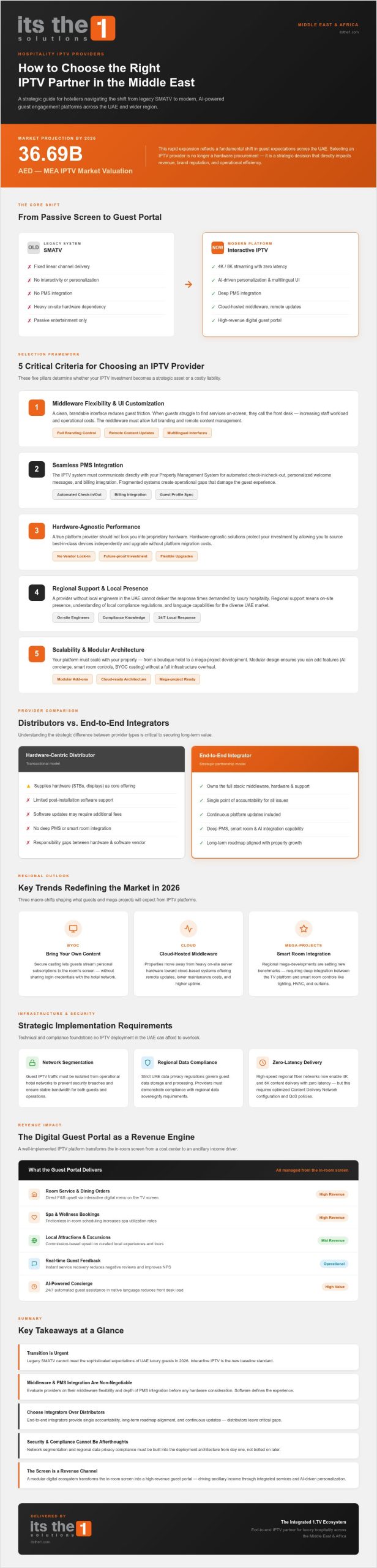
Selecting from the pool of hospitality IPTV providers Middle East requires a shift from viewing guest room entertainment as a simple amenity to seeing it as a strategic asset. Modern properties are increasingly prioritizing integrated ecosystems over standalone hardware. To ensure a high return on investment, your selection process should hinge on five core pillars: middleware flexibility, PMS integration, hardware-agnostic performance, regional support, and scalability. These criteria ensure that your technology stack remains relevant as guest demands evolve.
According to recent hospitality technology market trends, the ability to deliver personalized content is now a primary differentiator in the luxury segment. A provider must offer more than just a list of channels; they must provide a platform that enhances operational excellence. This means choosing a partner who values rigorous research and testing to ensure their software performs reliably under the high-occupancy demands prevalent throughout the Middle East and the wider region.
Evaluating Middleware and User Interface
A clean interface isn’t just about aesthetics; it’s about reducing friction. When guests struggle to find local attractions or order room service through the TV, they revert to calling the front desk. This increases the workload on your staff and raises operational costs. Your provider’s middleware must allow for full branding and remote updates to keep content fresh. It should support the region’s linguistic diversity, offering seamless transitions between Arabic, English, and other international languages. A robust system guides the guest journey from a personalized welcome message at check-in to a streamlined express check-out process.
Integration and Technical Compatibility
Reliability depends on how well the IPTV system communicates with your existing technical stack. Seamless integration with Property Management Systems (PMS) is non-negotiable for real-time billing, guest messaging, and automated language settings. Technically, the system should support industry-standard protocols like HLS and DASH while functioning efficiently over your specific network architecture, whether that’s GPON or traditional Ethernet. It’s also vital that the software remains hardware-agnostic. It should run smoothly on Smart TVs from various manufacturers, protecting your property from restrictive vendor lock-in and allowing for more flexible hardware replacement cycles.
Regional support infrastructure serves as the ultimate safeguard for your investment. Reliable hospitality IPTV providers Middle East maintain a physical footprint in the region, ensuring that technical assistance is available across local time zones. This local expertise is crucial for navigating regional regulations and data privacy standards. Finally, consider scalability. A truly professional solution accommodates a 50-room boutique property and a 1,000-room resort with equal stability. This requires a modular architecture that grows with your business goals. For properties seeking a balanced, modular approach, exploring a comprehensive IPTV solution can simplify these technical hurdles through pre-tested integrations.
Comparing Middle East Provider Models: Distributors vs. Integrators
The selection of hospitality IPTV providers Middle East often involves choosing between three distinct business models. Hardware-centric distributors typically focus on high-volume equipment sales. These vendors are suitable for properties with basic channel distribution needs and strict budget constraints. However, they frequently lack the internal software development capacity to customize the guest experience. This can lead to a generic interface that fails to reflect the unique branding of a luxury UAE property.
Global software giants offer feature-rich platforms backed by extensive research and development. While these solutions provide standardized excellence, they often lack the “feet on the ground” required for immediate technical assistance in the region. Relying on remote support for mission-critical systems can result in extended downtime. In contrast, regional strategic partners design proprietary software, such as 1.TV, specifically for the Middle Eastern market. These providers combine global standards with local expertise, ensuring that the technology aligns with regional connectivity standards and guest preferences.
Multi-vendor solutions often carry a “hidden cost” that only becomes apparent after implementation. When software from one vendor runs on hardware from another, supported by a third-party integrator, technical issues often lead to support finger-pointing. This fragmentation creates integration gaps that frustrate both staff and guests. A unified ecosystem eliminates these risks by providing a single point of accountability for the entire digital infrastructure.
Pros and Cons of Local vs. Global Providers
Local providers offer a deep understanding of regional regulatory requirements and content licensing nuances. They’re better equipped to navigate specific compliance frameworks within the United Arab Emirates. Global providers excel in providing standardized features that frequent international travelers find familiar. The most effective strategy for modern hoteliers is finding a regional partner that maintains global R&D standards. This approach ensures you receive a sophisticated product like 1.TV while benefiting from on-site support and regional market knowledge.
Software-Driven ROI: Beyond the Purchase Price
The value of an IPTV system isn’t found in the hardware, but in the revenue it generates. Integrated in-room ordering for Food and Beverage (F&B) can significantly offset the initial investment by making it easier for guests to spend within the property. Digital signage features within the IPTV interface allow hotels to promote high-margin amenities like spa services or late check-out options directly to the guest’s screen. ROI in hospitality technology is the measurable gain achieved when seamless digital interfaces convert guest engagement into sustained loyalty and incremental revenue.
By choosing a partner that offers a modular suite, such as the 1.TV ecosystem, properties can ensure their investment supports long-term business goals. This strategic alignment turns a standard entertainment system into a powerful engine for digital transformation.
Strategic Implementation: Security and Infrastructure Challenges
The successful deployment of a digital entertainment ecosystem depends on a foundation of robust security and strategic infrastructure. Leading hospitality IPTV providers Middle East understand that guest trust is built on more than just high-resolution screens; it’s anchored in the invisible layers of data protection and network stability. As properties in the UAE transition to more integrated systems, the complexity of managing these digital assets increases. A failure in security doesn’t just disrupt entertainment; it compromises the property’s entire digital perimeter.
Data privacy is a primary concern under regional regulations. It’s essential to ensure that guest viewing habits and personal data are strictly protected through encrypted transmission. This requires implementing robust Digital Rights Management (DRM) to secure premium content while maintaining compliance with local security mandates. Future-proofing your network involves designing for the bandwidth demands of 2026, where 8K streaming and AI-driven services will become standard requirements for luxury accommodations.
Network segmentation remains a critical technical hurdle. IPTV traffic must be kept entirely separate from corporate and guest Wi-Fi networks. This prevents high-bandwidth video streams from slowing down operational systems and ensures that a breach in one area doesn’t grant access to another. Professional hospitality IPTV providers Middle East prioritize this logical separation during the initial design phase to maintain operational excellence and guest safety.
Cybersecurity in the Guest Room
Unmanaged smart TV applications represent a significant vulnerability. Without proper oversight, these apps can become entry points for unauthorized access to the hotel’s broader network. A professional hospitality cybersecurity audit must include the IPTV network to identify and mitigate these risks. Physical security is equally vital. Properties must secure network ports located behind the TV to prevent guests or intruders from bypassing security protocols or intercepting data. Protecting the guest from unauthorized data harvesting is a hallmark of a mature digital strategy.
Infrastructure Planning for New Developments
Choosing between Fiber-to-the-Room (FTTR) and traditional copper is a critical decision for new developments. While copper remains common, FTTR provides the nearly unlimited bandwidth required for the next decade of digital evolution. Additionally, Power over Ethernet (PoE) simplifies the installation of set-top boxes and smart TVs by delivering power and data through a single cable. Centralizing the IPTV headend also reduces energy consumption, aligning with the region’s increasing focus on sustainable hospitality operations. This methodical approach to infrastructure ensures that the property can scale its services without costly rewiring in the future.
Professional integrators ensure these technical components work in harmony rather than as isolated parts. If you’re planning a new build or a major renovation, it’s vital to partner with experts who prioritize security from day one. You can consult with our team to learn how our 25 years of regional experience can secure your property’s digital future.
ITSthe1 Solutions: Delivering the Integrated 1.TV Ecosystem
Selecting a technology partner requires more than a review of technical specifications. It demands a commitment to long-term reliability and deep regional expertise. ITSthe1 Solutions distinguishes itself among hospitality IPTV providers Middle East by offering a proprietary ecosystem designed specifically for the unique demands of the UAE market. Established in 1999, our firm brings over 25 years of history to every project. We act as a trusted advisor, guiding properties through the complexities of digital evolution with a focus on stability and high-level value.
Our flagship solution, 1.TV, is not an isolated entertainment platform. It functions as a modular component within a broader digital transformation suite. By integrating 1.TV with 1.Hotel for guest mobile engagement and 1.AI for staff support, properties create a 360-degree guest experience. This unified approach ensures that information flows seamlessly between the guest’s screen and the hotel’s operational backend. This synergy addresses the common industry pain point of fragmented systems, allowing for a more cohesive and responsive service environment.
1.TV Features and Capabilities
The 1.TV platform transforms the in-room screen into a sophisticated service hub. Guests can browse digital menus, order room service, book spa treatments, or contact the concierge directly through an intuitive interface. Beyond the guest room, our 1.DSMM module provides advanced digital signage capabilities for meeting rooms and public areas, ensuring consistent branding throughout the property. To meet modern entertainment expectations, 1.TV includes seamless casting and Over-The-Top (OTT) integration. This allows guests to enjoy a “home-away-from-home” experience by securely accessing their personal content libraries on the hotel’s high-definition displays.
The ITSthe1 Partnership Model
Our engagement begins with meticulous research and consulting to ensure the solution aligns with your specific business goals. We don’t just install software; we provide a managed support framework that covers everything from initial deployment to long-term maintenance. This methodology is rooted in our philosophy of rigorous testing, ensuring that every module in the 1.TV family performs with operational excellence. Our integrated deployments have consistently reduced operational friction by automating guest requests and streamlining staff workflows through a single, secure backend.
Choosing the right hospitality IPTV providers Middle East is a strategic investment in your property’s future. Our team is ready to help you navigate this transition with a solution that is both ambitious in vision and disciplined in execution. Consult with our experts for a tailored 1.TV demonstration to see how an integrated ecosystem can redefine your guest engagement and drive ancillary revenue.
Securing Your Property’s Digital Legacy for 2026 and Beyond
The transition from legacy SMATV to interactive IPTV represents a fundamental shift in how UAE properties deliver value. Success in 2026 depends on selecting a partner that understands the intersection of entertainment, guest services, and cybersecurity. By prioritizing modular middleware and robust network infrastructure, hoteliers can transform guest room screens into high-revenue digital gateways that increase guest retention. It’s about moving beyond content delivery to create a seamless, branded experience that meets the sophisticated demands of the modern traveler.
Navigating the landscape of hospitality IPTV providers Middle East requires a strategic focus on long-term stability and integration. ITSthe1 Solutions brings over 25 years of regional history and proprietary 1.TV middleware to ensure your property stays ahead of technological shifts. Our commitment to comprehensive cybersecurity and research-driven performance provides the reliability your brand demands. We’re ready to guide your digital transformation with precision and expertise, ensuring your infrastructure is as ambitious as your vision.
Request a Strategic Consultation for Your Hospitality IPTV Needs
Frequently Asked Questions
What is the difference between SMATV and IPTV for hotels?
SMATV relies on coaxial cables to deliver a fixed set of satellite channels without any guest interactivity. IPTV uses your property’s local area network to provide a two-way digital experience. This allows guests to interact with the interface for services like room service, billing, and personalized content, which traditional analog systems can’t support.
How does hospitality IPTV increase hotel revenue?
IPTV increases revenue by converting the guest room screen into an active sales tool. Properties use the interface to promote high-margin services like spa treatments and late check-outs directly to the guest. Integrated digital menus allow for frictionless in-room dining orders, which often results in higher average check sizes compared to traditional phone orders.
Can hospitality IPTV systems integrate with existing PMS software?
Yes, modern systems from leading hospitality IPTV providers Middle East must integrate with your Property Management System (PMS). This connection automates personalized welcome messages and ensures that all in-room purchases are posted directly to the guest’s folio. It also allows the system to set the room’s language based on the guest’s profile automatically.
What are the bandwidth requirements for 4K IPTV in a luxury resort?
A stable 4K stream typically requires a dedicated bandwidth of approximately 25 Mbps per room. To meet 2026 luxury standards, including 8K readiness, we recommend a Fiber-to-the-Room (FTTR) infrastructure. This ensures that peak usage times don’t result in buffering or reduced picture quality during high-occupancy periods.
Is it possible to offer Netflix or YouTube on hotel IPTV systems securely?
Securing OTT services like Netflix or YouTube is achieved through sandboxed applications or secure casting solutions. These systems ensure that a guest’s login credentials are automatically cleared from the system upon check-out. This protects guest privacy while providing the “home-away-from-home” entertainment experience that modern travelers expect.
How do regional Middle East regulations affect content licensing for IPTV?
Regional regulations require that all broadcast content is licensed through authorized commercial distributors rather than residential accounts. In the United Arab Emirates, providers must also ensure that their systems comply with local data protection and privacy laws. Working with established hospitality IPTV providers Middle East helps you navigate these licensing complexities and avoid potential legal risks.
Why is cybersecurity important for a hotel’s IPTV network?
Cybersecurity is vital because the IPTV network often shares physical infrastructure with other hotel systems. An unsecured TV port or an unmanaged application can serve as an entry point for unauthorized access to the broader corporate network. Robust encryption and network segmentation are necessary to protect both guest data and property operations from digital threats.
What should I look for in a hospitality IPTV support contract?
A professional support contract should prioritize a local presence and guaranteed Service Level Agreements (SLAs). You should look for 24/7 technical assistance and a commitment to regular middleware updates. This ensures your system remains compatible with new streaming protocols and security standards without requiring a total hardware replacement in the future.




One comment on “Best Hospitality IPTV Providers in the Middle East: A 2026 Strategic Guide”