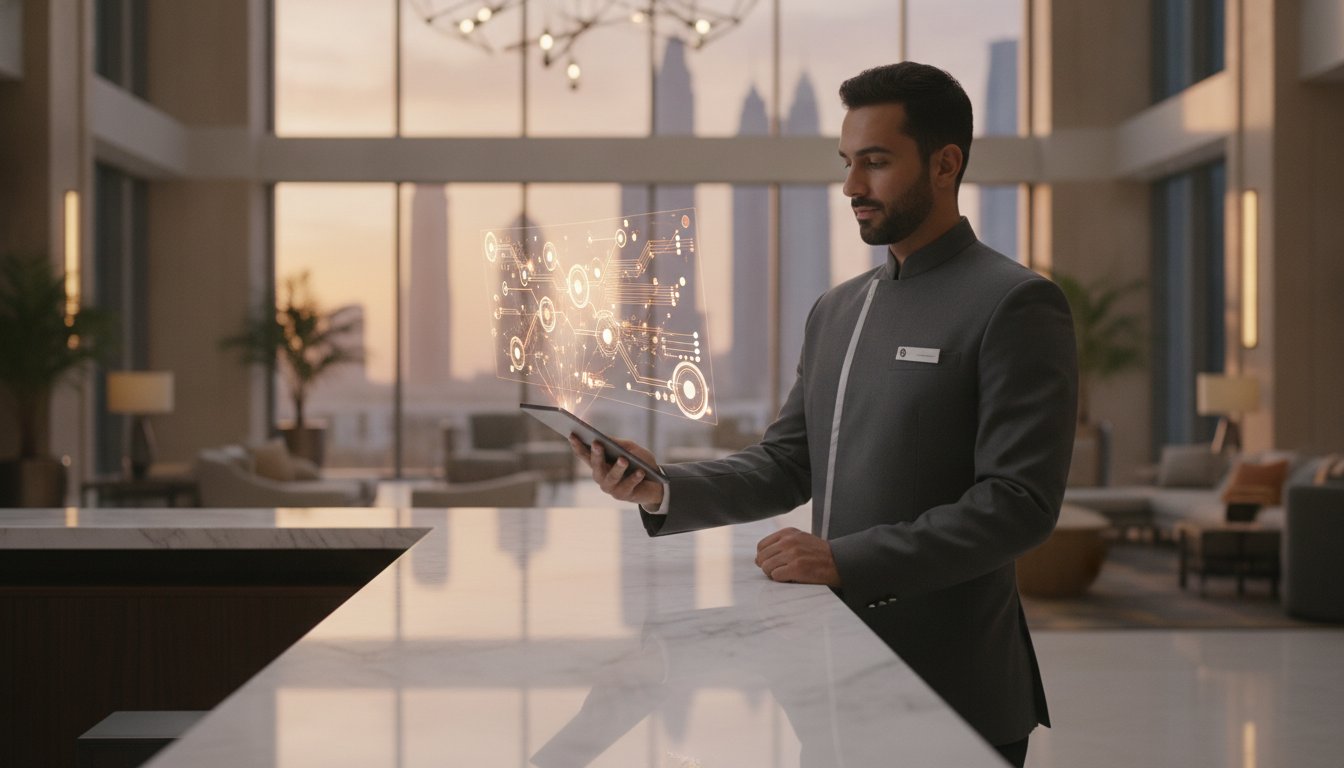
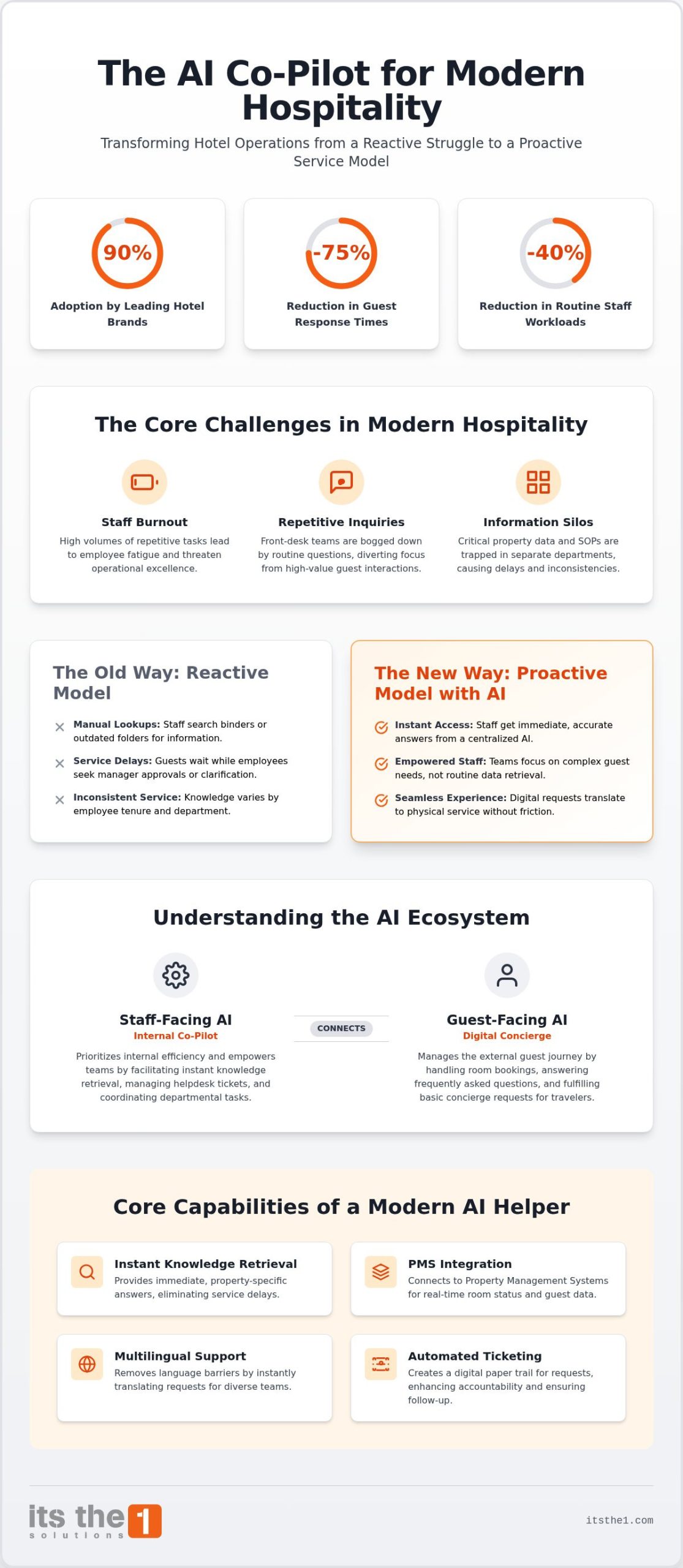
Did you know that 90% of leading hotel brands have already deployed conversational AI, reducing their response times by a staggering 75%? In the high-stakes hospitality market of the United Arab Emirates, your teams often face a relentless cycle of repetitive guest inquiries and departmental information silos. Integrating a dedicated hotel staff AI assistant is the strategic shift required to move your operations from a reactive struggle to a proactive service model that respects both your team’s time and your guests’ expectations.
You likely recognize that staff burnout isn’t just a management challenge; it’s a direct threat to the operational excellence your brand represents. This article explores how centralizing your property’s collective knowledge into one digital helper can reduce routine staff workloads by 40% or more. We’ll examine how modular solutions like 1.AI bridge the gap between digital data and physical service, ensuring your team stays empowered and efficient through 2026 and beyond. By moving toward a proactive operational model, you can improve internal ticketing speed and deliver a seamless experience that reinforces your status as a trusted industry leader.
Key Takeaways
- Transition from reactive service to a proactive operational model by leveraging sophisticated Large Language Models as internal co-pilots.
- Integrate a hotel staff AI assistant with your existing Property Management System to provide teams with instant access to real-time room status and internal policies.
- Enhance guest satisfaction by automating repetitive inquiries, which empowers your staff to prioritize complex, emotional guest needs.
- Implement a structured roadmap to centralize property data and SOPs, ensuring that critical information is no longer trapped in departmental silos.
- Utilize a unified digital ecosystem like ITSthe1’s 1.AI and 1.Support to streamline internal communication and significantly accelerate helpdesk ticketing response times.
What is a Hotel Staff AI Assistant and Why Does Your Team Need One?
A hotel staff AI assistant serves as a sophisticated internal co-pilot designed to streamline complex operational workflows. It isn’t a replacement for human talent, but rather a digital extension of it. By 2026, the hospitality industry has transitioned from the rigid, rule-based chatbots of the past to advanced Large Language Models (LLMs) that understand context, nuance, and intent. In the United Arab Emirates, where luxury service expectations remain exceptionally high despite persistent global labor shortages, this technology has become a cornerstone of operational excellence.
The primary purpose of this digital helper is to bridge the gap between vast amounts of property data and the employees who need it. Instead of searching through thick binders or outdated digital folders, staff members can query the assistant to receive instant, accurate answers regarding internal policies, local regulations, or specific guest preferences. This shift from manual retrieval to instant access allows your team to remain present and focused on the guest, rather than being tethered to a back-office terminal.
The Core Difference: Internal vs. External AI
Understanding the distinction between guest-facing and staff-facing AI is vital for a successful digital strategy. While guest AI focuses on the external journey, a hotel staff AI assistant prioritizes internal efficiency and departmental coordination. The differences are defined by their primary objectives:
- Guest AI: Manages room bookings, answers frequently asked questions, and handles basic concierge tasks for the traveler.
- Staff AI: Facilitates instant knowledge retrieval, manages helpdesk ticketing through modules like 1.Support, and coordinates cross-departmental tasks.
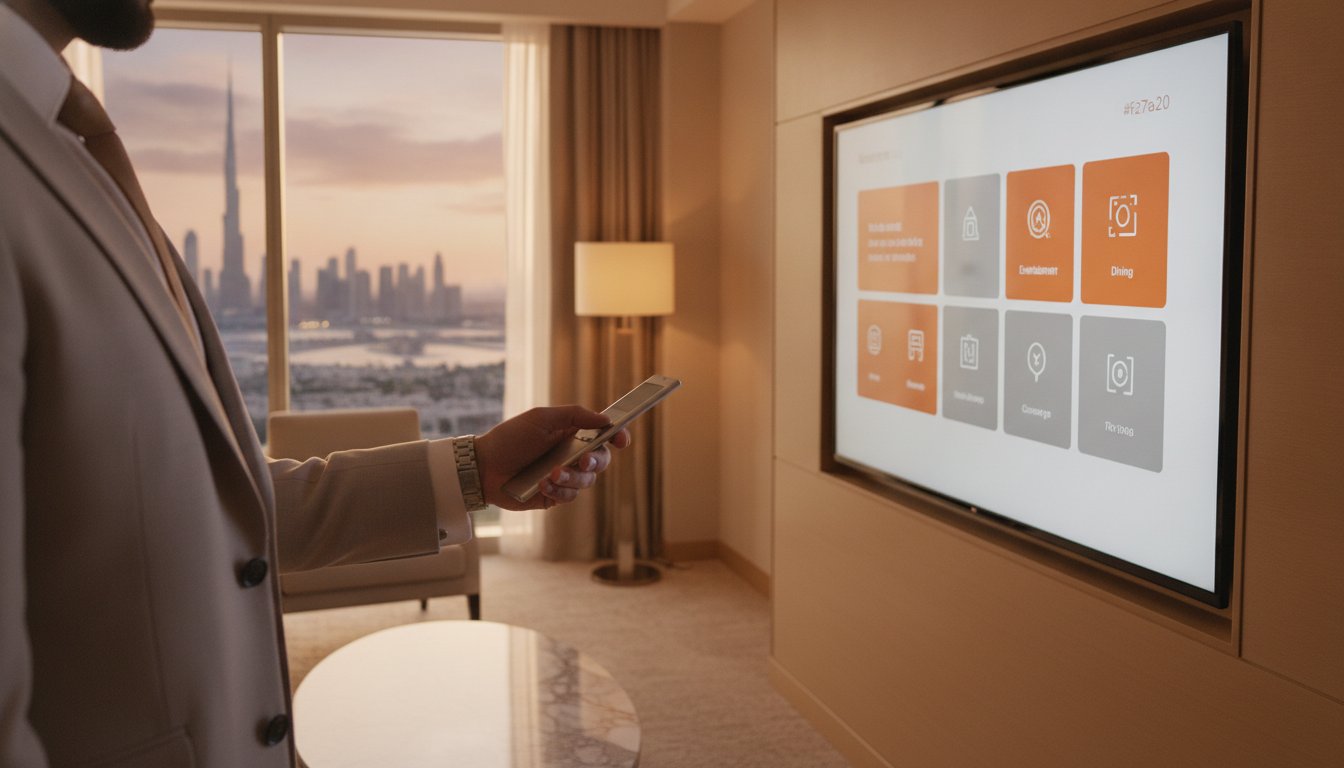
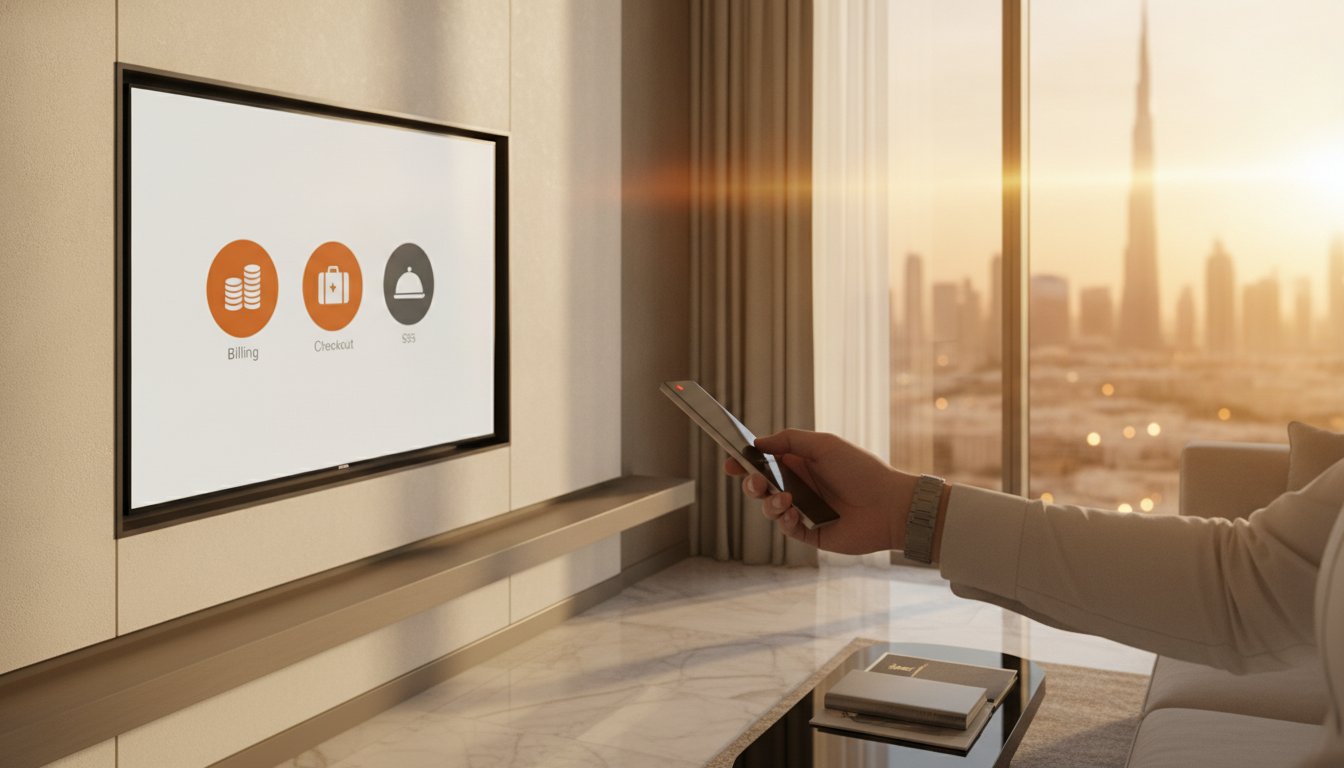
These systems don’t operate in isolation. When a guest requests a late checkout through a guest-facing interface, the staff AI assistant instantly verifies room status in the Property Management System (PMS) and alerts the housekeeping team. This creates a seamless journey where digital requests translate into physical service without manual intervention.
Why ‘Scale Output, Not Headcount’ is the 2026 Mantra
Staff retention and burnout are significant challenges for modern hotel operators. Research indicates that AI-driven tools can handle up to 80% of routine inquiries, which typically bog down front-desk teams during peak hours. By automating these repetitive administrative burdens, you directly address the root causes of employee fatigue. A hotel staff AI assistant acts as a force multiplier for high-touch service, enabling your employees to dedicate their energy to high-value guest interactions while the digital co-pilot manages technical precision. This approach allows properties to maintain elite service standards and scale their operational output without the continuous need to expand headcount in a tightening labor market.
Core Capabilities of a Modern Hospitality AI Helper
A sophisticated hotel staff AI assistant is defined by its ability to synthesize complex data into actionable insights for front-line employees. Beyond simple query responses, these helpers utilize Natural Language Processing (NLP) to navigate the intricate web of hotel standard operating procedures (SOPs). This ensures that every team member, regardless of their tenure, has the same level of expertise as a seasoned manager. By integrating directly with Property Management Systems (PMS), the assistant provides real-time updates on room availability and guest status, eliminating the need for manual cross-referencing between departments.
In the diverse labor market of the United Arab Emirates, multilingual support is a critical component of operational success. A modern assistant translates complex instructions and guest requests into the preferred language of the staff member instantly. This capability removes communication barriers that often lead to service errors. Combined with automated ticketing, the system ensures that no request is overlooked, creating a digital paper trail that enhances accountability across the entire property.
Instant Knowledge Retrieval for Front-Line Teams
The phrase ‘let me check with my manager’ often signals a service delay that guests in the UAE luxury market find frustrating. A hotel staff AI assistant removes this friction by providing immediate access to property-specific knowledge. Whether a staff member needs to clarify a complex local regulation or find a specific hotel policy, the information is available in seconds. This capability is particularly effective during the onboarding phase. Properties utilizing these systems often find they can onboard new employees significantly faster by centralizing training materials within the digital interface.
Proactive Task Management and Escalation
Efficiency depends on how quickly a guest request transforms into a completed task. The 1.AI module monitors incoming guest communication and automatically generates tickets within the 1.Support module, routing them to the correct department without human sorting. This proactive approach extends to predictive maintenance. By analyzing recurring issues reported across the property, the system identifies potential hardware failures before they result in a guest complaint. When human intervention is required, the assistant provides a detailed summary of the situation, ensuring a smooth transition and maintaining a high standard of care. This seamless handover ensures that technology supports the human element rather than replacing it.
AI vs. Human Touch: Addressing the Industry’s Biggest Concern
The apprehension that automation might erode the personal connection defining a luxury stay is common among hotel operators. This concern stems from a misunderstanding of how a hotel staff AI assistant actually functions within a high-touch environment. Rather than making guest interactions feel robotic, the technology acts as an invisible layer of intelligence. It manages the cold data processing tasks so that employees can focus on the warm, empathetic hospitality that guests expect in the United Arab Emirates. When technology handles the administrative burden, the human element is elevated, not diminished.
Adopting a “Digital Assistant, Human Execution” framework allows properties to maintain their elite service standards while improving operational speed. Consider a scenario where a repeat guest arrives at a premier property. Instead of the front desk agent spending minutes searching through disparate systems for guest history, the AI assistant surfaces specific preferences instantly. The agent can then greet the guest by name and confirm their preference for a high-floor room and specific dietary requirements without hesitation. The technology provides the insight, but the staff member provides the genuine human connection.
Enhancing Personalization Through Data Intelligence
Data intelligence is the foundation of modern personalization. A hotel staff AI assistant empowers your team to become super-concierges by putting relevant guest data at their fingertips. This includes everything from preferred pillow types to specific local tour interests. By surfacing these details in real-time, the assistant allows staff to anticipate needs before the guest even vocalizes them. This proactive service model transforms cold data into warm gestures, ensuring that every interaction feels tailored and intentional rather than transactional.
- Instant Preference Access: Staff can view guest history and specific requests without leaving the guest’s side.
- Proactive Problem Solving: AI identifies potential friction points based on previous stays, allowing staff to resolve them ahead of arrival.
- Anticipatory Service: Using data to suggest local experiences that align with the guest’s documented interests.
Staff Sentiment: Turning Skeptics into Champions
Gaining staff buy-in is essential for a successful digital evolution. When employees understand that AI is a tool for career growth rather than a replacement for their roles, they become champions of the technology. Involving the team in the training process ensures the AI reflects the property’s unique service culture. This collaborative approach demonstrates that the assistant is there to reduce their stress and handle repetitive tasks. For junior employees, the AI acts as a digital mentor that provides the answers and confidence they need to deliver senior-level service from their very first shift.
How to Implement a Staff AI Assistant: A 5-Step Roadmap
Transitioning from manual workflows to an AI-enhanced environment requires a methodical strategy to ensure long-term reliability. The first step involves a comprehensive audit of current communication bottlenecks. Identifying where your team spends the most time on repetitive tasks, such as answering the same guest questions about check-out times or local amenities, provides a clear baseline for automation. Once these pain points are mapped, the focus shifts to data centralization. You must clean and organize your property’s standard operating procedures (SOPs), menus, and local guides into a format that the hotel staff AI assistant can process accurately.
Selecting the right technology partner is the third and most critical step. A modular platform like ITSthe1’s 1.AI allows for tailored functionality that integrates with your existing ecosystem. After selection, initiate a pilot program within a single department, such as Housekeeping or the Front Office. This contained rollout allows you to identify any technical friction without disrupting the entire property’s operations. Finally, use the data gathered during the pilot to iterate. Refine the assistant’s responses based on direct staff feedback and guest satisfaction scores to ensure the tool remains a supportive partner in daily operations.
Feeding the AI: The Importance of Quality Data
The efficacy of your hotel staff AI assistant depends entirely on the quality of the information it consumes. Structuring your knowledge base involves more than just uploading PDFs; it requires categorizing data so the 1.AI module can label internal requests and retrieve information with high precision. In the United Arab Emirates, this process must also adhere to strict data privacy and security standards. Ensuring your digital helper operates within a secure cloud environment protects sensitive property information while maintaining compliance with local regulations.
Measuring Success: KPIs for Staff AI
To justify the investment and ensure continuous improvement, you must track specific key performance indicators. The most vital metric is ‘Time to Resolution’ for guest requests, which can be monitored through the 1.Support module. By comparing response times before and after implementation, you can quantify the efficiency gains. You should also monitor staff adoption rates and the accuracy of internal queries. Calculating ROI becomes straightforward when you account for labor hour savings and the subsequent uplift in guest reviews, proving that a well-implemented AI strategy is a significant force multiplier for your business.
Elevating Hospitality Operations with ITSthe1 1.AI Solutions
ITSthe1 Solutions provides a cohesive ecosystem designed to eliminate the friction of disjointed software silos. By integrating 1.AI, 1.Hotel, and 1.Support into a unified platform, properties can ensure that information flows seamlessly from a guest’s digital request to a staff member’s physical action. This synergy is vital for maintaining the high standards expected in the United Arab Emirates. With over 25 years of global hospitality expertise and a head office established in Dubai since 2003, ITSthe1 acts as a trusted advisor for properties navigating their digital evolution. Implementing a hotel staff AI assistant within this integrated framework ensures that your technology is as reliable as your service.
Customization is the cornerstone of the ITSthe1 approach. Every property operates with unique standard operating procedures and a distinct brand voice. The 1.AI module is not a generic tool; it’s a specialized helper trained on your specific property data and service culture. This level of precision allows the assistant to provide answers that are not only accurate but also aligned with your brand’s specific identity. By centralizing knowledge, you empower your team to deliver consistent, elite service across every department.
1.AI: The Specialized Helper for Your Team
The 1.AI module is built specifically for hospitality professionals who require instant, reliable data. It integrates directly with the 1.Support ticketing app to provide end-to-end task management. When a staff member queries the hotel staff AI assistant about a guest request, the system can automatically trigger a ticket, assign it to the correct department, and track its progress. This research-driven approach ensures that every feature serves a practical operational purpose, reducing the cognitive load on your front-line teams and allowing them to remain focused on guest engagement.
- End-to-End Integration: Seamless communication between 1.AI and 1.Support for instant task escalation.
- Proprietary Intelligence: A hospitality-first AI model that understands the nuances of hotel operations.
- Operational Clarity: Removes the ambiguity of departmental silos by centralizing all property knowledge.
Future-Proofing Your Property with ITSthe1
Scaling digital solutions across multiple properties requires a centralized architecture that maintains local precision. ITSthe1’s dashboard allows management to monitor AI performance and staff adoption rates across an entire portfolio from a single interface. This global perspective is supported by professional consulting and technical support from our international offices, ensuring your property remains at the forefront of hospitality technology. The transition to an AI-enhanced workforce is a strategic journey, and having a partner with a proven 25-year track record provides the stability your business requires. Discover how ITSthe1 1.AI can transform your staff efficiency today.
Securing Your Property’s Operational Future
The evolution of hospitality technology is no longer a distant prospect. It’s a current necessity for properties aiming to maintain a competitive edge in the United Arab Emirates. By integrating a dedicated hotel staff AI assistant, you transform your team’s daily experience. They move from managing repetitive administrative burdens to delivering the high-value, personalized service that guests demand. We’ve explored how sophisticated data centralization and modular task management can reduce workloads while eliminating information silos. This digital transition doesn’t replace the human element; it strengthens it by providing the intelligence needed for anticipatory service.
With over 25 years of hospitality tech expertise, ITSthe1 serves as a trusted global advisor for your digital transformation. Our ecosystem provides a stable, modular foundation for operational excellence through seamless 1.AI and 1.Support integration. Empower your team with ITSthe1 1.AI solutions and lead your property into a more efficient future. Embracing these advancements today ensures your property remains a leader in luxury service for years to come.
Frequently Asked Questions
Can a hotel staff AI assistant integrate with my existing PMS?
Yes, seamless integration with your Property Management System (PMS) is a foundational feature of the 1.AI platform. This connection allows the assistant to retrieve and update real-time data regarding room status, guest preferences, and reservation details. By bridging these systems, your team can access critical information through a single interface, which eliminates the need for manual data entry and reduces the risk of operational errors across departments.
Is it difficult to train an AI assistant on our specific hotel policies?
The training process is designed to be efficient and methodical. You simply provide your existing standard operating procedures, menus, and local guides, which the 1.AI module then processes into a structured knowledge base. ITSthe1’s research-driven approach ensures the assistant understands the specific nuances of your property’s culture. This centralized digital helper becomes an expert on your unique brand requirements, providing staff with instant and accurate policy guidance.
Will an AI assistant replace my front desk or concierge staff?
An AI assistant is a force multiplier designed to support your employees, not replace them. By automating 70% or more of repetitive administrative tasks and routine guest inquiries, the technology frees your team to focus on high-value, emotional guest interactions. This “Digital Assistant, Human Execution” model ensures that your staff can provide the warm, empathetic hospitality that defines the luxury market in the United Arab Emirates.
How does AI help with internal communication between housekeeping and maintenance?
The hotel staff AI assistant streamlines cross-departmental coordination by integrating directly with the 1.Support helpdesk ticketing app. When a guest request or maintenance issue is identified, the AI automatically generates a ticket and routes it to the appropriate team. This eliminates the delays caused by manual sorting or verbal handovers, ensuring that technical issues are resolved quickly and recorded for future operational analysis.
Is guest and staff data secure when using an AI assistant?
Security is a paramount concern, and our solutions are built to exceed international and UAE-specific data protection standards. ITSthe1 has maintained its global head office in Dubai since 2003, ensuring deep compliance with local regulations. All data is processed within secure cloud environments with robust encryption. We prioritize vendor accountability and rigorous testing to ensure that sensitive property and guest information remains protected against unauthorized access at all times.
What is the typical ROI for implementing a staff AI assistant in a large hotel?
Properties typically see a return on investment through significant labor hour savings and improved guest satisfaction scores. By reducing staff workload by 40% or more, you can scale your operational output without the need for additional headcount. While we don’t quote specific AED values for our services here, the efficiency gains in response times and the reduction in staff burnout provide a clear path to long-term financial and operational growth.
Can the AI assistant handle multiple languages for our international team?
Multilingual support is a core capability of 1.AI, making it an essential tool for the diverse workforce found in the UAE hospitality sector. The assistant can translate complex internal instructions and guest requests into the preferred language of each staff member instantly. This removes communication barriers between departments and ensures that every employee, regardless of their native language, can deliver service that meets your property’s exact standards.
How does 1.AI differ from a standard guest-facing chatbot?
While guest-facing bots focus on external interactions like bookings and FAQs, 1.AI is a specialized internal co-pilot for your employees. It’s designed for knowledge retrieval, ticketing through 1.Support, and deep departmental coordination. Standard chatbots often lack the integration required to access internal SOPs or PMS records. 1.AI serves as a comprehensive digital helper that empowers your staff to work faster and more accurately behind the scenes.
One comment on “Hotel Staff AI Assistant: Empowering Your Team for 2026 and Beyond”