A standard software solution often serves as a bottleneck rather than a catalyst for growth in the specialized world of garment manufacturing. You’ve likely experienced the frustration of inaccurate inventory levels caused by complex size, color, and style matrices that generic systems simply cannot process. Relying on fragmented data leads to missed deadlines and increased operational costs. Implementing a robust enterprise resource planning for clothing is no longer a luxury for UAE manufacturers aiming for global competitiveness; it’s a strategic necessity for maintaining precision from the design floor to the shipping port.
We understand that your primary objectives involve reducing lead times and ensuring that every export shipment meets rigorous international compliance standards without manual intervention. This 2026 buying guide provides a structured framework to help you evaluate specialized ERP systems that unify your design, manufacturing, and sales data into a single source of truth. You’ll discover how the right digital architecture can automate export documentation and provide the real-time visibility required to optimize your production floor efficiency.
Key Takeaways
- Identify the core functional differences between generic software and specialized enterprise resource planning for clothing to avoid costly customization pitfalls.
- Master a 5-step framework for evaluating ERP providers based on their ability to handle CMT or FOB manufacturing models and regional support capabilities.
- Gain insights into automating export documentation to navigate the complexities of global trade and UAE compliance requirements more efficiently.
- Learn how modular solutions like 1.ERP and 1.CRM work in tandem to provide end-to-end visibility from the production floor to the final sales delivery.
- Understand how industry-ready modules can accelerate digital transformation timelines while maximizing long-term operational ROI for apparel manufacturers.
Understanding Enterprise Resource Planning for Clothing
A specialized enterprise resource planning for clothing serves as the digital backbone for modern manufacturing, managing the entire lifecycle from initial fiber procurement to the final export shipment. While the foundational concept of Enterprise Resource Planning (ERP) focuses on integrating core business processes, the garment sector requires a much more granular level of control. In the UAE’s competitive export market, manufacturers need systems that don’t just track finished goods but also manage the intricate relationships between raw materials, labor costs, and global compliance standards.
The Unique Challenges of the Garment Industry
Garment production operates on high-velocity seasonal shifts that demand extreme agility. Manufacturers often juggle short product lifecycles where styles change within weeks. This makes traditional inventory models obsolete. Managing a multi-layered supply chain involves tracking everything from fabric rolls and buttons to specialized trims across various global suppliers. Without real-time visibility, bottlenecks in the supply chain lead to missed export windows and significant financial penalties in the international market. Success in 2026 relies on a system’s ability to provide a single source of truth across these complex variables.
Why “Generic” ERP is Not Enough
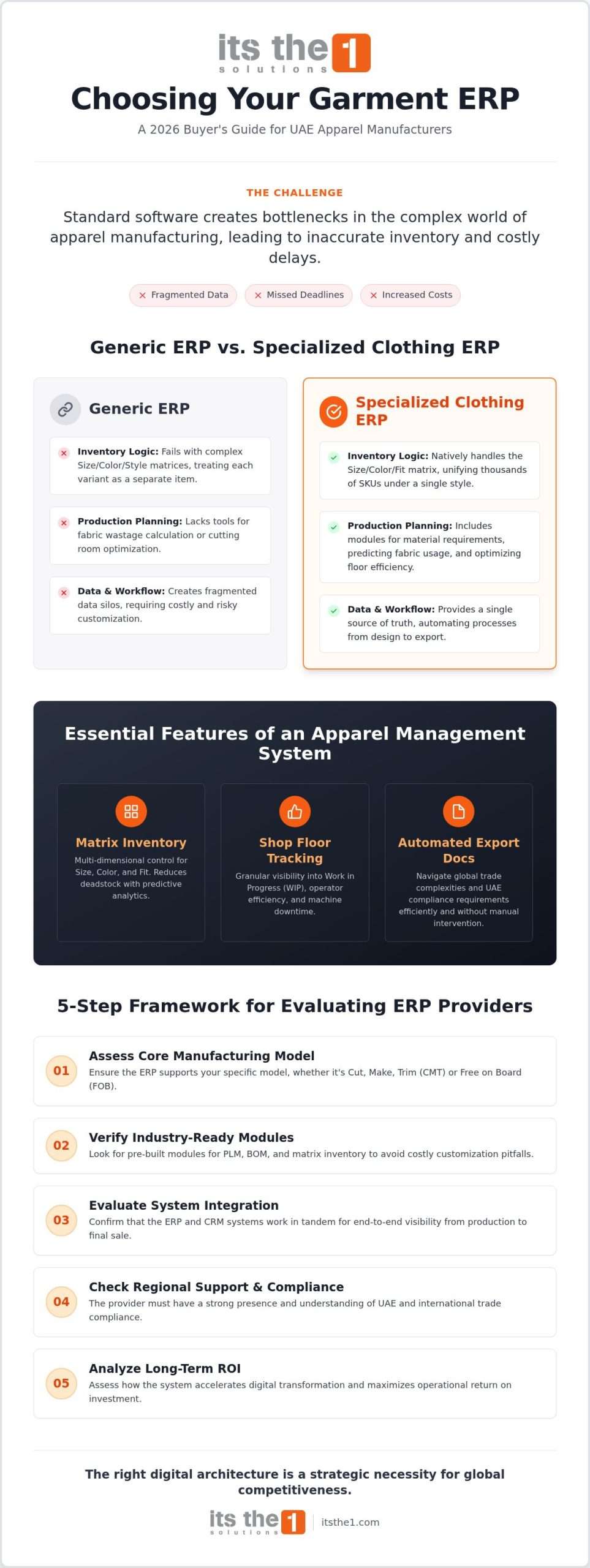
Most standard business systems utilize linear inventory logic that fails when confronted with the multi-dimensional size, color, and style matrix. A single shirt design might exist in five sizes and four colors, creating twenty distinct SKUs that a generic system treats as separate, unrelated items. Specialized enterprise resource planning for clothing recognizes these as variations of a single style, allowing for unified production planning. Generic tools also lack modules for calculating fabric wastage or optimizing cutting room efficiency, which are critical for maintaining margins. Specialized ERP systems in 2026 eliminate operational friction by synchronizing complex production variables into a single, automated workflow.
The 2026 garment sector is seeing a decisive shift toward cloud-based digital transformation. This movement allows design teams and factory floor managers to share a unified data environment, bridging the gap between creative conceptualization and physical manufacturing. By integrating Product Lifecycle Management (PLM) directly into the ERP, manufacturers ensure that every stitch and seam alignment matches the original design specifications. This level of integration is essential for UAE-based exporters who must guarantee quality and compliance to maintain their status in the global apparel ecosystem.
Essential Features of an Apparel Management System
Selecting the right enterprise resource planning for clothing involves looking beyond basic accounting modules. You need a system that integrates Product Lifecycle Management (PLM) to manage design-to-production handoffs seamlessly. Specialized enterprise resource planning for clothing must also facilitate a rapid response to market trends. This agility is only possible when design and production data reside in a unified ecosystem. An automated Bill of Materials (BOM) is equally critical. It must account for every thread, zipper, and button across multiple garment variations, ensuring that material requirements are precisely calculated before production begins.
Matrix-Based Inventory Control
Managing inventory in the apparel sector requires a multi-dimensional approach. 1.ERP specifically addresses the “Size/Color/Fit” matrix. It allows a single design to branch into thousands of unique SKUs without manual data entry errors. This level of control ensures real-time stock updates across your national distribution centers and regional retail points. In the UAE market, where luxury and fast fashion intersect, being able to track specific fabric batches is vital. By utilizing predictive inventory analytics, manufacturers can significantly reduce deadstock. This ensures capital isn’t tied up in unsold seasonal lines.
Shop Floor and Production Tracking
Operational excellence on the factory floor depends on granular visibility into Work in Progress (WIP). Advanced systems monitor individual operator efficiency and machine downtime. This allows managers to identify bottlenecks before they impact delivery dates. Monitoring energy consumption per machine is another emerging requirement for 2026. It helps manufacturers meet sustainability goals while lowering operational costs. Integrating 1.AI as a helper for staff further optimizes these workflows. It provides immediate technical support and guidance to the production team. This real-time tracking is essential for maintaining the high production standards expected in the global market.
For UAE-based manufacturers, automated export documentation is a non-negotiable feature. The system should handle everything from certificates of origin to customs declarations automatically. It reduces the risk of compliance bottlenecks at the port. It ensures your shipments move smoothly through international trade channels. If you’re looking to streamline these complex processes, exploring specialized apparel software solutions provides the technical foundation your business needs to scale. Having a system that speaks the language of the garment industry isn’t just an advantage; it’s the standard for 2026.
Generic ERP vs. Specialized Clothing ERP: A Strategic Comparison
Manufacturers often face a choice between a universal business system and a specialized enterprise resource planning for clothing. While universal platforms promise flexibility, the reality for garment producers involves extensive and expensive customization to handle industry-specific logic. These modifications often lead to “version lock,” where the system can’t be updated without breaking custom code. In contrast, an industry-built solution like 1.ERP provides these features out of the box, ensuring a higher return on investment and long-term technical stability.
Cost and Implementation Timeframes
Modifying a generic database to understand a size-color-fit matrix involves significant hidden costs. These expenses often exceed the initial license fee. Specialized systems offer a much faster “Time-to-Value” because the core architecture already aligns with garment manufacturing workflows. By choosing a purpose-built system, companies in the UAE can bypass months of development. Engaging with professional IT consulting ensures a smooth migration, as experts who understand both the technology and the textile trade can map existing processes to the new digital framework without disrupting daily operations.
Reporting and Business Intelligence
Generic reporting tools typically focus on financial totals, but they lack the depth required for garment-specific KPIs. A specialized enterprise resource planning for clothing provides dashboards that track critical metrics like cut-to-ship ratios and fabric wastage percentages. 1.ERP delivers this granular data, allowing executives to see exactly which styles are performing and which are draining resources. This level of business intelligence is vital for managing global exports from Dubai, where precision in planning directly impacts profitability. Real-time data visibility prevents overproduction by aligning manufacturing schedules with actual sales demand in 2026.
Industry-specific compliance is another area where generic systems fall short. Exporting apparel involves complex documentation and adherence to international standards that change frequently. Specialized modules automate these compliance checks, reducing the risk of administrative errors that could stall shipments at the port. This focused approach allows manufacturers to concentrate on their core craft rather than managing software limitations.
A 5-Step Framework for Evaluating Clothing ERP Providers
Selecting an enterprise resource planning for clothing requires a methodical approach that moves beyond feature checklists. Manufacturers must first define their specific production requirements, distinguishing between Cut, Make, Trim (CMT) and Free on Board (FOB) manufacturing models. A system that excels in tracking labor costs for CMT may lack the sophisticated procurement and financial modules needed for FOB operations. Once your model is defined, evaluate the integration potential with your broader digital ecosystem, including existing solutions like 1.CRM for sales management or 1.TV for corporate hospitality branding. Demanding a proof of concept (POC) that uses your most complex garment matrix is essential to verify the system can handle your actual production data without errors.
Assessing Global Support and Reliability
Regional presence is a critical factor for manufacturers operating in the UAE. A provider with a dedicated office in Dubai offers more than just proximity; they provide an understanding of local trade regulations and export requirements. You should evaluate the longevity and stability of the software provider to ensure they’ll be a long-term partner. Checking for managed IT support and 24/7 helpdesk availability ensures that production never stalls due to technical glitches. 1.ERP, backed by over 25 years of global experience, provides the stability required for high-stakes manufacturing environments.
The Role of Professional Consulting
Software alone doesn’t solve operational inefficiencies. You need a digital transformation strategy that aligns your technology with your business goals. A seasoned consultant conducts thorough research and testing to map your physical workflows to the digital environment. This process ensures the system is scalable for future growth and can accommodate new product lines as your business expands. Reliable enterprise resource planning for clothing must be flexible enough to evolve alongside market shifts. 1.ERP is designed with this modularity in mind, allowing you to add capabilities as your manufacturing complexity increases.
Cybersecurity and cloud stability are the final pillars of a successful evaluation. Your ERP holds sensitive design IP and financial data, making robust protection a non-negotiable requirement. Verify that your provider uses advanced encryption and has a proven track record of uptime. If you’re ready to move toward a more secure and efficient production model, you can consult with our experts today to begin your digital transformation journey. Professional guidance ensures that your transition to a modern ERP is both seamless and strategically sound.
Optimizing Global Operations with 1.ERP
ITSthe1’s 1.ERP represents a sophisticated ecosystem designed to address the specific operational hurdles of the apparel sector. Our proprietary module serves as a purpose-built solution that reflects over 25 years of global experience in digital transformation. By choosing a system built specifically for garment manufacturing, you’re partnering with a seasoned global expert that understands the nuances of the trade. This enterprise resource planning for clothing integrates seamlessly with 1.CRM, providing SMEs with unprecedented visibility into their sales pipeline. This unified data flow ensures that production schedules align precisely with sales forecasts, which directly enhances revenue and operational stability. Our status as a trusted advisor means we don’t just provide software; we deliver a long-term partnership focused on your strategic growth.
The strength of our solution lies in its modularity and its ability to serve as a comprehensive business engine. Beyond manufacturing, the ITSthe1 product family includes 1.Support for helpdesk ticketing and 1.AI to assist staff on the production floor. This cohesive ecosystem eliminates the data silos that often plague growing businesses by centralizing design, production, and sales data. Every module is designed to work in tandem, creating a narrative of comprehensive capability that supports your overarching business goals while maintaining a formal and disciplined execution style.
Centralizing Compliance and Exports
Managing international trade regulations requires meticulous attention to detail, especially for UAE-based exporters navigating diverse global markets. Within the 1.ERP environment, our enterprise resource planning for clothing allows manufacturers to centralize their compliance efforts to ensure every shipment meets specific international standards without manual errors. Automating documentation significantly reduces the administrative burden on your team. This automation shortens lead times for global clothing exports, allowing you to move products from the factory to the shipping port with greater efficiency. Data security remains a top priority, supported by ITSthe1’s robust cybersecurity services that protect your proprietary designs and financial records against emerging digital threats. This composed and reassuring approach to security instills confidence that your technical needs are in capable hands.
Future-Proofing with AI and Cloud
The synergy between 1.ERP and 1.AI offers a forward-thinking approach to operational support. 1.AI acts as a digital assistant, providing real-time guidance to staff and facilitating predictive maintenance for critical machinery. This proactive approach minimizes downtime and ensures that production targets are consistently met. Cloud-based accessibility allows distributed manufacturing units to access synchronized data from any location, which is essential for maintaining consistency across multiple sites. This level of technical sophistication ensures your business remains competitive in a rapidly evolving global market. If you’re ready to modernize your operations, you can consult with our experts for a tailored 1.ERP implementation strategy to begin your journey toward digital excellence.
Securing Your Manufacturing Future in 2026
The garment industry’s inherent complexity demands more than just a basic digital spreadsheet. You’ve seen how specialized enterprise resource planning for clothing eliminates the persistent inefficiencies of manual size-color matrices and fragmented export documentation. By moving beyond the limitations of generic systems, your business gains the operational precision required to reduce lead times and maintain rigorous international compliance from your Dubai headquarters. This transition is essential for any manufacturer looking to thrive in an increasingly competitive global landscape.
ITSthe1 Solutions acts as your steady guide through this digital evolution. We draw on over 25 years of global experience with established offices in Dubai, London, and Sri Lanka. Our comprehensive product family integrates 1.ERP with 1.CRM and robust Cyber Security to protect your proprietary designs while simultaneously optimizing your sales pipeline. This disciplined, modular approach ensures that your technical infrastructure scales seamlessly alongside your global ambitions. We’re committed to providing the stability and high-level value your organization requires.
Explore 1.ERP: The Specialized Solution for Garment Manufacturing to begin your digital transformation today. We’re ready to partner with you to achieve lasting excellence in the global apparel market.
Frequently Asked Questions
What is the primary difference between a generic ERP and a clothing ERP?
A generic system handles linear inventory, while enterprise resource planning for clothing manages complex, multi-dimensional data. Standard ERPs require extensive custom coding to understand that one style exists in twenty variations. Specialized systems include built-in logic for fabric wastage, cutting room efficiency, and apparel-specific Bill of Materials (BOM). This focus reduces the need for expensive modifications and ensures the software aligns with the physical reality of the factory floor.
How does a garment ERP handle size and color variations?
Specialized systems utilize a Style-Color-Size matrix to organize inventory. Instead of creating a separate item for every possible combination, the software treats them as variations of a single parent style. This architecture allows managers to view stock levels across the entire matrix at once. It prevents data entry errors and ensures that purchasing decisions are based on accurate, granular demand rather than broad estimates.
Can an ERP system help with clothing export compliance?
Yes, specialized ERPs automate the generation of international trade documents required for global markets. In the UAE, this includes producing certificates of origin, packing lists, and customs declarations that comply with regional regulations. By linking production data directly to shipping modules, the system ensures that every export shipment is backed by accurate documentation. This automation minimizes administrative delays and reduces the risk of compliance-related bottlenecks at the port.
What is the typical implementation timeline for a clothing ERP like 1.ERP?
Implementation timelines vary based on the scale of your manufacturing operation and the complexity of your current data. Because 1.ERP is industry-ready, the deployment phase is typically more efficient than modifying a generic platform. Our team focuses on mapping your existing workflows to the digital environment during the initial setup. This structured approach ensures a smooth transition while minimizing disruption to your daily production schedules.
How does shop floor tracking improve efficiency in apparel manufacturing?
Shop floor tracking provides real-time visibility into Work in Progress (WIP) by monitoring individual machine and operator performance. Managers can identify bottlenecks immediately rather than waiting for end-of-shift reports. This granular data allows for better load balancing across production lines. Tracking individual efficiency helps in identifying training needs and optimizing the overall manufacturing throughput, which is essential for meeting tight seasonal deadlines.
Is cloud-based ERP secure for sensitive garment production data?
Modern cloud-based systems for enterprise resource planning for clothing offer high levels of security through advanced encryption and dedicated cybersecurity protocols. ITSthe1 protects sensitive garment production data and design IP using robust security frameworks. Regular backups and multi-factor authentication ensure that your information remains accessible only to authorized personnel. This infrastructure provides better protection than most on-premise servers, which are often more vulnerable to local hardware failures.
How does 1.ERP integrate with other business tools like CRM?
1.ERP integrates directly with 1.CRM to create a unified data flow between the sales office and the production floor. This connection ensures that sales teams have real-time visibility into production status and inventory availability. When a sale is confirmed, the system can automatically trigger production orders or reserve existing stock. This synchronization eliminates manual data transfers and ensures that customer expectations are managed with accurate, real-time information.
What role does AI play in modern clothing ERP systems for 2026?
By 2026, AI serves as a proactive assistant for both staff support and predictive analytics. 1.AI helps production teams by providing immediate technical guidance and troubleshooting for machine issues. It also analyzes historical data to predict maintenance needs before a breakdown occurs. This forward-thinking approach shifts manufacturing from reactive repairs to a more disciplined, predictive model that maximizes machine uptime and production efficiency.