In 2026, the competitive advantage of a hotel is no longer defined by the volume of technology it owns, but by how seamlessly those systems communicate. Many hospitality leaders still view their legacy infrastructure as a safeguard, yet outdated hardware often creates more risk than it mitigates. Developing a robust hotel cloud migration strategy is no longer a luxury for the forward-thinking; it’s a fundamental requirement for maintaining operational continuity and data integrity in an era of strict PCI DSS 4.0 compliance.
You’ve likely felt the pressure of managing disconnected vendors while worrying about the potential for downtime during a critical system transition. It’s a valid concern, as the complexity of integrating legacy platforms can often feel overwhelming. This guide provides a clear, risk-mitigated roadmap to help you transition your infrastructure with confidence. We’ll explore how to improve staff efficiency and guest satisfaction through unified modules like 1.Hotel and 1.TV, ensuring your property is ready for the future of hospitality.
Key Takeaways
- Identify the ideal cloud architecture, whether Public, Private, or Hybrid, to ensure operational resilience and sufficient bandwidth for modern hospitality needs.
- Execute a structured 5-step roadmap that prioritises data auditing and secure environment configuration to prevent the loss of guest profiles and reservation records.
- Develop a risk-mitigated hotel cloud migration strategy that maintains PCI DSS 4.0 compliance while enhancing staff efficiency through modern, cloud-based interfaces.
- Leverage integrated modules like 1.Hotel and 1.TV to offer a unified guest experience, from mobile messaging to branded IPTV content across any network provider.
Selecting the Optimal Cloud Migration Strategy for Your Hotel
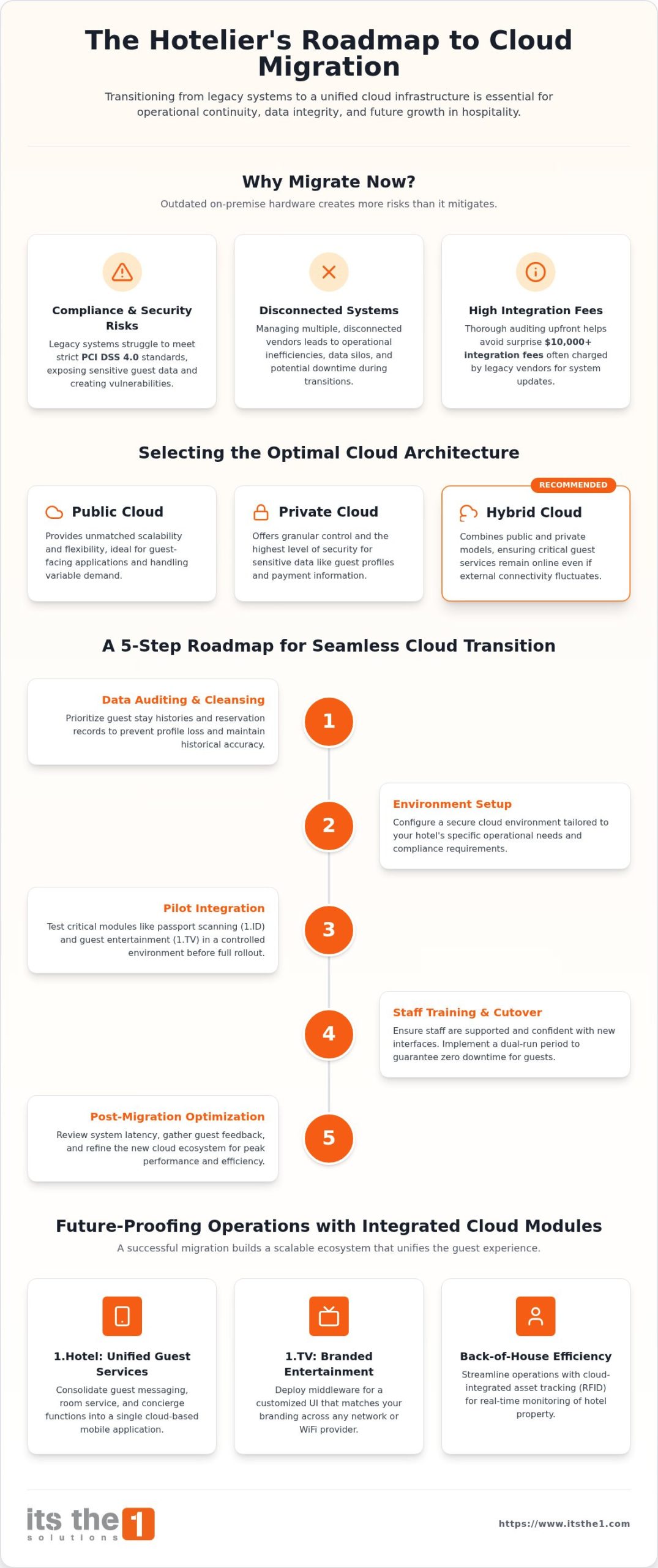
Selecting the right deployment model is the cornerstone of a successful hotel cloud migration strategy. While public clouds like AWS or Azure provide unmatched scalability, private clouds offer the granular control necessary for high-security environments. Many hospitality leaders opt for a hybrid model to ensure guest services remain uninterrupted if external connectivity fluctuates. Gaining a foundational understanding of cloud computing helps in deciding which workloads belong in each environment. It’s vital to align these choices with national data protection standards to keep guest privacy uncompromised.
Infrastructure readiness is often the silent deal-breaker. You must assess your current network infrastructure management to guarantee sufficient bandwidth for cloud-based operations. A “One Stop Technology Partner” approach significantly reduces vendor fragmentation, providing a single point of accountability for your entire stack. By leveraging professional cloud migration services for business, you can ensure that your transition is both stable and strategically sound.
Auditing Your Current Hospitality Tech Stack
Before committing to a path, identify legacy bottlenecks in your PMS, IPTV, and telephony systems. Digital Transformation is the integration of digital technology into all areas of hotel operations. Determine which on-premise servers can be decommissioned and which require a hybrid approach for low-latency guest services. With more than 20 years of expertise, we’ve seen that thorough auditing prevents the $10,000 integration fees often charged by legacy vendors. This step ensures your new cloud ecosystem is lean, efficient, and ready to support modern guest demands.
The 5-Step Roadmap for a Seamless Hospitality Cloud Transition
A successful hotel cloud migration strategy requires a methodical approach to ensure operational continuity. You can’t simply flip a switch. Instead, follow these structured phases to transition your property with minimal disruption:
- Phase 1: Data Auditing and Cleansing. Prioritise guest stay histories and reservation records to prevent profile loss and maintain historical accuracy.
- Phase 2: Environment Setup. Configure secure cloud migration services for business tailored to your operational needs. Understanding the technical stages of cloud migration ensures your team stays aligned during the build.
- Phase 3: Pilot Integration. Test critical modules like 1.ID for passport scanning and 1.TV for guest entertainment in a controlled environment.
- Phase 4: Staff Training and Cutover. Use 1.Support to manage internal helpdesk queries during the live transition, ensuring staff feel supported as they adapt to new interfaces.
- Phase 5: Post-Migration Optimization. Review system latency and guest feedback to refine the cloud ecosystem and ensure all integrations are performing at peak efficiency.
Mitigating Risks During Data Transfer
Implement a dual-run period where legacy and cloud systems operate in parallel. This ensures zero downtime for guest check-ins. You should utilise cybersecurity services for enterprises to encrypt sensitive data during the transit phase. Security remains paramount. For instance, verify that guest credentials on casting solutions like 1.Cast aren’t stored or logged on the TV system during the move. If you’re ready to modernize your infrastructure, consider how a unified technology partner can simplify this journey.
Future-Proofing Operations with Integrated Cloud Modules
A successful hotel cloud migration strategy doesn’t end with data transfer; it’s about building a scalable ecosystem. Once the core infrastructure is stable, you can leverage unified modules to drive high-level value across all departments. It’s a transition that allows you to consolidate guest services and back-of-house management into a single, cohesive environment.
- Unified Guest Services: Leverage 1.Hotel to unify guest messaging, room service, and concierge functions into a single cloud-based mobile application.
- Branded Entertainment: Deploy 1.TV middleware to offer a fully customised UI that matches your corporate branding across any network or WiFi vendor.
- Operational Visibility: Streamline back-of-house operations using cloud-integrated asset tracking with RFID tags for real-time monitoring of hotel property.
- Long-term Stability: Ensure performance with an Annual Maintenance Contract (AMC) that includes strict Service Level Agreements (SLA).
Enhancing the Guest Experience Post-Migration
Integrating hotel guest engagement apps provides guests with a seamless digital journey from booking to checkout. Utilise 1.DS for real-time updates and wayfinding, managed centrally via the cloud for consistency. Additionally, incorporate 1.AI to help staff handle high-frequency guest requests more efficiently. This layered approach ensures that your technology serves the overarching business goal of guest satisfaction while maintaining operational excellence.
Advancing Your Property with Strategic Cloud Integration
Successful digital evolution demands a disciplined approach to infrastructure. By selecting the optimal deployment model and following a structured roadmap, you ensure guest data remains secure while staff efficiency increases. A well-executed hotel cloud migration strategy provides the foundation for integrating proprietary modules like 1.Hotel and 1.TV, transforming your guest experience into a seamless digital journey. These steps move your property from fragmented legacy systems to a unified, scalable ecosystem that supports future growth.
With more than 20 years of hospitality tech expertise since our formation in 1999, ITSthe1 Solutions serves as a steady guide through these technical complexities. Our unified solutions and comprehensive AMC and SLA support models provide the stability your property needs to thrive in a cloud-first era. Take the next step toward operational excellence and partner with ITSthe1 Solutions for your hotel’s digital transformation. Your transition to a high-performance, future-proof environment is within reach.
Frequently Asked Questions
What are the primary risks of hotel cloud migration?
Data loss and operational downtime are the most common concerns for hospitality leaders during a transition. ITSthe1 Solutions addresses these risks by implementing a dual-run period where legacy and cloud systems operate in parallel. This methodology ensures that your hotel cloud migration strategy doesn’t compromise guest check-ins or the integrity of historical reservation records during the move.
How long does a typical hotel cloud migration strategy take to implement?
The duration depends on the scale of your property and the complexity of your existing tech stack. While a basic transition might take a few weeks, a full enterprise-level migration often spans several months to ensure stability. ITSthe1 Solutions leverages more than 20 years of expertise to streamline this process, moving from initial auditing to live cutover with precision.
Can I migrate my legacy IPTV system to the cloud?
You can modernize your entertainment offerings by deploying the 1.TV middleware solution, which operates independently of your physical hardware. This platform is compatible with any network vendor and any TV brand, allowing you to move away from bulky on-premise servers. ITSthe1 Solutions provides full UI customization during this process, ensuring your digital guest experience remains consistent with your corporate branding.
Is guest data safer in the cloud than on-premise?
Cloud environments generally offer superior security compared to on-premise servers because they receive continuous updates and professional monitoring. ITSthe1 Solutions implements robust encryption and identity management to align with current PCI DSS 4.0 standards. This proactive approach to digital resilience ensures that sensitive guest credentials remain protected against evolving cyber threats throughout your property’s lifecycle.