
Did you know that 83% of IT leaders are now looking toward external partners to manage their cybersecurity operations? As we move toward 2026, the escalating complexity of digital threats and the persistent talent shortage in the UAE have made enterprise IT support outsourcing a strategic necessity rather than a mere cost-saving measure. It’s a reality many executives face; the rising cost of maintaining a round-the-clock technical team often leads to fragmented systems and operational downtime.
You likely recognize that your internal resources are stretched thin, particularly when it comes to specialized cloud and security expertise. This article provides a strategic roadmap for transitioning your operations into a high-performance managed model. You’ll discover how to enhance your security posture, reduce costs, and build a technical foundation that scales alongside your enterprise. We’ll examine the critical phases of vendor selection, the integration of modular ticketing tools like 1.Support, and the alignment of technical objectives with your broader business goals.
Key Takeaways
- Learn how to transition from reactive troubleshooting to a proactive, modular infrastructure management model that scales with your business growth.
- Understand the 5-step process for a secure transition, beginning with a comprehensive cybersecurity audit and the establishment of clear Service Level Agreements.
- Discover how to manage high-level technical depth across Tier 1 to Tier 3 support while maintaining a robust, non-negotiable security layer.
- Identify why specialized sectors like hospitality benefit from industry-specific tools such as 1.TV and 1.ID to ensure seamless guest experiences.
- Master a strategic framework for enterprise IT support outsourcing that uses proprietary applications like 1.Support to guarantee transparency and operational excellence.
Defining the Scope of Enterprise IT Support Outsourcing
Enterprise operations demand a level of sophistication that goes far beyond basic technical troubleshooting. While a small business might only require occasional assistance with hardware issues, true enterprise IT support outsourcing involves managing a complex, modular ecosystem of interconnected services. This scale requires a transition from reactive “break-fix” models to a proactive infrastructure management philosophy. Instead of waiting for a system failure, a seasoned partner focuses on operational excellence through continuous monitoring and strategic network maintenance. It’s about building a resilient environment where technology serves the overarching business goals without interruption.
For those exploring the foundational shift in modern business operations, What is Outsourcing? provides a useful historical perspective on how simple delegation has evolved into strategic partnership. It’s no longer just about offloading tasks; it’s about integrating specialized Cloud Services and robust Cyber Security protocols into the very fabric of the organization. Professional IT consulting acts as the cornerstone here. It ensures that the outsourcing framework aligns with long-term objectives and specific regulatory requirements within the UAE market. This strategic foundation allows enterprises to scale their digital capabilities with confidence and precision.
Managed Services vs. Staff Augmentation
Choosing between these two models depends on the level of accountability your enterprise requires. Staff augmentation provides extra hands to work under your existing management, which is useful for short-term projects or specific skill gaps. However, a fully managed model offers greater stability because the provider takes ownership of the outcomes and service levels. Many organizations now opt for a hybrid approach. This allows internal leadership to retain strategic control while leveraging outsourced experts for specialized, high-level tasks. Using proprietary tools like 1.Support ensures that every ticket and task remains transparent. It bridges the gap between external teams and in-house stakeholders, fostering a culture of shared responsibility and measurable performance.
The Strategic Importance of 24/7 Availability
Global enterprises operate across multiple time zones, making localized downtime a significant risk to the bottom line. If a system fails in London while the Dubai office is closed, the resulting operational paralysis can be incredibly costly. A robust strategy utilizes multi-region support centers in hubs like Dubai, London, and Sri Lanka to ensure continuous uptime. This geographical footprint allows for seamless service delivery regardless of the hour. It provides a reassuring layer of stability for businesses that can’t afford even a few minutes of disconnection. Maintaining this level of continuity is essential for protecting the integrity of your digital infrastructure and ensuring that global teams remain productive around the clock.
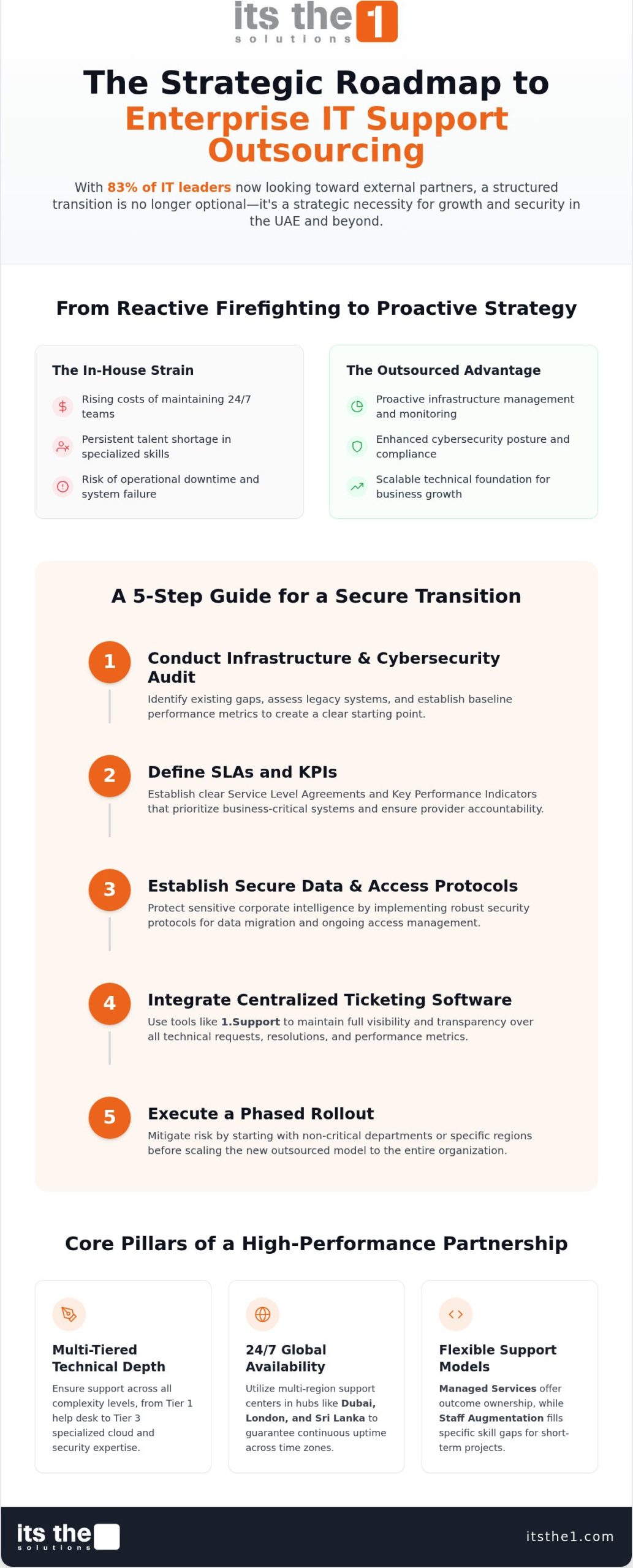
How to Transition to an Outsourced IT Model: A 5-Step Guide
Transitioning to a managed model requires a disciplined, methodical approach to ensure that business continuity remains intact. Successful enterprise IT support outsourcing isn’t a simple handoff of tasks; it’s a strategic integration that aligns external expertise with your internal objectives. By following a structured roadmap, enterprises can mitigate the risks of data loss and operational friction while building a more resilient infrastructure.
- Step 1: Conduct a comprehensive infrastructure and cybersecurity audit to identify existing gaps and establish baseline performance metrics.
- Step 2: Define Service Level Agreements (SLAs) and Key Performance Indicators (KPIs) that prioritize business-critical systems and set clear accountability for the provider.
- Step 3: Establish secure data migration and access protocols to protect sensitive corporate intelligence and maintain compliance during the transition.
- Step 4: Integrate centralized ticketing software, such as 1.Support, to maintain full visibility over technical requests and resolutions.
- Step 5: Execute a phased rollout, starting with non-critical departments or specific regions before scaling to the entire organization.
Phase 1: The Infrastructure Audit
A successful transition begins with a deep dive into your current technical landscape. This involves identifying legacy systems that may be nearing end-of-life and assessing where cloud migration can offer greater efficiency. In the UAE market, where regulatory compliance is paramount, mapping existing network vulnerabilities allows for immediate remediation before the outsourcing partner takes full control. The primary objective of this audit is to establish a verified technical baseline that serves as the foundation for all future return on investment calculations.
Phase 2: Tooling and Integration
Transparency is the bedrock of a reliable technical partnership. Proprietary applications like 1.Support are essential because they provide real-time visibility into the status of every technical issue across your global footprint. Setting up automated reporting allows leadership to track performance against the agreed-upon KPIs without manual intervention. It’s equally important to train internal stakeholders on the new support ecosystem to ensure they know exactly how to leverage the external expertise. For those seeking a partner with a 25-year history of delivering these results, exploring enterprise managed services can provide the necessary clarity for your next steps. This integration phase ensures that the enterprise IT support outsourcing model feels like a natural extension of your organization rather than a separate entity.
Evaluating Technical Depth: Beyond the Help Desk
Effective enterprise IT support outsourcing extends far beyond the surface-level interactions of a standard help desk. While basic troubleshooting is necessary, global enterprises require a technical hierarchy that spans from Tier 1 end-user assistance to Tier 3 architectural design. Managing complex server environments and global network infrastructure demands a partner who understands the intricate dependencies of high-scale systems. This depth ensures that while a password reset is handled efficiently, the underlying server architecture remains robust and ready for future expansion. It’s about providing a steady, grounded technical foundation that supports ambitious business intent.
Ensuring high-speed connectivity across global properties is a fundamental requirement for modern enterprises. This involves managing both the physical and logical layers of the network to guarantee that data flows without bottlenecks or latency issues. Whether it’s a luxury hotel chain in Dubai or a global garment manufacturing facility, the efficacy of the network directly impacts daily operational output. A proactive approach to network maintenance ensures that connectivity remains a competitive advantage rather than a source of frustration.
Advanced Cybersecurity Protocols
A layered approach to security is no longer optional. It’s a non-negotiable component of modern technical management. We focus on implementing proactive threat detection and rigorous data protection standards that align with international frameworks and UAE-specific regulations. Regular audits play a critical role in maintaining this compliance, ensuring that vulnerabilities are addressed before they can be exploited. In sectors like hospitality or manufacturing, where sensitive guest information and proprietary production data are at stake, these protocols provide a necessary safeguard for corporate reputation. Establishing this secure perimeter allows leadership to focus on strategic growth without the constant fear of digital disruption.
Cloud Infrastructure and Migration
Enterprises often operate within hybrid or multi-cloud environments that require sophisticated oversight to remain cost-effective. Transitioning to these models involves more than just moving data; it requires a strategy that prevents service interruption while optimizing resource allocation. For organizations managing legacy ERP systems or specialized hospitality software, understanding the full scope of cloud migration services for business is essential to avoiding the cost overruns and timeline delays that affect 70% of migrations. We manage the full spectrum of SaaS, PaaS, and IaaS within a unified outsourced framework. This allows for precise control over digital assets and helps prevent the “cloud sprawl” that often leads to unexpected expenses. By utilizing professional resource allocation, businesses can ensure their cloud spend stays within budget while maintaining peak performance. Leveraging tools like 1.Support provides the transparency needed to track these complex migrations in real-time, giving leadership the confidence that their digital transformation is on the right path.
Industry-Specific IT Support: Hospitality and Manufacturing
Generalist IT firms often struggle in specialized enterprise environments because they lack the vertical-specific knowledge required to manage niche software ecosystems. This is particularly evident in the UAE, where the hospitality and manufacturing sectors operate under stringent regulatory and operational requirements. Effective enterprise IT support outsourcing requires a partner who understands the nuances of your specific industry. This ensures that specialized hardware and IoT devices are integrated seamlessly into the broader network without creating security vulnerabilities or performance bottlenecks.
Hospitality Technology Management
Within the hospitality sector, technology is a primary driver of the guest experience. Systems like 1.TV for IPTV and 1.DSMM for Digital Signage require constant vigilance to ensure 100% uptime. A failure in these guest-facing systems can immediately impact brand perception and revenue. Beyond entertainment, support extends to critical administrative tools such as 1.ID for passport and ID scanning, which is essential for local regulatory compliance in Dubai and across the Emirates. Integrating these tools with existing property management systems requires deep technical expertise. Additionally, supporting AI-driven assistants like 1.AI for hospitality staff allows for more efficient service delivery, bridging the gap between technical infrastructure and guest satisfaction.
Garment Industry and SME ERP Support
For manufacturing entities, particularly in the apparel sector, the 1.ERP system serves as the operational backbone. It manages everything from production tracking to export documentation, requiring high levels of data integrity and compliance. Generalist providers often lack the insight to troubleshoot these complex garment industry ERPs or to manage the centralized customer relationships found in 1.CRM for SMEs. Managing specialized production hardware and the associated IoT sensors demands a steady, experienced hand. Our approach ensures that your manufacturing infrastructure remains a stable platform for growth, protecting the sensitive data involved in global export management. If you’re ready to align your technical infrastructure with your industry-specific goals, explore our specialized IT support solutions today.
Maintaining the backbone of apparel manufacturing management involves more than just software updates. It requires a deep understanding of how cloud CRM systems centralize customer relationships and how data integrity affects garment export management. By outsourcing these specialized functions, enterprises can ensure that their technical support is as precise as their production lines. This focused expertise reduces the risk of operational downtime caused by fragmented support systems that don’t understand the specific needs of the manufacturing floor.
The ITSthe1 Approach: Global Expertise, Proprietary Solutions
Our approach to enterprise IT support outsourcing is built on a foundation of 25 years of global operational experience. Since establishing our head office in Dubai in 2003, we’ve focused on delivering technical excellence that aligns with the ambitious goals of UAE enterprises. This isn’t just about managing servers; it’s about a research-driven philosophy that identifies the most cost-effective and reliable paths for digital evolution. We treat every engagement as a strategic partnership, acting as a steady guide through the complexities of modern infrastructure.
The Power of 1.Support
Transparency is often the biggest challenge in outsourced technical management. We address this through 1.Support, our proprietary helpdesk ticketing application. This centralized platform ensures that every request, from a simple password reset to a complex server migration, is logged and tracked with precision. By streamlining staff requests across multiple locations, we eliminate the fragmentation that often leads to operational downtime. It’s a disciplined tool that ensures accountability is maintained at every level of the technical hierarchy.
The real value of 1.Support lies in its ability to provide real-time analytics for enterprise-level decision making. Leadership can monitor resolution times, identify recurring technical bottlenecks, and verify that all service levels are being met. This data-driven approach improves accountability and ensures that your technical resources are utilized effectively. It’s a modular solution that grows with your enterprise, providing the visibility needed to maintain total control over your digital assets.
A Global Footprint for National Excellence
Our global footprint allows us to apply international best practices to the national excellence required in the UAE market. We don’t rely on off-the-shelf solutions that might fail in high-demand enterprise environments. Instead, we emphasize a philosophy of continuous testing and research. This ensures that the technology we deploy is not only current but also resilient enough to handle future shifts in the digital landscape. By applying global head office standards locally, we provide a level of stability that is essential for serious business intent.
Achieving your digital transformation goals requires a partner who understands both the technical and business implications of every decision. We provide the sophisticated oversight necessary to manage hybrid clouds, advanced cybersecurity, and industry-specific software like 1.TV and 1.ERP. Our commitment to excellence ensures that your infrastructure remains a stable platform for strategic growth. To learn more about how we can optimize your operations, consult with our enterprise IT experts today and discover the benefits of a truly integrated support model.
Securing Your Enterprise’s Digital Future
Successful enterprise IT support outsourcing in 2026 requires more than a simple delegation of tasks. It demands a strategic integration of specialized software and global expertise. By following a structured roadmap, your organization can transition from reactive troubleshooting to a proactive infrastructure model that enhances security and reduces operational friction. We’ve explored how a modular approach and deep technical layers ensure that your digital foundation remains resilient in a rapidly evolving landscape.
ITSthe1 Solutions brings over 25 years of global IT expertise to the UAE market. We provide total transparency through our proprietary 1.Support ticketing system and offer specialized knowledge in the hospitality and garment industries. This combination of historical longevity and innovative tooling makes us a trusted advisor for your digital transformation. Partner with ITSthe1 Solutions for Enterprise Managed IT to build a technical ecosystem that scales with your ambition. We look forward to guiding your enterprise toward sustained operational excellence.
Frequently Asked Questions
What are the primary benefits of enterprise IT support outsourcing?
The primary benefits include immediate access to specialized expertise in areas like cloud architecture and cybersecurity without the overhead of full-time hiring. Organizations achieve higher operational efficiency by delegating routine maintenance to experts. This allows internal leadership to focus on high-level strategic growth. Additionally, outsourcing provides a scalable technical foundation that adapts to fluctuating business demands, ensuring that enterprise IT support outsourcing remains a driver of stability rather than a cost burden.
How do I measure the ROI of outsourcing my IT support?
Measuring ROI involves analyzing the reduction in operational downtime and the shift in internal staff focus from maintenance to innovation. Enterprises should track the decrease in “break-fix” costs and the improved lifecycle management of hardware and software assets. By comparing the cost of a 24/7 in-house team against a managed service model, businesses often find significant savings. These metrics provide a clear view of the long-term financial health and technical efficacy of the technical partnership.
Is it secure to outsource my enterprise cybersecurity to a third party?
Outsourcing cybersecurity is often more secure than managing it in-house due to the provider’s access to advanced threat intelligence and dedicated security operations centers. Professional partners implement rigorous data protection standards that align with international frameworks and UAE regulations. This proactive approach ensures that vulnerabilities are identified and remediated before they can be exploited. It provides a level of constant vigilance that is difficult for most internal teams to maintain while managing other technical priorities.
Can an outsourced IT provider support my industry-specific software like 1.TV or ERPs?
Yes, a specialized provider can manage industry-specific ecosystems such as 1.TV for hospitality or 1.ERP for manufacturing. These platforms require a deep understanding of vertical-specific workflows and integration requirements. A partner with proven experience in these sectors ensures that niche software remains functional and secure. This specialized support prevents the fragmentation often caused by generalist firms that don’t understand the unique technical demands of the hospitality or garment manufacturing sectors.
What is the difference between Tier 1, Tier 2, and Tier 3 IT support?
Tier 1 support handles basic end-user issues like password resets and software installations. Tier 2 involves more complex troubleshooting that requires deeper system knowledge, such as network connectivity or hardware malfunctions. Tier 3 is the highest level, focusing on server architecture, advanced cloud management, and strategic infrastructure design. This hierarchical structure ensures that every technical challenge is addressed by a professional with the appropriate level of expertise, maintaining high standards of operational excellence across the organization.
How does the 1.Support app help in managing outsourced IT tasks?
The 1.Support app provides a centralized platform for tracking every technical request and resolution in real-time. It ensures total transparency by allowing leadership to monitor the status of tickets across multiple global locations. The application generates analytics that help identify recurring technical bottlenecks and measure provider performance against agreed KPIs. This visibility is essential for maintaining accountability and ensuring that all outsourced tasks are completed efficiently and within the expected timeframes, regardless of the region.
What should be included in a standard Enterprise IT Service Level Agreement (SLA)?
A standard Enterprise SLA should clearly define guaranteed uptime percentages, specific response times for different priority levels, and data protection protocols. It must outline the scope of services, including network maintenance and cloud management. Additionally, the agreement should specify the reporting frequency and the penalties for non-compliance with established performance metrics. Including these details ensures a mutual understanding of expectations and provides a legal framework for maintaining high-quality technical support throughout the partnership.