
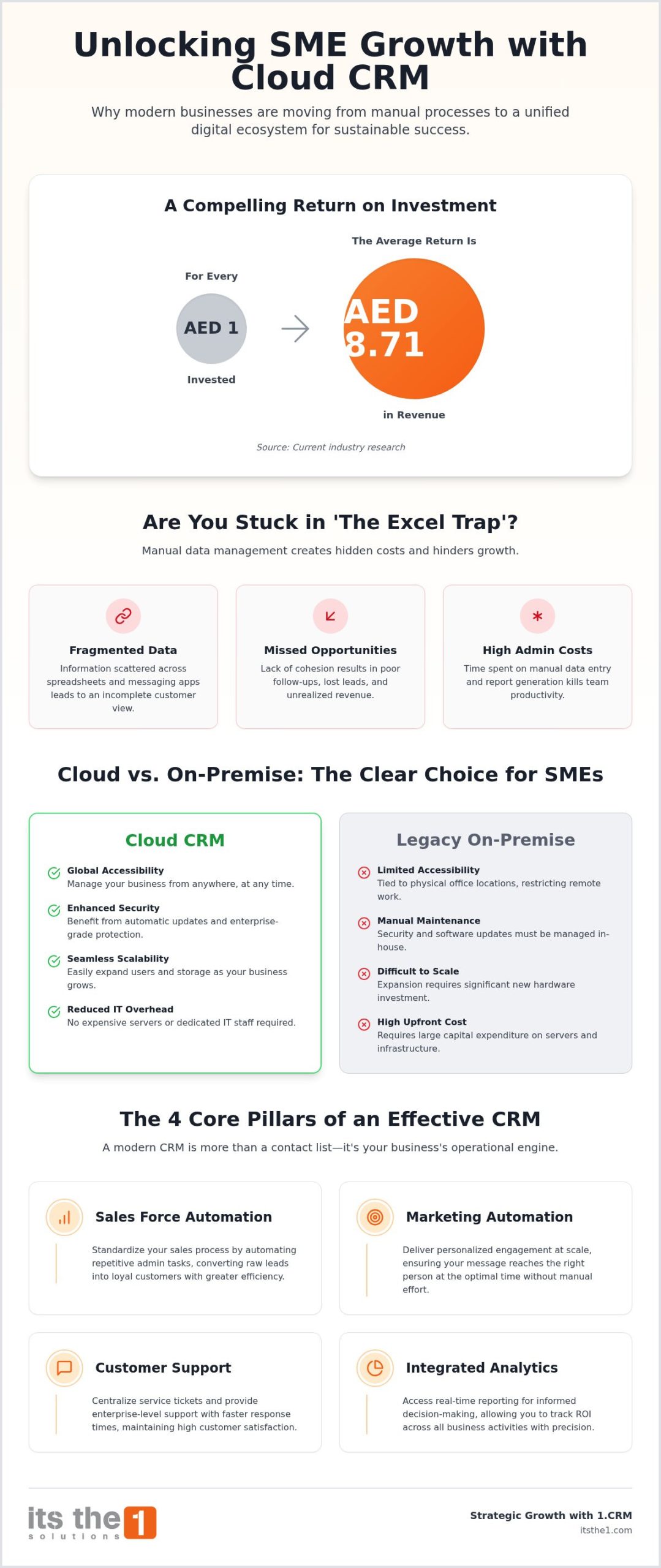
For every AED 1 your business invests in a sophisticated relationship management platform, the average return on investment stands at AED 8.71 according to current industry research. It’s a compelling figure that highlights why many growing firms are moving away from manual processes. You likely recognize the frustration of managing fragmented customer data across various spreadsheets and WhatsApp threads. This lack of cohesion often results in missed sales opportunities and high administrative costs that hinder your team’s productivity. Adopting a professional cloud CRM for SMEs serves as the foundation for modernizing these operations and reclaiming lost time.
Our guide explains how cloud-based systems empower your organization to eliminate data silos, automate sales, and drive sustainable growth through a structured digital transformation. We’ll explore the strategic advantages of the proprietary 1.CRM module and how it creates a single source of truth for your business. By the end of this article, you’ll understand how to implement automated pipelines that run 24/7, providing the clear visibility into business performance and ROI that is essential for competing in the UAE market.
Key Takeaways
- Learn why transitioning from manual spreadsheets to a unified digital ecosystem is essential for maintaining operational stability and data integrity.
- Identify the core functional pillars of sales and marketing automation that convert complex customer interactions into measurable business growth.
- Understand the financial advantages of a professional cloud CRM for SMEs, focusing on scalability and a reduced total cost of ownership.
- Follow a methodical implementation roadmap to audit existing data and ensure a seamless transition from legacy systems to the cloud.
- Discover how the proprietary 1.CRM module integrates into a wider business ecosystem to provide a research-driven foundation for scaling.
What is Cloud CRM for SMEs and Why Does it Matter in 2026?
A cloud CRM for SMEs is a centralized, internet-based platform designed to manage every facet of customer engagement within a single, unified interface. In 2026, this technology has moved beyond being a simple digital rolodex. It now serves as the operational heart of a business, facilitating professional digital transformation for firms that value efficiency and reliability. For enterprises in the UAE, adopting a structured approach to data is no longer optional. It’s the primary differentiator between businesses that struggle with administrative overhead and those that achieve sustainable, scalable growth.
The year 2026 represents a shift toward “Agility through Structure.” Small enterprises are increasingly moving away from “The Excel Trap,” where critical information is scattered across various local files and messaging apps. Instead, they’re embracing a unified digital ecosystem that provides a single source of truth. This transition is essential for modern digital transformation strategies, as it allows leadership to make decisions based on real-time data rather than intuition or outdated reports.
The Evolution from Spreadsheets to Centralized Intelligence
Manual data entry is often the silent killer of SME growth. When teams rely on spreadsheets or WhatsApp to track leads, they create data silos that prevent a 360-degree view of the customer journey. This fragmentation leads to missed follow-ups and lost revenue. Transitioning to a centralized system like 1.CRM allows businesses to move from reactive record-keeping to proactive relationship management. Instead of merely documenting what happened in the past, teams can use automated insights to predict what should happen next. This shift reduces the high cost of manual entry, allowing your staff to focus on high-value tasks that drive revenue.
Cloud vs. On-Premise: Why the Cloud Wins for SMEs
For smaller teams, the cloud offers a level of operational excellence that on-premise systems can’t match. The primary advantage is the total elimination of hardware maintenance. When you implement a cloud CRM for SMEs, you don’t need to invest in expensive server infrastructure or dedicated IT staff to manage local installations. This significantly reduces IT overhead and allows for a more predictable cost model. Additionally, cloud systems offer several key benefits:
- Global Accessibility: Manage your business operations from anywhere in the UAE or while traveling internationally, ensuring that your sales pipeline never stops moving.
- Enhanced Security: Benefit from automatic updates and enterprise-grade cybersecurity protocols that stay ahead of evolving threats without manual intervention.
- Seamless Scalability: Expand your user base and data storage as your revenue increases without needing to rebuild your entire IT foundation.
By leveraging cloud services, SMEs gain the stability and global reach typically reserved for much larger corporations, ensuring they’re prepared for the complexities of the 2026 business environment.
Core Functional Pillars: What Your SME CRM Should Actually Do
Operational excellence in 2026 requires more than just a digital address book. A professional cloud CRM for SMEs must function as a comprehensive engine that drives efficiency across the entire organization. To move beyond basic record-keeping, your system should be built upon four foundational pillars that ensure every customer interaction is purposeful and documented. It’s a shift from operational chaos to a structured, data-driven environment.
- Sales Force Automation (SFA): This pillar standardizes your sales process, converting raw leads into loyal customers by automating repetitive administrative tasks.
- Marketing Automation: It allows your team to deliver personalized engagement at scale, ensuring your messaging reaches the right person at the optimal time without manual effort.
- Customer Support Integration: By centralizing service tickets, you can provide enterprise-level support on an SME budget, maintaining high satisfaction rates through faster response times.
- Integrated Analytics: Real-time reporting offers the visibility needed for informed decision-making, allowing you to track ROI across all business activities with precision.
When these components work in harmony, they transform your business from a reactive entity into a proactive market player. As a trusted advisor in cloud services and digital evolution, we’ve observed that the most successful UAE firms prioritize these integrated functionalities to maintain a competitive edge and build long-term stability.
Sales Pipeline Management and Lead Scoring
Visualizing the customer journey is essential for identifying bottlenecks in your revenue stream. A visual pipeline provides a clear overview from the first point of contact to the final sale, allowing managers to allocate resources where they’re most needed. Automating follow-ups ensures that no lead is ever forgotten, even during peak business periods. Intelligent lead scoring also allows your team to prioritize high-value prospects based on their engagement levels. This data-driven approach ensures your sales efforts are always focused on the opportunities most likely to close, maximizing your team’s productivity.
Centralized Customer Data and Cybersecurity
Establishing a “Single Source of Truth” is the only way to eliminate the confusion caused by fragmented data. When every department accesses the same centralized record, you eliminate discrepancies and improve the speed of service. However, centralizing data also requires a rigorous approach to protection. Protecting sensitive customer information in a cloud environment involves encrypted storage and strict access controls that meet modern standards. The integration of a robust CRM with proactive cybersecurity protocols creates a resilient business safeguard that protects both corporate reputation and client trust. This synergy ensures that your digital transformation remains secure as you scale your operations across the UAE.
Cloud CRM vs. Legacy Systems: Calculating the Real ROI
Quantifying the value of a digital transition requires looking beyond the initial setup fees. While legacy systems often demand significant upfront capital expenditure (CapEx) for hardware and perpetual licenses, a cloud CRM for SMEs operates on a subscription model. This shift to operational expenditure (OpEx) provides predictable monthly costs that align with your business’s cash flow. Industry research indicates that businesses see an average ROI of AED 8.71 for every AED 1 spent on CRM software. This return isn’t just a theoretical number; it’s the result of reclaimed time and improved sales precision.
Efficiency gains are measurable through the reduction of administrative overhead. When your team stops manually cross-referencing data between disconnected systems, they gain hours back each week for high-value client engagement. These improvements in productivity directly impact your bottom line. Organized data also leads to higher customer retention rates. By maintaining a clear history of every interaction, you can provide the personalized service that builds long-term loyalty and increases the lifetime value of each client in the UAE market.
Scalability: Growing Your Business Without Changing Your Tools
A major risk for expanding firms is outgrowing their software, leading to a costly “re-platforming” nightmare. Modular systems like 1.CRM allow you to start with essential features and add complexity as your revenue increases. This flexibility ensures that your technology remains an asset rather than a bottleneck. Because our solutions are part of a broader ecosystem, you can easily integrate your CRM with other specialized modules. For example, a garment manufacturer can link 1.CRM with garment factory production tracking software for seamless production tracking, while a hospitality provider might integrate it with 1.TV to personalize the guest experience. This interoperability ensures your digital foundation stays firm as you scale.
The Hidden Costs of Sticking to Legacy Processes
The price of maintaining outdated processes is often higher than the cost of a modern subscription. Opportunity costs arise whenever a lead is lost due to a missed follow-up or a forgotten spreadsheet entry. These “leaks” in your sales funnel represent direct revenue loss that is difficult to recover. Security risks also escalate when sensitive customer data is scattered across unmanaged local files, leaving your business vulnerable to breaches that could damage your corporate reputation. Inefficient systems contribute to employee burnout. Top talent won’t stay in an environment where they’re forced to perform tedious, manual data entry that could easily be automated. Investing in a professional cloud environment protects your data, your revenue, and your human capital.
The Implementation Roadmap: Moving from Chaos to Cloud
Success in digital transformation depends on a methodical approach that respects the complexity of your current data. Transitioning to a cloud CRM for SMEs isn’t a simple software installation; it’s a phased evolution that requires discipline. The process begins with a comprehensive audit of existing data sources, such as WhatsApp threads and local spreadsheets, to define clear business objectives. Only after this audit should you select a modular system like 1.CRM that aligns with your specific industry requirements. Following a structured roadmap ensures that your investment yields the stability and growth you expect.
- Professional Data Cleansing: Removing duplicate records and outdated information before the migration ensures your new system remains a reliable source of truth.
- Cloud Migration: Moving cleaned data to the secure cloud environment under professional supervision to prevent loss or corruption.
- Staff Training: Introducing the platform to your team through structured sessions that emphasize the tool’s value in reducing their daily administrative workload.
- Managed Support: Utilizing ongoing optimization and helpdesk services to ensure the system evolves alongside your business growth in the UAE.
Why Managed Implementation Beats the DIY Approach
Professional IT consulting plays a critical role in bridging the gap between technical capability and business utility. While a DIY approach might seem cost-effective initially, it often results in common migration pitfalls like broken workflows or fragmented records. A managed implementation allows for deep customization, ensuring the CRM reflects your unique operational logic. As a trusted advisor, ITSthe1 provides the expertise needed to navigate these technical hurdles safely and efficiently. Explore our managed implementation services for a seamless transition to the cloud.
Ensuring High User Adoption Among Your Team
High user adoption is the final hurdle in any implementation roadmap. If the interface is too complex, staff will revert to their old, manual habits, which undermines the entire digital transformation. Designing the CRM for ease of use and intuitive navigation is essential for long-term success. Integrating a dedicated helpdesk ticketing app, such as 1.Support, ensures that your team has a reliable safety net during the initial weeks of the transition. Comprehensive staff training remains the single most important factor in determining the ultimate ROI of your CRM investment. This human-centric approach guarantees that the technology serves the team, rather than adding to their burden.
Strategic Growth with 1.CRM: The ITSthe1 Solutions Advantage
A successful digital strategy requires more than just functional software; it demands a foundation built on research and proven performance. The 1.CRM module is a proprietary solution designed specifically to address the nuances of modern small and medium enterprises. Since our establishment in 1999, ITSthe1 Solutions has acted as a trusted advisor for firms looking to move beyond basic operations into a phase of disciplined, strategic growth. With a strong global presence, we provide a localized understanding of diverse business environments, ensuring that your cloud CRM for SMEs complies with regional standards while maintaining a global reach.
A Unified Ecosystem for Enterprise and Hospitality
The true strength of 1.CRM lies in its ability to function as a modular component within a much larger, cohesive ecosystem. Instead of struggling with disconnected third-party applications, your business can leverage seamless integrations across our entire product family. This unified approach provides several strategic advantages for diverse sectors:
- Hospitality Integration: Connect 1.CRM with 1.Hotel and 1.AI to create a personalized guest journey supported by intelligent, automated staff assistance.
- Operational Synergy: Link your customer data with 1.DSMM for targeted digital signage or 1.ERP for integrated garment industry management.
- Streamlined Support: Utilize 1.Support to ensure that every client interaction is documented and resolved with professional precision.
This level of integration eliminates the technical friction that often accompanies business expansion. By working with an established provider that has spent over two decades refining these modules, you ensure that your technology stack remains stable as your revenue increases. Our methodology prioritizes operational excellence, ensuring every module feels like a deliberate part of your larger business ecosystem.
Managed IT and Cloud Services: Beyond the Software
Choosing ITSthe1 Solutions means gaining access to a comprehensive suite of managed services that support your digital infrastructure. We don’t just provide the CRM; we provide the professional cloud services and cybersecurity protocols required to keep your data safe. Our dedicated teams monitor your environment to stay ahead of evolving threats, ensuring that your corporate reputation remains untarnished. This holistic approach allows you to focus on your core business goals while we manage the technical complexities of your digital evolution. To begin your journey toward operational excellence, learn more about our 1.CRM solutions and professional consulting today.
Securing Your Competitive Advantage through Digital Evolution
Transitioning to a professional cloud CRM for SMEs is the definitive step toward operational excellence. By centralizing data and automating complex sales pipelines, your organization moves beyond the limitations of manual record-keeping. You gain a resilient infrastructure that scales with your revenue, ensuring that no lead is lost and every customer interaction is purposeful. It’s a strategic shift that converts operational chaos into a structured, data-driven workforce.
ITSthe1 Solutions has led expert-led digital transformations since 1999, providing the stability and global reach required for modern business success. With our global head office in Dubai since 2003, we understand the specific commercial landscape of the UAE. Our proprietary 1.CRM module offers a research-driven path to sustainable growth. It is a foundation designed to integrate seamlessly into a wider enterprise ecosystem, ensuring your digital assets remain secure and effective. Relying on a trusted advisor ensures your migration is efficient and your team’s adoption is seamless.
Empower your SME with ITSthe1’s 1.CRM and Professional Consulting to secure your market position today. We are ready to guide your organization through its next phase of digital maturity.
Frequently Asked Questions
What is the difference between a standard CRM and a cloud CRM?
A standard CRM typically requires local server installations and manual maintenance, whereas a cloud CRM is hosted on secure remote servers and accessed through an internet connection. This model eliminates the need for significant hardware investment. For many firms, a cloud CRM for SMEs provides the flexibility to access data from any location in the UAE, ensuring business continuity without the burden of physical infrastructure management.
Is cloud CRM secure for small businesses handling sensitive data?
Professional cloud systems are highly secure, utilizing enterprise-grade encryption and multi-factor authentication to protect sensitive data. Since our managed services include dedicated cybersecurity monitoring, your customer information is often safer in a professional cloud environment than on unmanaged local drives. These systems receive automatic security patches to defend against evolving threats, providing a resilient safeguard for your corporate reputation and client trust.
How long does it take for an SME to implement a cloud CRM system?
The timeline for implementation varies based on the volume of data and the complexity of your existing workflows. A typical transition for a small enterprise can range from a few weeks to several months. Our methodical roadmap prioritizes professional data cleansing and migration to ensure accuracy from day one. This structured approach prevents the common pitfalls of rushed deployments, ensuring a stable foundation for your long-term digital evolution.
Can cloud CRM integrate with my existing email and accounting software?
Yes, modern cloud systems are designed to integrate seamlessly with standard business tools like email platforms and accounting software. This interoperability eliminates the need for manual data entry across different applications. By connecting your 1.CRM module with your existing digital stack, you create a unified ecosystem that improves data flow and reduces administrative errors, allowing your team to maintain a single source of truth for all interactions.
What are the typical costs associated with cloud CRM for SMEs?
Cloud-based solutions move your IT costs from capital expenditure to a more predictable operational expenditure model. Instead of paying for expensive hardware and perpetual licenses upfront, you pay a subscription fee based on your usage. This approach makes professional digital transformation accessible for growing firms. It’s important to remember that the total cost of ownership also includes managed support and training, which are essential for maximizing your return on investment.
Does my SME need a full-time IT person to manage a cloud CRM?
You don’t need a full-time, in-house IT specialist to manage a professional cloud system. Because the software is hosted and maintained by the provider, the technical heavy lifting is handled externally. Choosing a partner that offers managed support and helpdesk services allows your team to focus on their core roles. We act as your trusted advisor, providing the expertise needed to optimize the system without increasing your permanent headcount.
How does cloud CRM improve sales team productivity?
Productivity increases when sales teams spend less time on manual data entry and more time on high-value client engagement. Automation features handle repetitive tasks like follow-up reminders and lead scoring, ensuring your staff prioritizes the most promising opportunities. With real-time visibility into the sales pipeline, managers can identify bottlenecks quickly. This structured environment empowers your team to work more efficiently, directly impacting your business’s overall ROI.