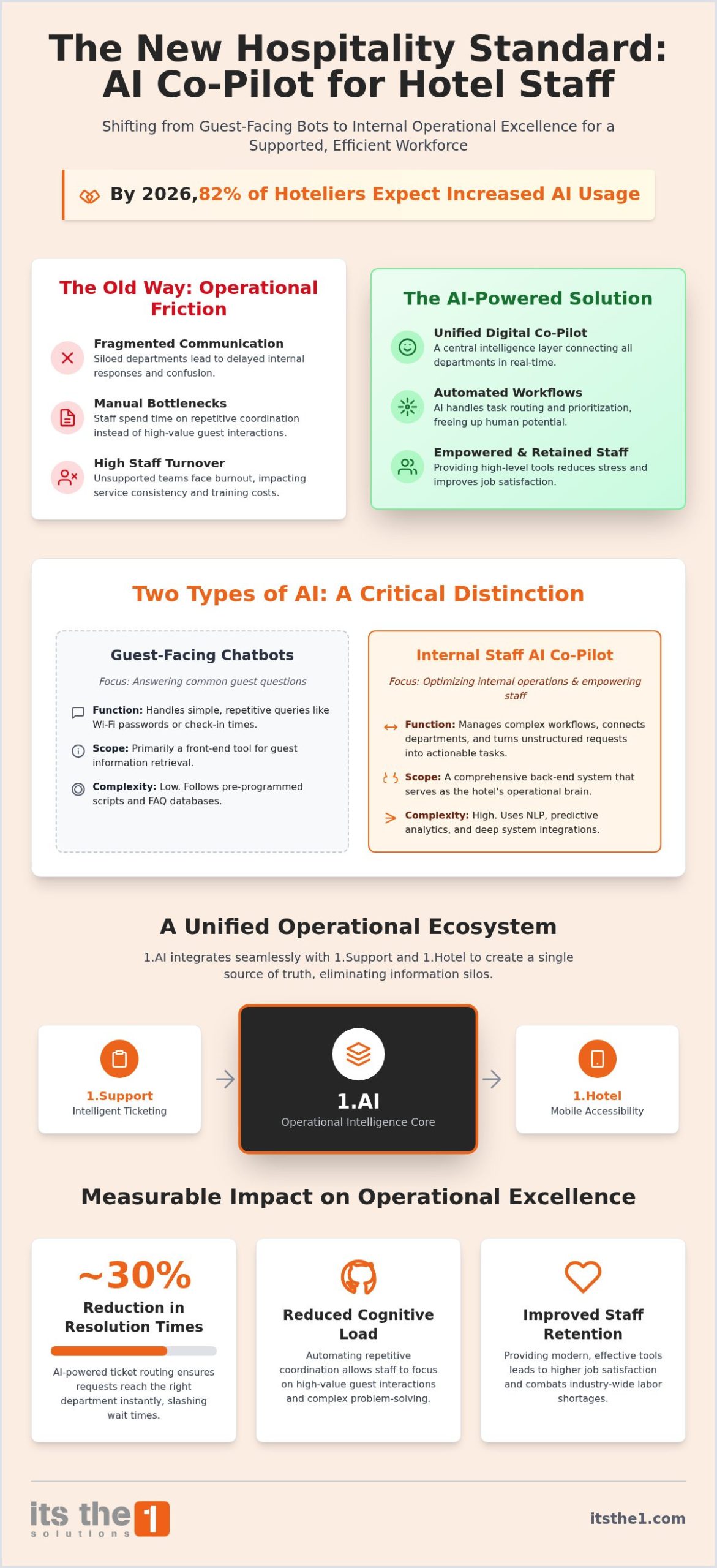
What if the primary driver of staff turnover isn’t the workload itself, but the fragmented communication and manual bottlenecks that prevent your team from doing what they love? By 2026, 82% of hoteliers expect AI usage across their organizations to increase, yet many still struggle with delayed response times for internal guest requests. Implementing a dedicated AI assistant for hotel staff provides the operational intelligence needed to bridge the gap between the front desk and back-of-house operations. It’s a strategic shift from simple guest-facing chatbots to sophisticated internal agents that act as a co-pilot for your employees.
You likely recognize that a supported workforce is the foundation of superior guest service, but the complexity of modern digital evolution can feel overwhelming. This article explores how specialized tools like 1.AI, when integrated with the 1.Hotel ecosystem and 1.Support ticketing modules, empower hospitality teams to resolve issues faster and reduce operational costs. We’ll examine the transition from basic automation to autonomous agents that handle complex internal workflows. You’ll learn how these technologies improve staff retention by providing the reliable, high-level tools your team needs to excel in a demanding global market.
Key Takeaways
- Understand the critical distinction between guest-facing chatbots and a specialized AI assistant for hotel staff designed to function as a sophisticated internal co-pilot.
- Discover how integrating the 1.AI module with 1.Support and 1.Hotel creates a unified ecosystem that eliminates manual communication bottlenecks between departments.
- Learn how automated request routing and “Human-in-the-Loop” workflows ensure complex hospitality needs are addressed with high-level precision and speed.
- Explore the strategic impact of AI-driven tools on operational excellence, specifically regarding cost reduction and improved staff retention through better resource management.
- Identify the essential steps for a successful digital transformation, from conducting a comprehensive IT audit to establishing clear KPIs for staff productivity.
What is an AI Assistant for Hotel Staff in 2026?
The definition of an AI assistant for hotel staff has evolved significantly. In 2026, it’s no longer just a digital interface; it’s a comprehensive digital co-pilot that manages the intricacies of hospitality operations from the inside out. While many properties focus on guest-facing chatbots to handle simple check-in queries, an internal helper like 1.AI prioritizes the productivity of the team. It uses Natural Language Processing (NLP) to interpret complex staff queries, turning unstructured requests into actionable tasks. This shift marks the transition from reactive helpdesks to a proactive, AI-driven management style where the system anticipates needs before they become bottlenecks.
The Core Components of 1.AI Intelligence
To drive operational excellence, 1.AI leverages real-time data processing. It connects directly with Property Management Systems (PMS) and CRM platforms to provide staff with immediate insights. This connectivity allows for automated task prioritization. For instance, housekeeping and maintenance teams receive updates based on guest checkout status or urgent internal tickets generated through 1.Support. Because hotel teams are often international, 1.AI includes robust multi-language support. This ensures that every department, regardless of the primary language of the employee, can operate with total clarity. Such integration is a cornerstone of AI in the hospitality industry, where operational precision is paramount.
Why Internal AI is the New Hospitality Standard
The hospitality sector continues to face a global labor shortage. This reality makes internal efficiency a necessity rather than a luxury. An AI assistant for hotel staff addresses this by reducing the cognitive load on front-desk and concierge teams. Instead of juggling fragmented communication across multiple channels, staff rely on a centralized intelligence layer to manage routine logistics. This ensures consistency in service standards, even across large properties with hundreds of rooms. By automating the repetitive coordination of guest requests, hotels can focus on high-value guest interactions. This directly combats the training gaps often caused by high staff turnover, as the AI maintains the property’s operational knowledge base regardless of personnel changes.
Key Features of a High-Performance Staff AI Co-Pilot
To achieve operational excellence, a high-performance AI assistant for hotel staff must serve as the connective tissue between disparate departments. It’s not enough to simply process data; the system must translate that data into immediate, departmental actions. High-performance systems prioritize mobile accessibility through integrated applications like 1.Hotel, ensuring that staff members remain connected while moving throughout the property. This mobility is supported by predictive analytics that forecast room readiness and inventory needs, allowing managers to allocate resources before a shortage occurs. Central to this efficiency is the seamless integration with ticketing platforms like 1.Support, which transforms guest communication into structured internal tasks.
Intelligent Ticketing and 1.Support Integration
The 1.AI module excels at categorizing and assigning tickets without the need for manual human intervention. By analyzing the intent behind a guest request, the system routes the task to the specific department responsible, whether it’s housekeeping, maintenance, or the concierge. High-priority issues trigger immediate escalation protocols, ensuring that urgent guest needs never go overlooked. It’s estimated that using 1.Support in tandem with AI can reduce resolution times by approximately 30%. You can explore these integrated hospitality solutions to see how they fit your property’s specific needs.
Knowledge Base Access for Instant Staff Training
Internal AI serves as a living repository for Standard Operating Procedures (SOPs) and hotel policies. Instead of searching through physical manuals or outdated digital folders, staff members can query the AI for instant answers regarding complex protocols. This capability significantly reduces “on-the-floor” training time for new hires, which is vital in high-turnover environments. By providing a reliable source of truth, the system empowers junior staff to handle intricate guest inquiries with the same confidence as seasoned professionals. This democratization of knowledge ensures that service standards remain consistent across all shifts. This level of support is exactly why an AI assistant for hotel staff has become an essential component of modern hospitality management.
Comparing AI Solutions: Staff Empowerment vs. Guest Chatbots
Guest-facing chatbots often fail to deliver on their promise because they operate in isolation. While these tools can answer basic questions, they frequently lack the internal connectivity required to fulfill physical requests. This creates a “digital dead end” where a guest interacts with a bot, but no action occurs behind the scenes. In contrast, an AI assistant for hotel staff serves as the bridge between guest expectations and back-of-house execution. By focusing on staff empowerment, hotels ensure that every digital interaction results in a tangible service outcome. This distinction is vital for maintaining the high standards expected in a luxury environment.
Bridging the Gap Between Guest and Back-of-House
In a unified ecosystem, the transition from a guest request to a completed task is seamless. When a guest uses 1.Hotel to request a service, 1.AI immediately evaluates the requirement and generates an actionable ticket within 1.Support. This process eliminates the “handshake” problem where requests are lost between the front desk and various departments. The system monitors these tasks in real time, providing automated follow-ups if a request isn’t acknowledged within a specific timeframe. This “Human-in-the-Loop” approach allows technology to handle the logistics while your team focuses on the high-touch elements of hospitality. It transforms a simple messaging tool into a robust operational engine that prevents service lapses.
Operational ROI: Beyond the Booking Engine
Evaluating the success of AI shouldn’t be limited to direct booking metrics. While revenue uplift is important, the most significant gains often come from operational cost reductions. Some industry reports suggest that integrating AI as a connective layer across systems can lead to a 60% reduction in operational costs with a payback period measured in weeks. These savings stem from the elimination of manual data entry and the reduction of training gaps. When you provide your team with an AI assistant for hotel staff, you’re investing in staff retention. Better tools lead to higher job satisfaction and lower turnover, which is critical in an industry where training new employees is a major expense. Centralized data also provides a long-term strategic advantage, allowing for precise decision-making based on documented operational performance.
Case Study: Achieving Operational Excellence with 1.AI
Large-scale hospitality environments require a level of coordination that manual systems simply cannot sustain. One major partner faced the significant hurdle of managing over 500 daily guest requests across a sprawling property. These requests spanned multiple departments, from housekeeping to technical support, often resulting in fragmented communication and delayed service. By deploying the 1.AI module as a dedicated AI assistant for hotel staff, the property aimed to unify these workstreams. This implementation wasn’t just about automation; it was about creating a reliable intelligence layer that could support the workforce in real time.
Phase 1: Integration and Data Training
The initial phase focused on connecting 1.AI directly to the property’s existing Management System. This connectivity allowed the system to access real-time occupancy data and guest profiles. The team trained the AI on specific hotel Standard Operating Procedures (SOPs) to ensure that every automated action aligned with the brand’s established service standards. A critical focus remained on cybersecurity and data protection, ensuring that guest information was handled with the highest level of integrity. This rigorous training period transformed the AI assistant for hotel staff from a general tool into a property-specific asset that understood the unique nuances of their guest demographics.
The Outcome: 40% Reduction in Staff Response Latency
The results of the 1.AI and 1.Support deployment were immediate and measurable. The property achieved a 40% reduction in staff response latency, with average resolution times dropping from 15 minutes to under 5 minutes. This efficiency gain allowed the team to handle a higher volume of requests without increasing headcount or compromising service quality. Beyond the numbers, staff reported a significant decrease in workplace stress, as the AI handled the repetitive task of ticket routing and follow-ups. This successful deployment demonstrates that 1.AI is a scalable solution capable of driving excellence across diverse hospitality portfolios. If you’re ready to modernize your operations, you can request a consultation with our technology experts to discuss a tailored roadmap for your property.
Implementing 1.AI: Your Roadmap to Digital Transformation
Successful digital transformation begins with a clear understanding of your current technical environment. A comprehensive IT audit and infrastructure assessment are the first steps to ensure your network can support real-time data processing. You should define clear Key Performance Indicators (KPIs) for staff productivity and guest engagement early in the process. These metrics provide a baseline for measuring the efficacy of your AI assistant for hotel staff. We recommend a modular approach to implementation. Starting with the 1.AI and 1.Support modules allows your team to master core internal automation before expanding into more complex guest-facing features. This phased rollout ensures that your staff isn’t overwhelmed by new technology while still achieving immediate operational gains.
Professional Consulting and Managed Support
Enterprise-level hospitality requires more than a simple plug-and-play installation. Professional implementation ensures that the AI is correctly mapped to your property’s unique workflows. ITSthe1 provides long-term managed IT support to ensure your system remains secure and efficient. This partnership allows your AI assistant for hotel staff to evolve as new hospitality trends and guest expectations emerge. It’s about maintaining a competitive edge through continuous optimization rather than a one-time setup. Relying on a partner with 25 years of experience provides the stability needed for such a significant strategic shift.
Expanding the Ecosystem: IPTV and Signage
Once the internal ticketing and AI co-pilot are operational, you can extend the intelligence layer to other guest touchpoints. Connecting 1.AI to 1.TV provides interactive hotel TV system support that reduces the burden on your concierge. You can also utilize 1.DSMM to display real-time operational metrics for staff in back-of-house areas. This transparency keeps every department aligned with current property goals and service levels. By integrating these modular components, you create a cohesive ecosystem that supports every aspect of the guest journey. To begin your journey toward a more efficient property, you should consult with ITSthe1 for a tailored AI roadmap today.
Securing the Future of Hospitality Operations
The shift toward internal digital intelligence isn’t just an option for properties aiming for long-term growth. By prioritizing an AI assistant for hotel staff, you bridge the gap between guest expectations and back-of-house execution. This strategic alignment ensures that every request is routed with precision, reducing response latency and minimizing the cognitive load on your team. It’s a fundamental change that moves your operations from reactive fire-fighting to proactive management, allowing your employees to focus on delivering a superior guest experience.
ITSthe1 brings 25+ years of hospitality IT expertise to every deployment, offering a global support network that ensures your technical needs are in capable hands. Our proprietary 1.AI module features seamless integration with 1.Support and 1.Hotel, creating a unified ecosystem designed for stability and high-level performance. Investing in a robust internal co-pilot is the most reliable way to achieve operational excellence and improve staff retention in a competitive market. Empower your hospitality team with 1.AI today and build a more resilient property for the years ahead.
Frequently Asked Questions
How does an AI assistant for hotel staff differ from a guest chatbot?
A guest chatbot primarily handles external inquiries like booking confirmations or check-in times. In contrast, an AI assistant for hotel staff focuses on internal productivity and back-of-house coordination. It translates guest requests into actionable tasks for housekeeping or maintenance teams. While guest bots are informational, staff-facing AI is operational. It integrates with tools like 1.Support to route tickets and manage internal workflows, ensuring that digital promises become physical services.
Can 1.AI integrate with my existing Property Management System (PMS)?
Yes, 1.AI is designed to integrate seamlessly with most modern Property Management Systems. This connectivity allows the AI to pull real-time room status, guest preferences, and occupancy data. By acting as a middleware layer, it ensures that your staff has immediate access to the information they need without switching between multiple platforms. This integration is essential for automating task prioritization and maintaining a unified data ecosystem across your entire property.
Will using an AI assistant lead to staff redundancies in my hotel?
No, the implementation of an AI assistant for hotel staff is intended to augment your existing team rather than replace them. The technology handles repetitive, manual tasks like ticket routing and data entry. This allows your employees to focus on high-touch guest interactions that require human empathy and problem-solving. By reducing the administrative burden, hotels often see improved staff retention and higher job satisfaction scores rather than a reduction in headcount.
How long does it take to implement a staff-facing AI assistant?
A typical implementation of the 1.AI module generally takes between four to eight weeks, depending on the complexity of your existing infrastructure. This timeframe includes the initial IT audit, system integration with your PMS, and data training on your hotel’s specific SOPs. We utilize a modular approach to ensure a smooth transition. This allows your team to adapt to the new digital co-pilot without disrupting daily operations or guest service standards.
Is guest data secure when using AI-driven hospitality tools?
Data security is a foundational component of the 1.AI architecture. The system adheres to global data sovereignty standards and employs advanced encryption for all guest information. In compliance with the transparency obligations of the EU AI Act of 2026, the system maintains rigorous access controls and audit logs. ITSthe1 also provides managed cybersecurity services to ensure that your property’s digital ecosystem remains protected against evolving threats and unauthorized data access.
What training is required for my team to use 1.AI effectively?
Training for 1.AI is designed to be intuitive and requires minimal “on-the-floor” time. Because the system utilizes Natural Language Processing, staff can interact with the assistant using standard conversational language. Most teams become proficient within a few days of hands-on usage. ITSthe1 provides comprehensive onboarding support and digital manuals to ensure that even junior staff members can handle complex operational queries with total confidence and technical precision.
Can 1.AI handle multi-language requests for international properties?
Yes, 1.AI features robust multi-language support to accommodate diverse, international hotel teams. The system can process and translate queries in real time, ensuring that language barriers don’t hinder internal communication. This is particularly useful for properties with a global workforce where housekeeping, maintenance, and front-desk teams may speak different primary languages. Clear communication ensures that service standards remain consistent regardless of the staff member’s linguistic background.
What is the expected ROI for implementing an AI assistant in operations?
Properties often see a significant return on investment through a combination of reduced operational costs and increased staff efficiency. Some industry data indicates that AI-driven operational intelligence can lead to a 60% reduction in resolution times. These gains are realized through the elimination of manual routing and a reduction in training gaps. Over the long term, the centralized data provided by the AI allows for more precise resource allocation and better strategic planning. Properties looking to maximize guest-facing ROI should also consider how a modern interactive hotel TV system can complement internal AI tools by transforming in-room screens into additional revenue-generating touchpoints.