Cloud solutions for hospitality industry operations should fit the systems a property already uses and the needs of the people who rely on them. A hotel’s cloud plan may involve applications, data storage and recovery, network security, and the connections between platforms. Start by understanding those requirements and dependencies, then decide which workloads are suitable for cloud hosting.
Planning around existing technology helps teams identify integration needs, security responsibilities, and the support required to keep operations running. This guide sets out a practical way to assess workloads, compare hosting options, and build a phased plan for guest services and day-to-day hotel operations.
Key Takeaways
- Review each hospitality workload against its operational purpose, data needs, dependencies, and recovery requirements.
- Inventory systems and map their connections before deciding what to host in the cloud.
- Include existing PMS, IPTV, and network systems in integration planning. Do not assume they will connect seamlessly.
- Set security and support responsibilities for each phase, then assess hosting options such as AWS, Azure, and Google against project requirements.
What Cloud Solutions for the Hospitality Industry Can Support
Cloud solutions for hospitality can include hosted applications, data storage and recovery, network security, and the connections between hotel platforms. The right mix depends on what each system does, the information it handles, and which other systems rely on it. For a foundational overview of service and deployment models, see What is cloud computing?
Cloud hosting provides a place to run systems, but hosting alone does not determine how those systems support guests, staff, security, and daily operations. A useful plan considers workloads and their dependencies together, rather than treating the move to hosted infrastructure as the entire technology strategy.
Which hospitality systems and workloads should be considered?
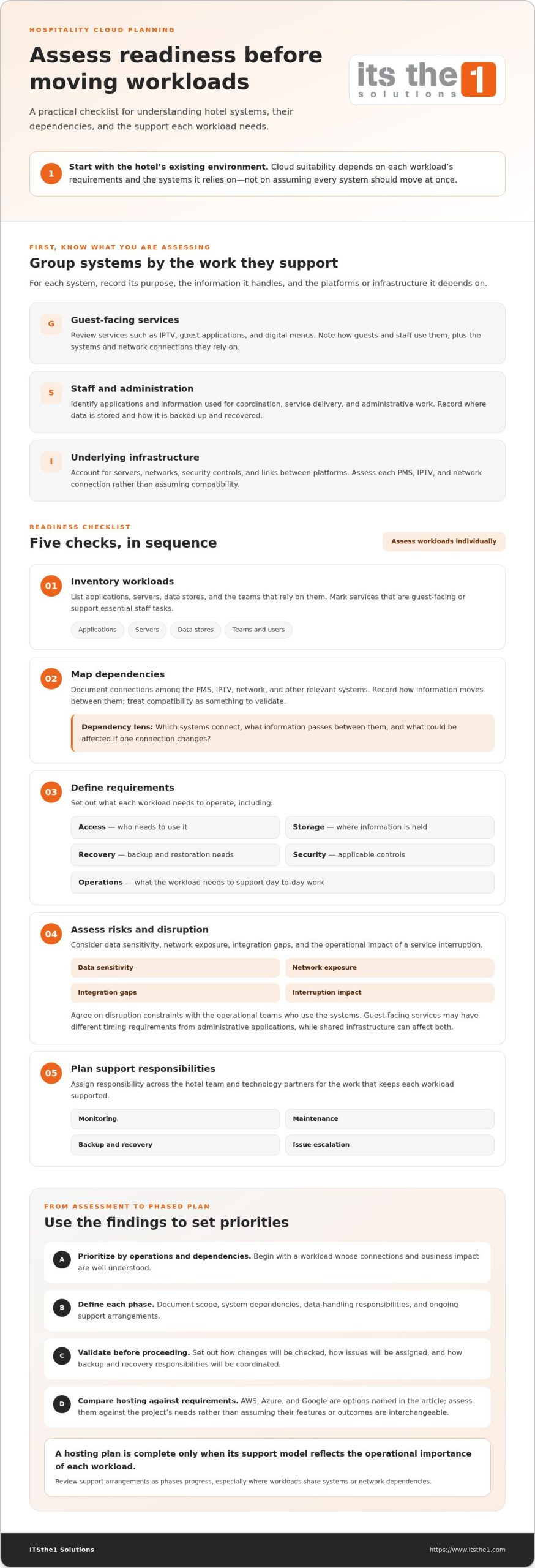
Group systems by the people who use them and the work they support. For each one, record its purpose, the information it handles, and the other platforms or infrastructure it depends on. This helps reveal operational dependencies before you decide what belongs in a cloud plan.
- Guest-facing services: Review services such as IPTV, guest applications, and digital menus. Map how guests and staff use them, and note any systems or network connections they rely on.
- Staff and administration: Identify the applications and information used for coordination, service delivery, and administrative work. Record where data is stored and how it is backed up and recovered.
- Underlying infrastructure: Account for servers, networks, security controls, and links between platforms. A property’s PMS, IPTV, and network can have different dependencies, so assess each connection instead of assuming compatibility.
For a closer look at one integration question, the existing guide to integrating IPTV with hotel PMS provides relevant system-planning context. These categories help connect cloud planning to the property’s actual operating environment.
How to Assess Cloud Solutions for Hospitality Before Planning a Move
Begin with the hotel’s existing environment, not a decision to move every system at once. Cloud suitability depends on each workload’s requirements and its dependencies on other systems. Assess applications individually so the plan reflects operational needs rather than assuming every workload is equally suitable for cloud hosting.
What should a hospitality cloud-readiness assessment cover?
For each workload, document the information it handles, who needs access, how data is backed up and recovered, and what network security controls apply. Then identify its dependencies. For example, a PMS, IPTV service, and property network may have separate integration points. Record those connections before setting priorities. Security planning should also consider guidance in an enterprise cybersecurity framework.
Use this sequence to turn the assessment into decisions:
- Inventory workloads: List applications, servers, data stores, and the teams that rely on them. Note which services are guest-facing or support essential staff tasks.
- Map dependencies: Document connections among the PMS, IPTV, network, and other relevant systems. Record how information moves between them and treat compatibility as something to validate.
- Define requirements: Set out access, storage, recovery, security, and operational needs for each workload.
- Assess risks: Consider data sensitivity, network exposure, integration gaps, and the operational impact of a service interruption.
- Plan support: Assign responsibility for monitoring, maintenance, recovery, and issue escalation across the hotel team and technology partners.
Before ranking workloads for a move, agree on disruption constraints with the operational teams that use them. Guest-facing services may have different timing requirements from administrative applications, while shared infrastructure can affect both. Use these requirements and dependencies to set phases and coordinate support.
ITSthe1 Solutions provides cloud hosting and consultancy as part of its IT and telecom services. Explore ITSthe1 Solutions’ cloud planning support as you assess your requirements.
How to Build a Hospitality Cloud Plan with Hosting and Ongoing Support
Use the assessment findings to create a phased plan based on operational priorities, system dependencies, and security responsibilities. Begin with a workload whose connections and business impact are well understood. Define how the team will validate the work before proceeding to systems that depend on it. This creates a structured way to review progress instead of treating cloud adoption as a single change.
For each phase, document its scope, system dependencies, data-handling responsibilities, and ongoing support arrangements. ITSthe1 Solutions provides Cloud Hosting options that include AWS, Azure, and Google. Compare options against the project’s requirements rather than assuming their features or outcomes are interchangeable. Consider hosting in the wider IT and telecom environment, including on-premise and cloud servers, data backup, storage, recovery, and network security.
Where can a technology partner contribute?
A technology partner can help bring hosting decisions together with the surrounding IT and telecom environment. ITSthe1 Solutions provides cloud hosting and consultancy alongside related IT and telecom services. Its Annual IT Network Maintenance Contract includes Service Level Agreements. These can inform support planning, with responsibilities and service expectations defined for the project.
A hosting plan is complete only when its support model reflects the operational importance of each workload. Before implementation, document how changes will be validated, how issues will be assigned, and how backup and recovery responsibilities will be coordinated. Review these arrangements as phases progress, especially where workloads share systems or network dependencies.
To discuss a hospitality cloud plan, connect with ITSthe1 Solutions about its cloud and IT services.
Make Your Next Cloud Decision Deliberate
Turn your priorities into a roadmap that can adapt as your property’s technology changes. Treat cloud planning as an ongoing process: revisit system dependencies when services change, keep support responsibilities clear, and align future technology decisions with the experience you want guests and staff to have.
You do not need to address every workload at once. A useful plan gives your team a basis for deciding what to address first, how to manage the transition, and how to support the environment over time. With requirements and dependencies clearly documented, cloud hosting can fit into a broader technology direction rather than becoming a standalone project.
Discuss your hospitality cloud requirements with ITSthe1 Solutions and take a considered next step toward a plan that fits your operations.
Frequently Asked Questions
What are cloud solutions for the hospitality industry?
They are hosted technology services and infrastructure arranged to support a hotel’s digital operations. A property might host some applications while keeping other systems on-site. Assess how each arrangement affects staff access, guest services, information handling, and connections to existing systems rather than assuming every component should use the same hosting approach.
Which cloud platform is best for hotels?
There is no single platform that suits every hotel. Compare options against workload requirements, existing integrations, security responsibilities, internal expertise, and the support model your team needs. ITSthe1 Solutions’ Cloud Hosting options include AWS, Azure, and Google. The appropriate option depends on project requirements, so assess each against the needs of the workloads in scope.
Can hotel systems work with cloud services?
Hotel systems can work with cloud services when their technical interfaces and operating requirements support the intended connection. Compatibility depends on the specific systems and their configuration. Before committing, validate a representative workflow, such as whether a change in one system appears where staff expect to see it, and document any manual steps that remain.
Is cloud hosting secure for hospitality businesses?
Cloud hosting can be part of a secure environment, but security depends on how services are configured and managed. Define responsibility for user access, network controls, software updates, and data protection. Review who can access sensitive information and how unusual activity is handled. Reassess security controls as systems, staff roles, and operational needs change.