
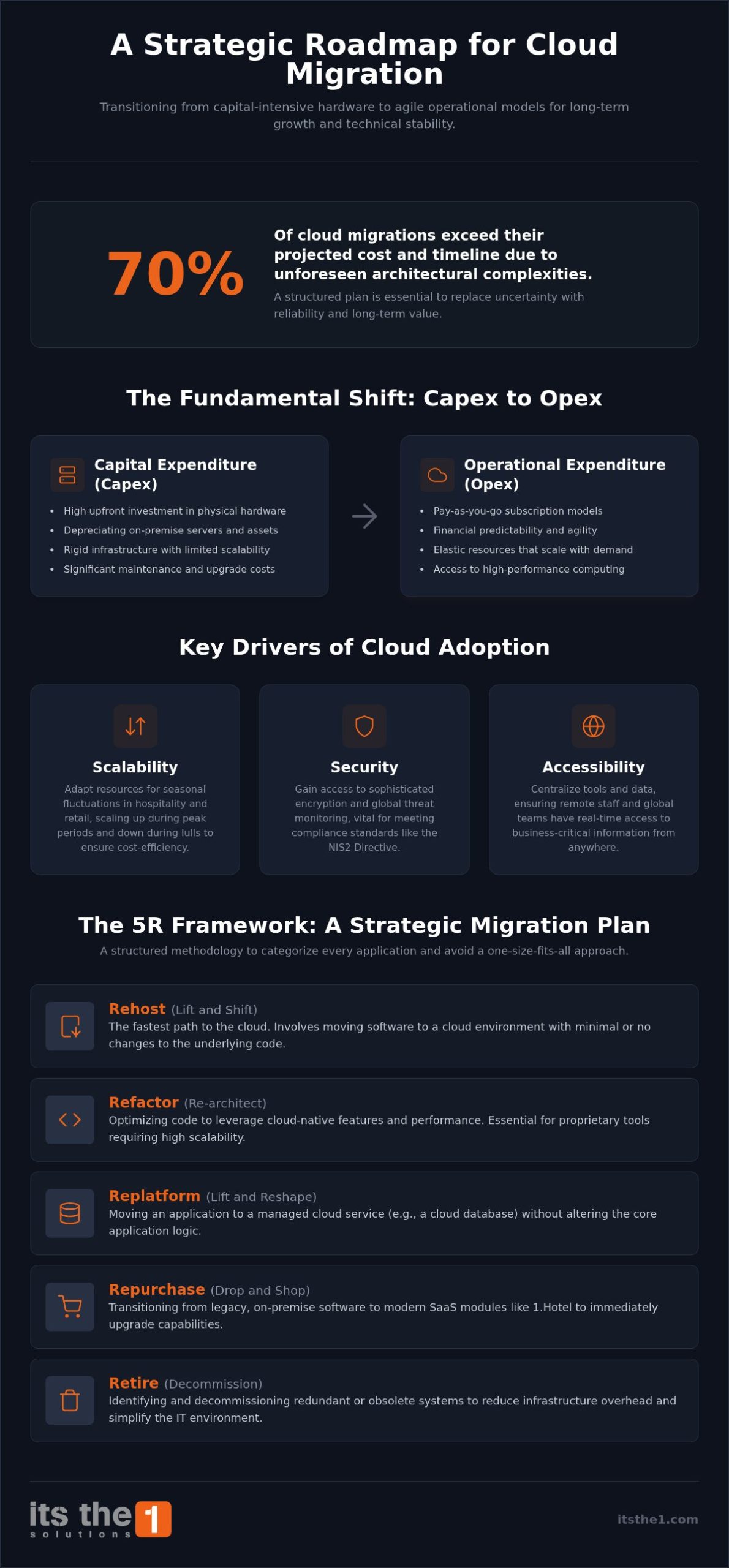
Recent industry data indicates that 70% of cloud migrations exceed their projected cost and timeline because of architectural complexities. As you evaluate cloud migration services for business, it’s clear that the transition is no longer a choice but a requirement for operational excellence. For an organization managing legacy ERP systems or specialized hospitality software, this move often brings a valid fear of operational downtime and unpredictable expenses.
You’ve likely found that maintaining stability while modernizing is a delicate balance. This guide serves as your strategic manual for navigating these complexities with a focus on reliability and long-term value. We’ll provide a structured roadmap for your digital evolution, focusing on how to reduce infrastructure overhead while maintaining strict compliance with evolving standards like the NIS2 Directive.
We will examine the 7Rs framework and identify selection criteria for partners who understand the nuances of proprietary modules such as 1.TV or 1.ERP. Our objective is to replace uncertainty with a clear, methodical plan that secures your proprietary software and enhances global scalability.
Key Takeaways
- Understand how to transition from capital-intensive hardware to agile operational models that support long-term business growth and technical stability.
- Evaluate the 5R framework to determine whether a rapid “lift and shift” or a deep code refactoring is the most efficient path for your legacy applications.
- Discover how to select the optimal cloud migration services for business by balancing the scalability of public clouds with the enhanced security of private environments for sensitive ERP data.
- Learn proven strategies to minimize operational downtime and maintain data integrity during the transfer of complex hospitality and financial systems.
- Identify the critical criteria for selecting a strategic partner with a 25-year track record in specialized sectors like IPTV and garment industry ERP modernization.
Understanding Cloud Migration Services for Modern Enterprises
Cloud migration denotes the methodical transfer of digital assets, including data, applications, and core IT processes, from localized on-premise hardware to secure, scalable cloud environments. Engaging professional cloud migration services for business is no longer a peripheral IT project; it’s a fundamental shift in how modern enterprises manage their technical debt. By 2026, over 85% of organizations are expected to adopt a “cloud-first” principle, making this the definitive year for retiring legacy systems that can no longer support modern operational demands.
This transition represents a critical move from Capital Expenditure (Capex) to Operational Expenditure (Opex). Instead of depreciating physical servers, national businesses now leverage subscription models that offer financial predictability. This flexibility is essential for deploying AI-driven tools like 1.AI, which require the high-performance computing power only found in cloud ecosystems. A deep understanding of cloud computing models allows leaders to align their technical infrastructure with overarching growth objectives.
Drivers of Cloud Adoption in the Current Market
Strategic migration is fueled by the need for enterprise-grade performance and stability. Key drivers include:
- Scalability: Hospitality and retail sectors face intense seasonal fluctuations. Cloud environments allow these businesses to scale resources up during peak periods and down during lulls, ensuring cost-efficiency.
- Security: Moving beyond localized firewalls, enterprises gain access to sophisticated encryption and global threat monitoring. This is vital for meeting 2026 compliance standards like the NIS2 Directive.
- Accessibility: Centralizing tools like 1.CRM or 1.Hotel ensures that remote staff and global teams maintain real-time access to business-critical data.
Types of Cloud Migration Services
Organizations typically select a service model based on their specific technical requirements and internal capabilities. These models define the level of control and management required:
- Infrastructure-as-a-Service (IaaS): This involves migrating core servers and networking to the cloud while maintaining control over the operating systems and applications.
- Platform-as-a-Service (PaaS): Developers use this model to build and manage custom software without the complexity of maintaining the underlying infrastructure.
- Software-as-a-Service (SaaS): This is the most common transition for business applications. It involves moving to fully managed tools such as 1.Support for helpdesk management or 1.CRM for client relations, eliminating the need for local installations.
The 5R Framework: A Strategic Roadmap for Migration
Successful cloud transitions require a structured methodology to categorize every application in your technical portfolio. The 5R framework provides a clear logic for determining the future of each system, ensuring that resources are allocated where they’ll provide the most value. By applying these categories, enterprises can avoid the common mistake of treating every application with a one-size-fits-all approach.
- Rehost (Lift and Shift): This is the fastest path to the cloud for legacy applications. It involves moving the software to a cloud environment with minimal changes to the underlying code.
- Refactor (Re-architect): This strategy involves optimizing code to leverage cloud-native features and performance. It’s essential for proprietary tools that require high scalability.
- Replatform: This involves moving an application to a managed service, such as a cloud-hosted database, without altering the core application logic.
- Repurchase: This strategy involves transitioning from legacy software to modern SaaS modules like 1.Hotel, which immediately modernizes the guest and staff experience.
- Retire: This focuses on identifying and decommissioning redundant or obsolete systems, which can significantly reduce infrastructure overhead and simplify the environment.
Phase 1: Assessment and Discovery
Before any data moves, a rigorous audit of the current infrastructure is essential. This discovery process identifies workloads that are truly cloud-ready and maps the intricate dependencies between hospitality IPTV systems, such as 1.TV, and guest databases. Failure to map these links can lead to unexpected outages in guest-facing services during the transition. The Discovery phase is the foundation of zero-downtime migration. By following migration readiness and best practices, organizations can avoid common pitfalls that often lead to cost overruns.
Phase 2: Strategy and Architecture Design
Designing a resilient architecture requires a balance between performance, security, and compliance. Most modern enterprises opt for multi-cloud or hybrid environments to ensure maximum redundancy. This design must strictly adhere to national data residency and cybersecurity standards to protect sensitive guest and financial records. A Pilot phase is established to test critical enterprise ERP functions, ensuring the new environment supports complex workflows before the final cutover. Engaging professional cloud migration services for business ensures that these architectural decisions align with your long-term operational goals and technical stability.
Comparing Cloud Models: Public, Private, and Hybrid
Selecting the correct deployment model is a strategic decision that defines the long-term efficacy of your IT infrastructure. Modern organizations rarely rely on a single platform. Instead, they utilize a combination of environments to satisfy diverse operational needs. Research indicates that over 85% of enterprises now operate in hybrid and multi-cloud environments. This diversified approach allows leaders to leverage professional cloud migration services for business while maintaining rigorous standards for data sovereignty and system availability.
Public Cloud for Scalable Growth
Public clouds, such as AWS, Azure, and Google Cloud, offer unparalleled scalability and lower initial entry costs. These platforms are ideal for guest engagement applications and high-traffic customer portals. By utilizing pay-as-you-go licensing models, businesses can optimize their technical spend to match actual usage. For enterprises with an international footprint, the global reach of public providers ensures that staff and guests experience low latency regardless of their physical location. This model provides the burst capacity needed to handle seasonal peaks in hospitality without permanent hardware investments.
Private and Hybrid Clouds for Data Sovereignty
Certain workloads require the heightened control offered by private infrastructure. This is particularly true for sensitive garment industry ERP data or proprietary manufacturing processes that demand strict privacy. Private clouds ensure that critical assets remain within a dedicated environment, protected by enterprise-grade security protocols tailored to specific industry regulations.
Hybrid models provide a balanced approach for hospitality groups that maintain on-site hardware requirements. For example, integrating on-site 1.TV IPTV hardware with cloud-based management consoles allows for centralized control without sacrificing local performance. This architecture is vital for managing real-time production tracking in apparel manufacturing, where even minor latency can disrupt operations. Insights from federal agencies’ cloud migration strategies suggest that a phased approach to these complex integrations minimizes risk and ensures that resources are allocated efficiently during the transition.
A multi-cloud strategy further enhances resilience by distributing workloads across multiple providers. This avoids vendor lock-in and maximizes service availability. If one provider experiences an outage, critical business functions can failover to a secondary cloud environment. This level of redundancy is essential for maintaining guest trust and operational continuity in a 24/7 global economy. By spreading risk, businesses ensure that their cloud migration services for business deliver a robust, future-proof foundation for digital growth.
Overcoming Common Migration Challenges and Risks
Moving business-critical systems is a complex endeavor that requires meticulous planning to avoid operational friction. While the benefits of modernization are clear, the execution phase often presents risks that can disrupt a company’s momentum. Professional cloud migration services for business prioritize risk mitigation through structured protocols designed to protect data and maintain uptime. By addressing these hurdles early, organizations can transition with confidence.
Downtime remains a primary concern for hospitality and manufacturing leaders. To minimize disruption, we recommend phased cutovers and off-peak migrations. This strategy ensures that guest-facing services or production lines remain active while back-end systems are transitioned in stages. Data integrity is equally vital. When transferring complex guest records or financial data from legacy systems to modules like 1.ERP, zero-loss protocols are mandatory. We utilize rigorous validation checks to ensure every record is accounted for post-migration.
Cost sprawl is another common pitfall. Organizations often see cloud spending escalate due to unoptimized resource allocation or forgotten instances. Post-migration, it’s essential to monitor usage patterns and adjust subscriptions to match actual demand. This financial discipline prevents the “bill shock” that can occur when moving from fixed hardware costs to variable cloud fees. Managing these variables requires a partner who treats migration as a managed evolution rather than a one-time event.
Ensuring Cybersecurity During Transition
The “transit” phase of migration is when data is most vulnerable to interception. Implementing end-to-end encryption ensures that enterprise data remains secure as it moves between environments. We also establish Identity and Access Management (IAM) protocols from day one to restrict system access to authorized personnel only. A comprehensive cybersecurity audit is an essential prerequisite that identifies existing vulnerabilities before the migration process begins.
Managing Post-Migration Operational Efficiency
Success in the cloud depends on continuous oversight and staff readiness. Managed IT Support plays a critical role in monitoring cloud health and addressing performance bottlenecks before they impact the user experience. The human element is also vital. Staff must be trained to navigate new cloud-based tools such as 1.Support or 1.Menu to ensure the business realizes the full value of its investment. Continuous optimization involves adjusting cloud resources in real-time based on actual usage data, ensuring peak performance without unnecessary expenditure. For organizations looking to extend this operational model further, exploring enterprise IT support outsourcing provides a strategic framework for building a high-performance managed model that scales alongside your business.
To secure your enterprise transition with a partner who understands these complexities, explore our specialized cloud migration services for business.
Why ITSthe1 is the Strategic Partner for National Cloud Migration
ITSthe1 Solutions has been at the forefront of digital transformation since 1999. With our global headquarters established in the UAE since 2003, we possess a profound understanding of the national business landscape and its specific regulatory requirements. Our cloud migration services for business are rooted in a “Trusted Advisor” philosophy, where we prioritize the long-term technical stability of our partners over simple vendor transactions. This legacy of excellence allows us to guide enterprises through the complexities of cloud adoption with a composed and disciplined approach.
Our expertise extends beyond generic IT support. We specialize in the migration of proprietary modules designed for high-stakes environments, such as specialized 1.ERP systems for the garment industry and global hospitality groups. By leveraging a methodical research and testing philosophy, we ensure that every transition is a deliberate step toward operational excellence. Our national reach, combined with an established global footprint, provides the reliability required by organizations managing complex, sensitive data sets across multiple regions.
Specialized Migration for the Hospitality Sector
Hospitality environments require a seamless integration between guest-facing technology and back-end efficiency. We facilitate the transition of specialized tools like 1.DSMM (Digital Signage & Meeting Room) and 1.ID (Passport & ID Scanning) to the cloud, ensuring these systems remain responsive and secure. Centralizing these displays and scanning protocols allows staff to provide a more personalized guest experience while reducing administrative friction during check-in. Our team ensures that your IPTV and guest app ecosystems are optimized for high-performance cloud environments, maintaining the high standards of service your guests expect without the overhead of localized hardware.
Enterprise-Grade Support and Managed Services
A successful migration is only the first phase of a long-term digital strategy. We provide 24/7 technical assistance and proactive network infrastructure management to ensure your cloud-based hospitality and corporate stacks remain resilient. This managed support is essential for preventing downtime and addressing performance bottlenecks before they impact your bottom line. Organizations seeking to complement this with a broader operational strategy will find that a structured approach to enterprise IT support outsourcing can further reduce costs and strengthen cybersecurity posture across all environments. Our capability in custom web and mobile application development allows us to enhance your cloud functionality, ensuring your proprietary tools evolve alongside your business goals. This holistic approach ensures that your investment in cloud migration services for business delivers sustained value and strategic growth.
Securing Your Enterprise Legacy through Strategic Modernization
Transitioning to a cloud-first infrastructure requires more than just technical execution; it demands a partner who understands the intricate dependencies of your specific industry. By applying a structured 5R roadmap and selecting the optimal hybrid or multi-cloud model, your organization can achieve the scalability and security necessary for sustained growth. We’ve examined how professional cloud migration services for business mitigate the risks of operational downtime while preparing legacy systems for an AI-integrated future.
ITSthe1 Solutions brings 25+ years of global IT expertise to every project, acting as a trusted advisor through each phase of your digital evolution. Whether you’re migrating specialized hospitality modules like 1.TV and 1.Hotel or modernizing enterprise ERP stacks, our national reach and managed support ensure your technical needs are in capable hands. We prioritize stability and operational excellence so you can focus on strategic expansion.
Partner with ITSthe1 for your seamless cloud migration strategy. Your path to a more resilient and agile business environment is well within reach.
Frequently Asked Questions
What are the primary benefits of cloud migration for a national business?
Transitioning to the cloud allows national businesses to replace heavy capital investments in hardware with predictable subscription models. This shift enhances operational agility, enabling organizations to scale resources in response to seasonal demands. Additionally, centralized data management improves collaboration across multiple regions. By utilizing cloud migration services for business, enterprises gain access to advanced security protocols and disaster recovery capabilities that are often too costly to maintain on-premise.
How long does a typical cloud migration project take for an enterprise?
The duration of an enterprise migration typically ranges from three months to over a year, depending on the complexity of the technical environment. A simple “lift and shift” of a few applications might be completed within a single quarter. However, modernizing legacy ERP systems or integrating complex hospitality modules like 1.TV requires a more methodical approach. Meticulous planning during the discovery phase ensures that the transition remains steady and purposeful.
Will our business experience downtime during the cloud migration process?
Strategic planning significantly reduces the risk of downtime during the transition. We utilize phased cutovers and off-peak migration windows to ensure that business-critical functions remain active. For hospitality groups, this means guest-facing apps and IPTV services continue to run while back-end databases are synchronized. By establishing a pilot phase to test functionality before the final switch, we maintain operational continuity and instill confidence in the migration’s success.
How does cloud migration impact our existing cybersecurity infrastructure?
Cloud migration modernizes your security posture by replacing localized firewalls with enterprise-grade protection and global threat monitoring. While existing local protocols may change, the transition introduces sophisticated encryption and Identity and Access Management (IAM) tools. These systems ensure that sensitive data remains protected throughout the transit phase. Professional cloud migration services for business incorporate comprehensive audits to close any vulnerabilities, ensuring compliance with 2026 standards such as the NIS2 Directive.
Can we migrate our legacy ERP system to the cloud without losing data?
Yes, legacy ERP systems can be migrated securely by employing rigorous zero-loss data protocols. The process involves a detailed audit of existing guest and financial records followed by a structured transfer to the new environment. We use validation checks to confirm that every data point is accurately reflected in the cloud-hosted version of 1.ERP. This methodical approach ensures that your historical data remains intact, providing a stable foundation for future growth and analytics.
What is the difference between a lift-and-shift migration and re-platforming?
A lift-and-shift migration, also known as rehosting, involves moving applications to the cloud exactly as they are with minimal changes. In contrast, re-platforming involves making minor optimizations to the application to take better advantage of cloud features without changing its core architecture. While rehosting is the fastest path for legacy software, re-platforming offers a balance between speed and improved performance. Both strategies are part of the broader 5R framework for digital evolution.
How do we calculate the ROI of cloud migration services for our business?
Calculating ROI involves comparing the Total Cost of Ownership (TCO) of on-premise hardware against the operational costs of a cloud environment. Businesses should factor in the reduction of maintenance expenses, energy costs, and hardware depreciation. Beyond direct savings, ROI is measured through increased staff productivity and the ability to deploy revenue-generating tools like 1.Hotel more quickly. High-performance cloud systems also reduce the financial impact of potential downtime or security breaches.
What post-migration support services does ITSthe1 provide?
ITSthe1 provides a comprehensive suite of managed services to ensure your cloud environment remains healthy and efficient. This includes 24/7 technical assistance for hospitality and corporate stacks, alongside proactive network monitoring. We also offer staff training for new modules like 1.Support or 1.Menu to maximize user adoption. Our commitment to excellence includes continuous resource optimization, where we adjust your cloud configurations based on real-time usage data to prevent cost sprawl.





One comment on “Cloud Migration Services: Strategic Guide for 2026”