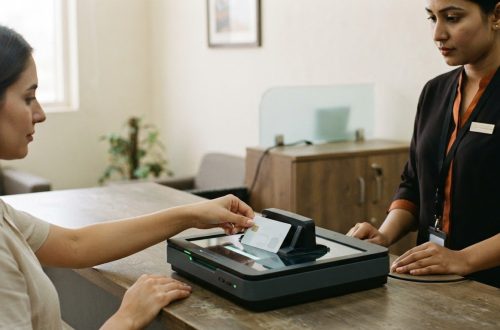
What if the value of hotel technology could be measured not only in savings, but also in revenue and staff time available for guest service? Making that case can be difficult: guest experience is hard to translate into currency, upfront IT investment invites scrutiny, and performance data often sits across separate platforms. A hotel technology ROI calculator brings these factors into a consistent financial framework.
This article explains how to compare the full cost of an investment with measurable returns, from reduced manual work to additional sales. It also shows how to build a practical case for systems such as 1.TV and 1.ID without treating projected benefits as guaranteed outcomes. You’ll learn which inputs to track, how to include maintenance in your calculations, and how an integrated technology approach can help you understand total cost of ownership over time.
Key Takeaways
- Use a hotel technology ROI calculator to compare the full investment cost with measurable savings and revenue gains. Track guest satisfaction separately as a supporting measure.
- Set a credible baseline by documenting manual tasks, such as passport data entry, then measure the time involved before and after introducing 1.ID.
- Estimate potential sales linked to guest-facing tools such as 1.Menu, and evaluate 1.TV against the guest experience and operating outcomes you can measure.
- Include implementation, licensing, maintenance and staff time when comparing options. An integrated approach can also help you assess vendor management and total cost of ownership.
The Fundamentals of a Hotel Technology ROI Calculator
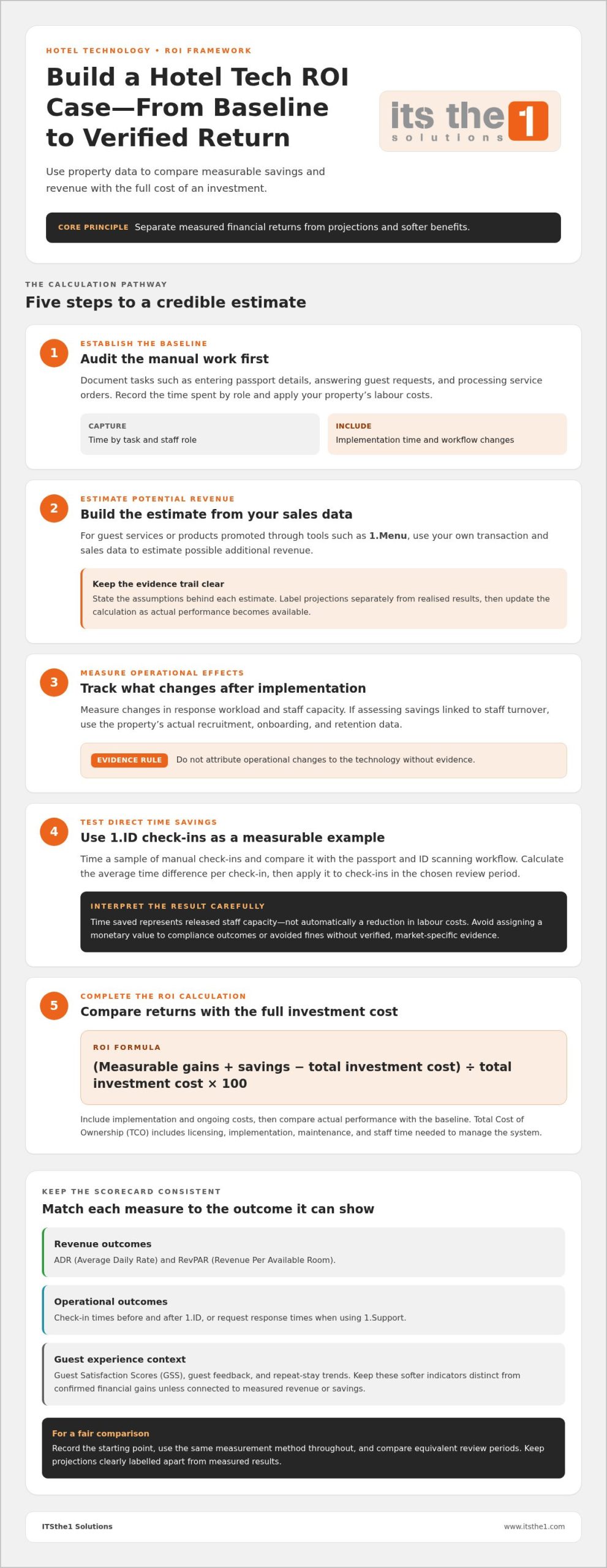
A hotel technology ROI calculator should account for more than room-rate growth. Calculate return on investment as net profit from the investment divided by its total cost, multiplied by 100. For a foundational overview of the formula, see Understanding Return on Investment (ROI). For a hotel technology project, identify the financial gains and savings you can measure, then subtract the full cost of the investment. Guest satisfaction and brand loyalty can provide useful context, but should not be counted as financial returns unless you can connect them to measured revenue or savings.
Hard ROI covers measurable outcomes, such as labour hours saved through automation or revenue from additional sales. Soft ROI includes benefits that are harder to value in currency, such as guest satisfaction and stronger brand loyalty. Track these through indicators such as guest feedback and repeat-stay trends, but keep them distinct from confirmed financial gains in board reporting.
Assess each technology on its own contribution before considering the combined value of multiple systems. For example, 1.TV supports in-room television experiences, while 1.Hotel is a mobile app for guests and staff. Together, they provide different guest and staff touchpoints, but integration alone does not prove a financial return. Record the costs and outcomes for each system, then include shared benefits only when you can measure them. A consistent, brand-aligned experience can also support guest recognition across these touchpoints.
Key Performance Indicators (KPIs) for Modern Hospitality Tech
Choose KPIs that connect the technology to property performance. ADR (Average Daily Rate) and RevPAR (Revenue Per Available Room) help track revenue outcomes, while Guest Satisfaction Scores (GSS) indicate how guests perceive their stay. Pair these with operational measures relevant to the system: compare check-in times before and after introducing 1.ID, or track request response times when using 1.Support. Record the starting point, use the same measurement method throughout, and compare equivalent review periods.
Total Cost of Ownership (TCO) is the full cost of a technology investment over its lifecycle. Include licensing, implementation, maintenance and the staff time needed to manage the system. This broader view helps prevent a low initial cost from obscuring ongoing expenses.
A Step-by-Step Framework for Calculating Your Returns
Build your estimate from property data rather than generic assumptions. A hotel technology ROI calculator is most useful when it reflects actual workflows, staffing costs and operating requirements. Compare equivalent periods before and after implementation, and label projections separately from results you have measured.
- Audit manual processes. Document how staff handle tasks such as entering passport details, responding to guest requests and processing service orders. Record the time spent by role and apply your property’s labour costs to establish a baseline. Include staff time spent on implementation and any changes to existing workflows.
- Estimate potential revenue. Identify guest services or products promoted through tools such as 1.Menu. Use your own transaction and sales data to estimate possible additional revenue, and state the assumptions behind the estimate. Keep projections separate from realised results, then update the calculation as actual performance becomes available.
- Measure wider operational effects. Track changes in response workload and staff capacity after introducing a technology. If you assess savings related to staff turnover, use your property’s actual recruitment, onboarding and retention data. Do not attribute changes to the technology without evidence.
Calculating Direct Savings with 1.ID and Automated Systems
To evaluate 1.ID, time a sample of manual check-ins, then compare the results with the passport and ID scanning workflow. Calculate the average time difference per check-in and apply it to the number of check-ins in your chosen review period. The mobile passport scanning guide offers further context on check-in efficiency. Treat any time saved as released capacity, not an automatic reduction in labour costs. Avoid assigning a monetary value to compliance outcomes or avoided fines without verified, market-specific evidence.
Include implementation and ongoing maintenance on the cost side of the calculation, then compare actual performance with your baseline. For a broader view of hospitality technology, explore ITSthe1 Solutions’ hospitality technology solutions.
Maximising ROI through Integrated Hospitality Ecosystems
A connected guest journey can involve systems used by different departments. 1.TV supports in-room television, while 1.Cast is a Chromecast-based solution that lets guests cast their own content to the TV. The casting solution stores or logs no guest data or credentials on the TV system. When assessing its contribution, consider guest engagement and privacy alongside the costs of setup and support.
A fragmented technology stack can add integration work, complicate support and make total costs harder to see. A “One Stop Technology Partner” approach can help coordinate related hospitality systems and simplify vendor management. Use a hotel technology ROI calculator to include licensing and implementation alongside maintenance and the staff time required to manage separate systems. Compare those costs with a coordinated approach using the same assumptions and review period.
Include maintenance arrangements in your long-term ROI model. ITSthe1 offers an IPTV Maintenance Contract, and its IT network services include an Annual Maintenance Contract (AMC) with Service Level Agreements (SLA). Record the applicable costs and scope, then track maintenance activity, system performance and operational interruptions over time. This keeps your calculation grounded in the technology’s lifecycle, not just its initial deployment.
Leveraging ITSthe1’s 20+ Years of Strategic Expertise
ITSthe1’s proprietary 1.TV middleware supports an interface customised to brand standards, helping properties shape a digital experience that reflects their identity. To assess signage as part of a wider technology plan, explore this guide to hotel digital signage software. Founded in 1999, ITSthe1 brings more than 20 years of IPTV expertise and provides consultancy, turnkey implementation, maintenance and ongoing support for hospitality technology. These services can help properties plan for both deployment and lifecycle requirements.
For hotels planning an integrated approach, explore ITSthe1’s hospitality technology solutions as a starting point for aligning guest-facing systems with operational priorities.
Turn ROI Insights into Your Next Technology Decision
Turn your ROI analysis into a practical decision plan. Identify the operational priority with the clearest evidence, agree how you will measure progress, and use the results to inform future investments. A hotel technology ROI calculator is most useful when it guides ongoing decisions, not just an initial approval.
Before committing to a long-term investment, consider how implementation, system compatibility and maintenance fit your property’s operating model. ITSthe1 provides IPTV consultancy and turnkey solutions, helping hotels plan technology around their operational priorities and brand standards.
Explore ITSthe1’s hospitality technology solutions to discuss how your priorities can translate into a clear investment plan. A disciplined approach helps you make technology decisions based on measured costs, realistic assumptions and outcomes that matter to your property.
Frequently Asked Questions
How long does it typically take to see a return on hotel technology investments?
There is no single payback period. It depends on the property, implementation, staff adoption and the benefits being measured. Use a hotel technology ROI calculator to estimate when cumulative net returns might cover the investment, then compare the projection with actual results at regular intervals. If you introduce the technology in stages, use each stage to review adoption and refine your assumptions before proceeding.
Does the ROI calculator account for staff training and implementation time?
It should. Include training and implementation effort in the investment estimate, even when staff time is not a separate invoice. Record the hours employees spend on training and setup, along with any temporary changes in productivity during the transition. This gives decision-makers a fuller view of the resources required and helps distinguish short-term adoption costs from ongoing operating costs.
What is the ROI of an IPTV system compared to traditional cable TV?
It varies by property, service agreements and how guests use the system, so there is no reliable universal comparison. Assess the current cable and proposed IPTV arrangements using equivalent content and service assumptions, then include implementation, maintenance and operational changes. Consider guest engagement and brand presentation as separate indicators unless you can connect them to measured revenue or savings.
Can automated check-in systems like 1.ID actually reduce front-desk labour costs?
1.ID is a Passport & ID Scanning Solution, but time saved on manual data entry does not automatically lower payroll costs. Measure handling time across comparable check-ins, then assess whether the released capacity changes overtime, peak-period coverage or staff responsibilities. The financial return depends on how the hotel uses that time and whether the change affects actual staffing expenditure.