The lowest subscription price does not necessarily mean the lowest total cost. Hotel guest messaging gives guests digital channels to contact hotel teams, while staff manage and respond to conversations. The cost of guest messaging and communication platforms depends on factors such as conversation volume, property count, channels, and integration depth.
Comparing platforms can be difficult when pricing models and included capabilities differ. This guide explains how hotel guest messaging works, what to include when assessing total ownership costs, and how five options compare. It also outlines which features matter for different hotel operations, so you can focus on the fit and ongoing costs rather than the subscription price alone.
Key Takeaways
- Hotel messaging can help organise guest requests and routine replies, while complaints and sensitive matters need staff attention.
- Assess total ownership cost by considering conversation volume, property and channel count, integration depth, and implementation needs.
- Compare platforms by channel coverage, reservation-data connections, and how well each fits your hotel’s operational needs.
- Explore how ITSthe1 Solutions’ 1.Hotel hospitality app can support communication between guests and hotel staff.
What is hotel guest messaging?
Hotel guest messaging lets guests send requests through channels such as WhatsApp, while hotel teams manage conversations and coordinate responses. Automation can handle routine questions, but operational requests still need a clear route to the right staff member.
In the UAE, hotels should make consent clear, explain why guest data is collected, and control access and retention under applicable data-protection requirements. Specific obligations depend on the data and applicable rules, so a messaging channel alone should not be treated as consent.
AI Guest Response Handling
AI can interpret a guest message, answer a routine question, or direct a request to staff. For example, it may answer a question about breakfast hours, then route a complaint or accessibility request to a person. Unlike fixed routines, AI responds to the conversation’s content. Reporting should distinguish automated replies from requests resolved by staff.
Reviewed Replies and Automated Routines
Reviewed replies use staff-approved wording for recurring questions, such as directions to the hotel or information about facilities. A routine can match a guest’s message to an approved response, while staff handle requests that fall outside it. Compared with AI, this approach is narrower but gives hotels more control over exact wording. Track usage and unresolved conversations to refine the reply library.
Event-Triggered Guest Messages
Event-triggered messages are sent when a defined event occurs, such as a booking confirmation or an approaching arrival. Unlike AI and reviewed replies, these messages are initiated by timing rather than a guest’s question. Use them for relevant updates, then route replies into the team’s conversation workflow so follow-up requests are not missed.
For operational resolution, connect incoming requests to an owner and status, such as “housekeeping assigned” or “maintenance complete.” A unified inbox can bring WhatsApp and other conversations together, but teams still need to assign and resolve work. Gartner projected that 70% of guest interactions would take place through tools such as mobile messaging by 2022, compared with 15% in 2018. Reporting on response handling, automation rates, and open requests helps hotels assess performance.
| Approach | How it handles messages | Operational focus |
|---|---|---|
| AI responses | Interprets message content | Routine answers and routing |
| Reviewed replies | Uses approved wording | Consistency and control |
| Event triggers | Sends messages at defined events | Timely guest updates |
| Unified inbox | Consolidates channels | Conversation visibility |
| Staff-led workflow | Assigns requests to people | Resolution and follow-up |
Choose the approach that matches the request type, required staff oversight, and reporting needs.
Platform pricing and total cost of ownership
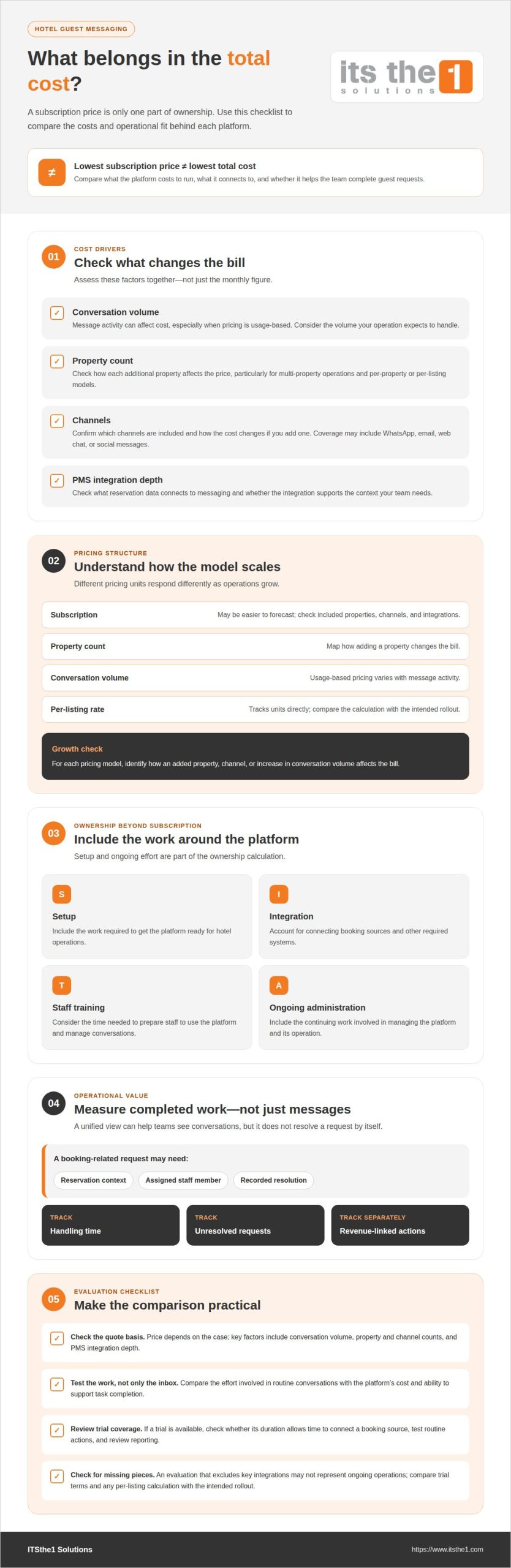
Hotel messaging costs involve more than a subscription: conversation volume, property and channel counts, and PMS integration depth all influence the total. For UAE hotels, assess these alongside operational fit rather than treating the monthly figure in isolation.
Value and Operational Efficiency
Value depends on whether the platform helps hotel teams complete tasks, not simply receive messages. For example, a booking-related request may require reservation context, an assigned staff member, and a recorded resolution. Include setup, integration, staff training, and ongoing administration in your ownership calculation. The price depends on the case and is provided after a quote request; key factors include conversation volume, property and channel counts, and PMS integration depth.
Compare the work involved in managing routine conversations with the platform’s cost. Automation can support hospitality operations, but a unified view alone does not resolve a guest request. Track handling time, unresolved requests, and revenue-linked actions separately to assess whether the investment supports the hotel’s priorities.
Pricing Models and Scalability
Pricing may be based on a subscription, property count, conversation volume, or per-listing rate. Each structure responds differently as a hotel grows. A per-listing model tracks units directly, while usage-based pricing varies with message activity. A fixed subscription may be easier to forecast, but the included properties, channels, and integrations determine its practical value.
For a multi-property operation, map expected growth against each pricing unit. Identify how an added property, channel, or increase in conversation volume affects the bill. This makes scalability easier to compare without relying on the headline rate.
If a trial is available, assess its duration against the time needed to connect a booking source, test routine actions, and review reporting. A short evaluation that excludes key integrations may not represent ongoing operations. Compare the trial terms and per-listing calculation with the intended rollout. For a broader view of hospitality technology solutions, consider how guest communication fits into the hotel’s wider systems.
Comparison of five guest messaging platforms
Messages can be missed when channels remain separate, ownership is unclear, or teams fail to track request status. Data breaches are another risk if guest information is exposed through weak access controls or mishandled accounts.
These five platform types differ in channel coverage, reservation context, and how staff manage response workflows. The table compares their typical operational focus rather than ranking individual brands.
| Platform type | Channel | Reservation context | Best suited to |
|---|---|---|---|
| Unified hotel inbox | WhatsApp, email, web chat, social messages | Varies by connection | Managing conversations together |
| AI-response platform | Digital messaging channels | Useful for context-aware replies | Handling routine interactions |
| PMS-connected messaging | Guest messaging channels | Arrival date, room type, booking status | Reservation-specific communication |
| Short-term rental platform | Airbnb, SMS, email, WhatsApp | Booking and stay details | Rental-focused guest conversations |
| Direct web-chat tool | Hotel website chat | May require a separate connection | Pre-booking questions and responses |
A unified inbox consolidates channels, but it does not automatically reduce workload: teams still need to assign requests and update their status. A PMS connection can provide reservation details, helping staff tailor arrival messages and responses. Short-term rental tools prioritise channels familiar to rental guests, while direct web chat focuses on website interactions. Language support and channel coverage also shape the guest experience, especially when conversations arrive through separate systems.
Choose according to your main booking source, guest channels, and staff workflow. To discuss how hospitality technology can support guest communication, contact ITSthe1 Solutions.
ITSthe1 Solutions: 1.Hotel – Hospitality App for Guests and Staff
ITSthe1 Solutions offers 1.Hotel, a hospitality app for guests and staff, as a relevant option for hotels assessing digital guest communication. It fits operations looking to bring guest-facing and staff-facing app use into their hospitality technology planning.
Consider 1.Hotel when evaluating how an app for guests and staff aligns with your hotel’s communication priorities and wider digital setup. Define the guest and staff needs the app should address, then assess how it fits alongside your existing processes. This keeps the decision grounded in operational requirements rather than a feature comparison alone.
For hotels reviewing guest communication as part of a broader technology plan, ITSthe1 Solutions can discuss 1.Hotel and its relevance to your requirements. Contact ITSthe1 Solutions to discuss your hospitality app needs.
Shape the next stage of your guest experience
Use your technology decisions to create a more connected guest journey. Before adding another tool, identify where communication meets other hotel touchpoints and decide which operational priorities should guide future investment. This broader view helps place guest messaging and communication platforms within a considered hospitality technology strategy.
ITSthe1 Solutions offers 1.TV for enterprise and hospitality IPTV, 1.DSMM for digital signage and meeting rooms, and 1.ID for passport and ID scanning. These offerings address different parts of hotel technology planning, alongside 1.Hotel for guests and staff. Each should be considered according to the operational need it is intended to serve.
When you’re ready to explore how these priorities apply to your hotel, contact ITSthe1 Solutions. A clear next step can help turn your guest experience priorities into a practical technology direction.
Frequently Asked Questions
Does a unified inbox reduce the front desk’s workload?
A unified inbox can reduce coordination overhead, but it will not automatically eliminate front-desk tasks. Assign an owner to each conversation, separate urgent service requests from information queries, and establish escalation rules for unanswered messages. During shift handovers, review open requests alongside completed work. This shows whether the inbox improves task visibility or simply puts messages on one screen.
How can I simplify guest communication across different booking channels?
Use one intake process for messages from each booking channel, with a consistent way to identify the guest and reservation. Give each conversation a clear owner and status, and keep handover notes where the next staff member can find them. For example, a guest changing an arrival time should receive one coordinated response, not conflicting replies from separate teams.
How do I compare hotel chatbots fairly?
Test each chatbot with the same hotel scenarios, including a room amenity question, a booking change, and a complaint requiring staff attention. Compare answer accuracy, handoff quality, conversation history, language handling, and the effort needed to maintain responses. Use a written scorecard and record where each tool requires human intervention. This makes comparisons more consistent than relying on demonstrations alone.
Is a hospitality-specific AI better than a generic chatbot builder?
Not in every case: the better fit depends on the hotel’s workflows and resources. A hospitality-focused system may align more closely with guest enquiries and hotel operations, while a general builder may offer flexibility for customised conversation flows. Consider who will configure and maintain it, how staff take over complex conversations, and whether it suits the hotel’s existing guest-service process.
What should a new Airbnb host look for in guest communication software?
Choose guest messaging and communication platforms that work with the channels your guests use, such as Airbnb, SMS, email, or WhatsApp. Prioritise clear conversation ownership, reusable check-in instructions, and a straightforward way to track unanswered guest questions. If you manage multiple listings, also consider whether messages can be organised by property, so arrival details are not confused between bookings.