The right hotel workflow automation ideas often start with a handoff, not a new app. When guest requests or staff tasks move between teams manually, it can be hard to see what needs attention, who owns the next step, or whether the task is complete. That makes choosing a useful automation opportunity a question of operational fit, not simply a search for more technology.
Automation should support a connected, personal guest experience rather than add another disconnected process. This guide compares guest-facing and internal workflows, with practical criteria for assessing integration needs, staff usability, and day-to-day value. It also explains how options such as 1.Hotel and 1.Support may fit into a broader hospitality technology environment, without assuming that one tool covers every step. Use the guidance to map a current handoff and choose a manageable next step for your hotel.
Key Takeaways
- Separate automating a defined task from redesigning an entire operation to keep the scope practical.
- Compare guest requests, service information, and check-in data capture by the friction each creates and how well a solution fits.
- Map each workflow’s owners, exceptions, and system dependencies before assessing technology options.
- Replacing every existing system may not be necessary. Verify integration scope and technical requirements for the workflow you prioritise.
Hotel Workflow Automation Ideas: Where Manual Handoffs Create Friction
Automating a defined task is not the same as redesigning an entire hotel operation. Start by identifying a recurring handoff, clarifying who owns it, and noting where information is recorded or repeated. Then assess whether technology could support that step. Business process automation (BPA) offers a useful framework for considering how structured processes can be supported by technology.
Potential hotel workflow automation ideas include capturing and routing guest requests, coordinating staff follow-up, collecting check-in information, and making service details easier to access. Treat these as opportunities to investigate, not promises that a particular tool will automate every step or produce a specific result. For example, 1.Support is a helpdesk ticketing app and 1.Hotel is a hospitality app for guests and staff. Assess each against the workflow requirements rather than assuming a particular function.
Which hotel workflows are strongest candidates for automation?
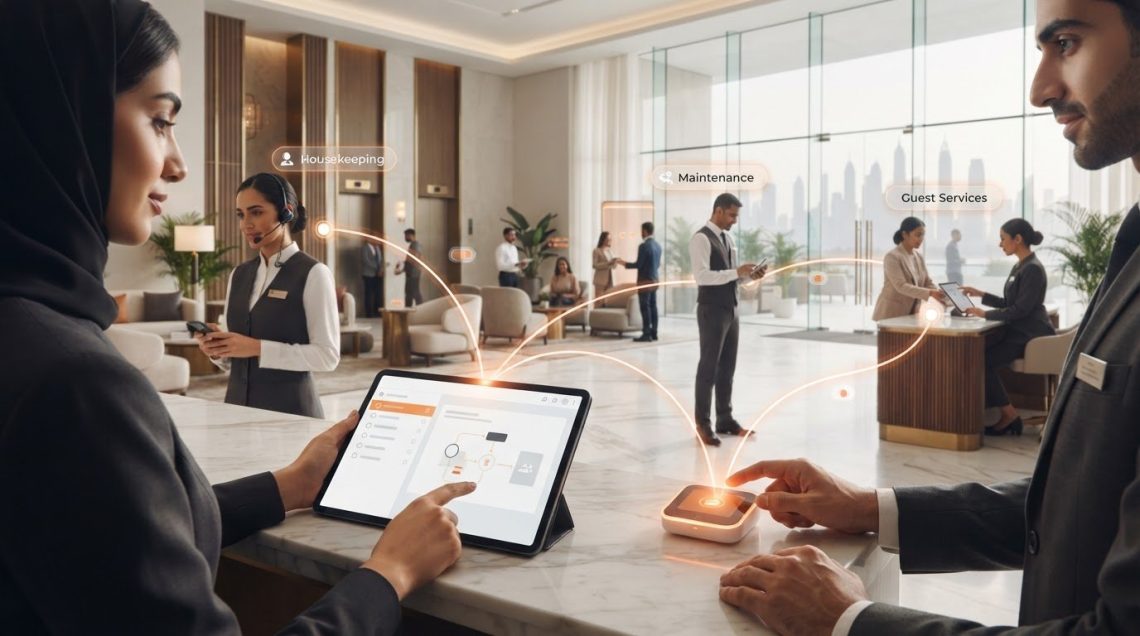
Look first at repetitive, rule-based steps with clear ownership and a visible handoff. A guest request that needs to reach the responsible team, or an internal service ticket that needs assignment and follow-up, may be worth mapping. Record where the request starts, where its details are stored, who acts next, and how staff confirm completion. If those steps are unclear, define the process before evaluating technology.
Not every request should follow the same route. Sensitive issues, unusual circumstances, and requests that require judgement need a clear path to a staff member. Before introducing technology, define when to escalate, who handles incomplete requests, and what happens when a case falls outside standard procedures. The aim is to support coordination while preserving human attention where it matters.
Hotel Workflow Automation Ideas to Compare Across Guest and Staff Journeys
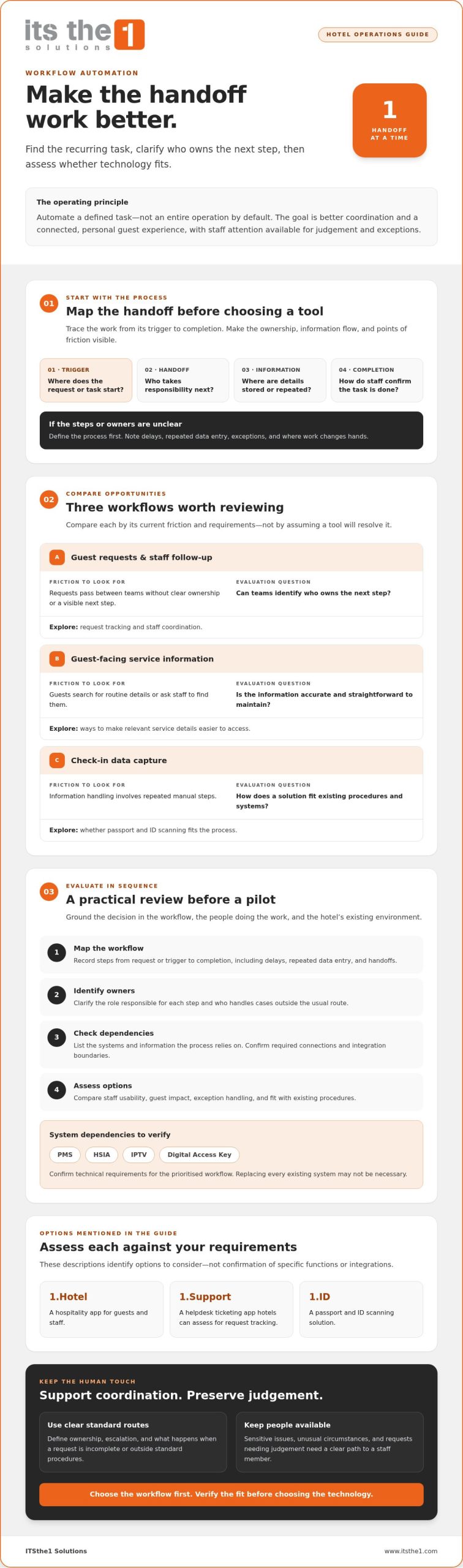
Compare hotel workflow automation ideas by the friction each process creates, not by assuming a tool will resolve it. The table outlines three opportunities to review. For each one, document the current steps, identify the people and systems involved, and verify product capabilities and staff requirements before choosing a solution.
| Workflow | Current friction | Automation opportunity | Evaluation question |
|---|---|---|---|
| Guest requests and staff follow-up | Requests may pass between teams without clear ownership or a clear next step. | Assess tools that could support request tracking and staff coordination. | Can teams identify who owns the next step? |
| Guest-facing service information | Guests may need to search for routine details or ask staff to find them. | Review ways to make relevant service information easier to access. | Is the information accurate and straightforward to maintain? |
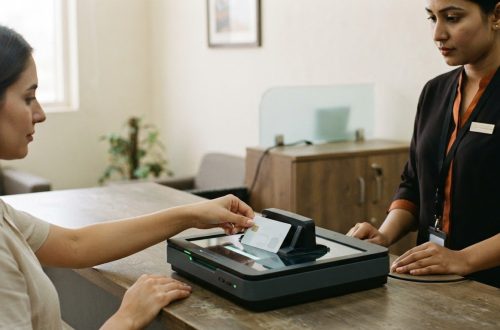
| Check-in data capture | Information handling may involve repeated manual steps. | Evaluate whether a passport and ID scanning solution fits the process. | How does it fit with existing procedures and systems? |
How can guest and staff workflows connect without losing the human touch?
Choose technology that supports communication while leaving staff available for judgement, personal assistance, and exceptions. 1.Hotel is an app for guests and staff, while 1.Support is a helpdesk ticketing app that hotels can assess for request tracking. 1.ID is a passport and ID scanning solution. These descriptions identify options to consider, not confirmation of specific functions or integrations. Review the hospitality technology portfolio alongside your requirements, then confirm the technical scope before deciding how tools may fit together.
How to Evaluate Hotel Workflow Automation Before Choosing a Solution
Choosing among hotel workflow automation ideas is easier when you define the process before selecting a product. A hotel may not need to replace every existing system. First, establish what the workflow requires, then verify whether a potential solution can work with the hotel’s current environment and identify any integration boundaries.
What should a hotel check before piloting a workflow?
Use this evaluation sequence to keep the decision grounded:
- Map the workflow: Record the steps from request or trigger to completion, including delays, repeated data entry, and points where work changes hands.
- Identify owners: Clarify which role handles each step and who takes responsibility when the usual route does not apply.
- Check dependencies: List the systems and information the process relies on, including any data staff need to complete the task.
- Assess options: Compare staff usability, guest impact, exception handling, and fit with existing procedures.
For system dependencies, confirm whether the required connections to a PMS, HSIA, IPTV, or Digital Access Key are supported for the specific workflow. ITSthe1 Solutions hospitality technology solutions can integrate with existing hotel subsystems, but the scope and technical requirements should be confirmed for the project. Ask which data or actions can pass between systems, what needs separate handling, and what must be validated before a pilot. A general compatibility statement is not a substitute for checking the hotel’s actual setup.
Keep the first step manageable. Document one workflow, such as how a request moves between teams, and use that map to discuss requirements with a hospitality technology partner. A clear process gives the hotel team and potential providers a concrete basis for evaluating fit without assuming an outcome in advance. Explore the hospitality technology portfolio from ITSthe1 Solutions as part of that review.
Make Your Next Workflow Decision with Confidence
The most useful hotel workflow automation ideas begin with a clearly defined handoff, not a commitment to replace every system. Map one process, identify who owns each step, and assess whether a potential solution fits staff needs, guest expectations, and existing technology.
Options such as 1.Hotel, a hospitality app for guests and staff, and 1.Support, a helpdesk ticketing app, may suit different operational requirements. ITSthe1’s hospitality technology solutions can integrate with existing hotel subsystems, but confirm the project-specific scope and technical requirements before making a decision.
Start with one workflow your team wants to understand better, then use the map to guide a practical discussion. Discuss your hotel workflow requirements and explore what may fit your operation.
Frequently Asked Questions
What hotel workflows can be automated?
Hotels can assess repetitive workflows such as routing guest requests, coordinating staff follow-up, sharing service information, and capturing check-in data. These hotel workflow automation ideas are starting points, not guaranteed capabilities or outcomes. Map each process first, including who handles each step and what happens when a request falls outside the usual procedure.
How can hotels automate guest requests without losing personal service?
Use technology to support request visibility and staff coordination, while keeping a clear route to a team member for sensitive, unusual, or complex needs. Define which requests follow a standard process and which require personal judgement. For example, 1.Support is a helpdesk ticketing app hotels can assess for request tracking, but confirm its fit against the specific workflow.
Can hotel workflow automation work with existing systems?
It may be possible to add technology without replacing every existing system, but compatibility depends on the solution and the hotel’s setup. Confirm the required integration scope and technical requirements for systems such as a PMS, HSIA, IPTV, or Digital Access Key. Ask which data or actions can connect and which steps will remain separate.
How should a hotel choose which workflow to automate first?
Start with a recurring process that has clear ownership, visible handoffs, and a defined outcome. Document its steps, identify staff responsibilities, and note exceptions before comparing options. Then assess staff usability, guest impact, and system dependencies. A focused first workflow gives the hotel a practical basis for evaluating fit without assuming savings or other results.