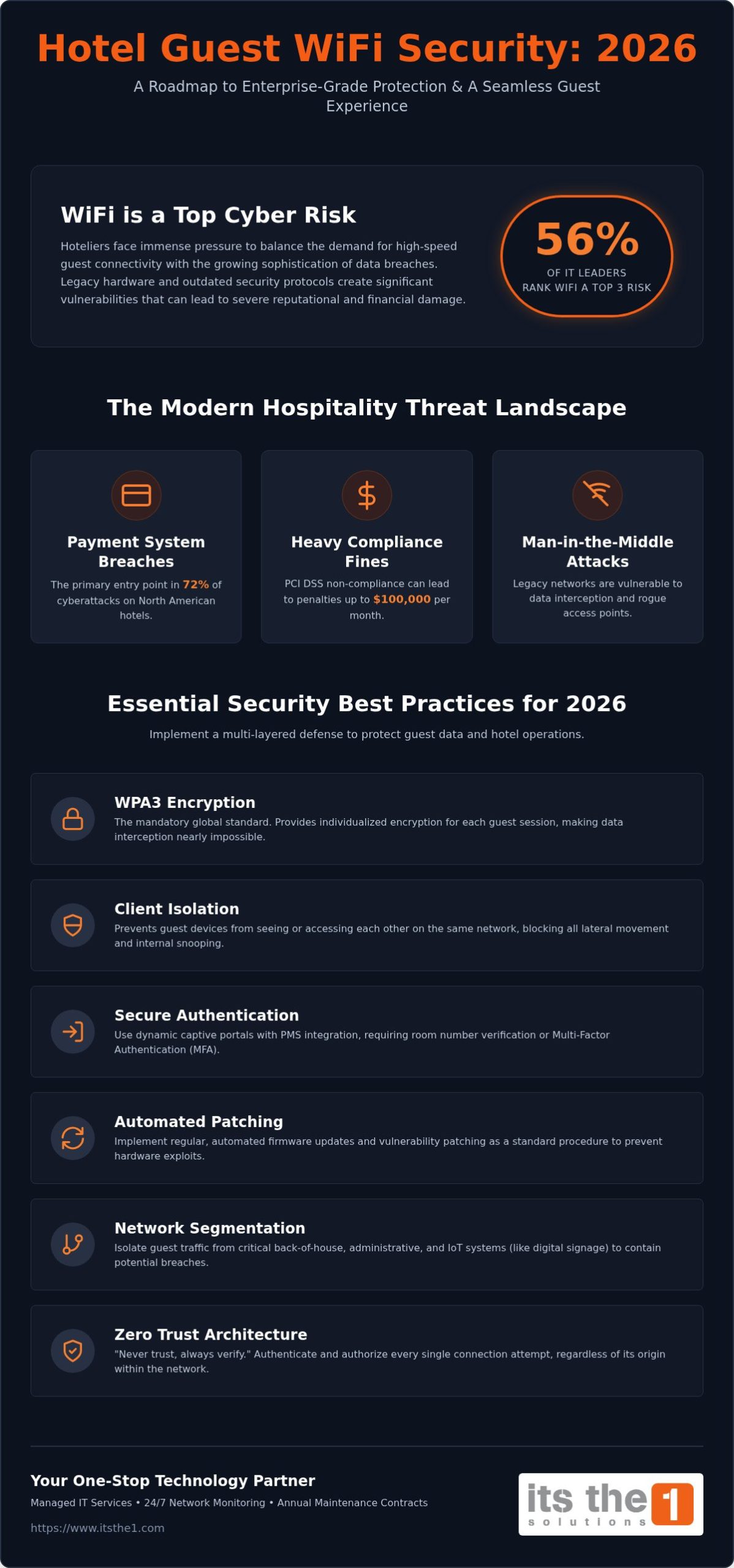
Did you know that 56% of hotel IT and security leaders now rank guest WiFi as one of their top three cyber risks? Hoteliers must balance the demand for high speed connectivity with the increasing sophistication of data breaches. You likely feel the pressure of maintaining a competitive edge while fearing that a single vulnerability in legacy hardware could lead to reputational damage. Finding the right balance between rigorous hotel guest wifi security best practices and a frictionless login process remains a primary challenge for modern hospitality brands.
This strategic guide provides the roadmap to implementing enterprise grade security that protects sensitive data without frustrating your guests. You’ll learn how to deploy a secure, compliant network that meets 2026 standards while ensuring seamless onboarding. We’ll examine how managed services and intentional network design can reduce the burden on your IT staff and reinforce guest trust.
Key Takeaways
- Modern hotel guest wifi security best practices require a transition from basic connectivity to a multi-layered infrastructure that prioritizes the protection of individual guest data.
- Implement technical standards such as WPA3 encryption and Client Isolation to prevent lateral movement and unauthorized access between devices on the same network.
- Balance enterprise-grade security with a frictionless user experience by utilizing privacy-centric solutions that meet the high expectations of today’s business travelers.
- Strengthen operational reliability through managed IT services and Annual Maintenance Contracts that provide the continuous monitoring and expert support necessary for 2026 compliance.
Why Hotel Guest WiFi Security is a Non-Negotiable Standard in 2026
In 2026, secure guest WiFi is a multi-layered infrastructure designed to shield user data from interception while maintaining high network availability. The industry has moved past the “convenience-only” era. Business travelers now expect enterprise-grade protection for remote work. This shift makes hotel guest wifi security best practices a cornerstone of the modern guest experience. High-Speed Internet Access (HSIA) serves as the critical backbone for this digital transformation. It supports essential services like mobile check-ins and cloud-based management systems, making its security profile vital to operational continuity.
Understanding the Modern Threat Landscape for Hospitality Networks
Hotels remain primary targets for cybercriminals because they process a high volume of high-value data from diverse, unmanaged devices. Legacy networks often lack the robust wireless security protocols required to block “Man-in-the-Middle” attacks or identify rogue access points. Research shows that in 72% of cyberattacks on North American hotels, the payment system was the entry point. These incidents cause severe reputational damage and carry heavy legal risks. For instance, PCI DSS 4.0.1 non-compliance fines can reach $100,000 per month. Establishing a baseline of resilience through professional cybersecurity services for enterprises is essential to protect your brand’s integrity. A single breach can violate regional standards like GDPR and destroy years of built trust. Prioritizing hotel guest wifi security best practices ensures that your connectivity remains a safe asset rather than a liability.
7 Essential Hotel Guest WiFi Security Best Practices for 2026
Implementing hotel guest wifi security best practices requires a technical shift toward automated resilience. In 2026, the mandatory adoption of WPA3 ensures individualized encryption for every guest session. This global standard mitigates many Public Wi-Fi security risks by making it significantly harder for attackers to decrypt intercepted data. You must also enforce Client Isolation. This protocol prevents guests from seeing or accessing other devices on the same network, effectively blocking lateral movement and internal snooping.
Authentication has evolved beyond simple passwords. Modern networks use dynamic captive portals integrated with your Property Management System (PMS). Requiring multi-factor authentication or room number verification ensures only legitimate guests gain access. Additionally, regular firmware updates and automated vulnerability patching must be standard operational procedures. These measures prevent exploits on network hardware and ensure your infrastructure remains a stable, secure asset for the long term.
Implementing Network Segmentation and Zero Trust Architecture
A robust defense relies on separating guest traffic from back-of-house operations. Segmenting your network ensures that a breach in the guest area won’t compromise your administrative or IoT systems. This is particularly important when managing hotel digital signage software, as display networks must remain isolated to prevent unauthorized content overrides. Adopting a Zero Trust model means your system verifies every connection attempt, regardless of the device’s location. For properties seeking to modernize their infrastructure, partnering with a trusted technology advisor ensures these complex layers are implemented correctly without disrupting the guest experience. This structured approach provides the stability needed to scale your digital services safely.
Managed IT Services: Scaling Security with ITSthe1 Solutions
Choosing a “One Stop Partner” for your technology needs eliminates the risks associated with fragmented vendor management. ITSthe1 Solutions leverages over 20 years of expertise across the MENA region and the UK to deliver turnkey infrastructure that adheres to strict regional compliance. By centralizing your connectivity and protection, you ensure that hotel guest wifi security best practices are applied consistently across all digital touchpoints. Our Annual Maintenance Contracts (AMC) provide the stability of competitive SLAs and 24/7 network monitoring. This proactive approach allows for rapid incident response, ensuring that your state-of-the-art security protocols never compromise the guest experience. We customize every installation to match specific brand standards, ensuring that high-level protection feels like a natural part of your hospitality offering.
Integrating Guest Privacy with 1.Cast and IPTV Systems
Modern security extends beyond the network to the in-room entertainment ecosystem. Our proprietary 1.Cast solution guarantees guest privacy by ensuring no personal credentials or streaming data are stored on the TV system. This creates a secure environment for content sharing while integrating IPTV with hotel PMS for a truly personalized journey. For a seamless and protected onboarding process, properties can utilize the hotel guest engagement app, known as 1.Hotel. This application serves as a secure gateway for WiFi registration, reducing the burden on front-desk staff while maintaining rigorous data standards. These integrated modules work together to form a cohesive, high-performance ecosystem that supports your strategic growth. This unified approach ensures that your digital evolution is both ambitious in its vision and disciplined in its execution.
Securing the Future of Hospitality Connectivity
Adopting robust hotel guest wifi security best practices is no longer an optional upgrade; it’s a fundamental requirement for operational stability. By implementing technical standards like WPA3 encryption and network segmentation, you protect your brand from the legal and reputational fallout of data breaches. These measures ensure that your property meets the high expectations of modern business travelers who require secure, enterprise-grade connectivity for remote work. Integrating these protocols with privacy-centric solutions like 1.Cast and 1.TV further reinforces guest trust without adding complexity to the user journey.
With over 20 years of hospitality technology expertise, ITSthe1 Solutions provides turnkey implementation from Dubai to London. Our managed services allow you to scale your infrastructure confidently while maintaining state-of-the-art protection. Secure your guest network with ITSthe1 Solutions today to ensure your digital ecosystem remains resilient and guest-focused. We look forward to being your steady guide through the complexities of digital evolution.
Frequently Asked Questions
What are the primary risks of using open hotel WiFi for guests?
The primary risks include unencrypted data interception, Man-in-the-Middle attacks, and the presence of rogue access points. Without encryption, hackers can easily monitor traffic to steal login credentials or financial information. These vulnerabilities compromise the guest experience and expose the property to legal liability. Implementing hotel guest wifi security best practices is essential to mitigate these threats and protect sensitive user data.
How does a secure captive portal improve hotel network safety?
A secure captive portal acts as a gatekeeper by requiring user authentication before granting network access. It validates guest credentials against the Property Management System (PMS) to ensure only registered guests connect. This layer of verification prevents unauthorized users from leeching bandwidth. It also provides a platform to communicate security terms and conditions, establishing a clear protocol for safe internet usage during their stay.
Is WPA3 encryption necessary for hotel guest networks in 2026?
WPA3 encryption is a mandatory standard in 2026 for providing individualized data protection. It replaces the aging WPA2 protocol with more robust encryption that prevents attackers from cracking passwords through brute force. By adopting WPA3, hotels ensure that each guest session is isolated and secure. This technical upgrade is a critical component of modern hotel guest wifi security best practices, especially for business travelers handling sensitive data.
How can hotels ensure guest privacy when using casting solutions like 1.Cast?
Hotels can guarantee privacy by deploying solutions like 1.Cast, which uses a “Bring Your Own Content” (BYOC) model. This system ensures that no guest credentials or streaming data are stored or logged on the TV hardware. Guests simply pair their devices using a secure QR code. This privacy-first approach allows travelers to stream their favorite content without the risk of leaving behind personal account information.
What is the benefit of an Annual Maintenance Contract (AMC) for hotel IT?
An Annual Maintenance Contract (AMC) provides hotels with 24/7 network monitoring and guaranteed Service Level Agreements (SLAs). This proactive service model ensures that technical issues are identified and resolved before they impact the guest experience. It reduces the burden on internal IT staff by providing access to expert support for complex infrastructure. AMCs offer a cost-effective way to maintain high-performance networks with predictable operational expenses.
Can network segmentation prevent hackers from accessing hotel servers?
Network segmentation is highly effective because it isolates guest traffic from critical back-of-house servers and IoT systems. If a guest device is compromised, the hacker is contained within the guest segment and cannot move laterally to access reservation databases or payment systems. This structural barrier is vital for protecting sensitive property data and ensuring that a single point of entry doesn’t lead to a total system breach.